FREE SHIPPING ON ALL ORDERS

Cookie Packaging Ideas: How to Package Cookies for Retail & Gifting

Cookies may be small, but their packaging can make a big difference in how customers perceive your bakery. Whether you sell chocolate chip cookies, decorated sugar cookies, gourmet assortments, or gift boxes, the right packaging helps protect the product, present it attractively, and communicate your brand.

The best cookie packaging ideas combine practical protection with a design that suits the occasion. Retail packaging should make products easy to display and identify, while gifting packaging can focus on presentation, variety, and a memorable unboxing experience. For bakeries, cafes, home-based baking businesses, and cookie brands, custom packaging also provides an opportunity to create a consistent look across different products.

Quick takeaway

Choose cookie packaging according to cookie size, fragility, quantity, and intended use. Kraft boxes offer a versatile base for custom branding, window boxes help display the product, and inserts or dividers can organize assorted cookies. Always test the box with your actual cookies before ordering in bulk.

1. Choose Kraft Cookie Boxes for a Natural, Versatile Look

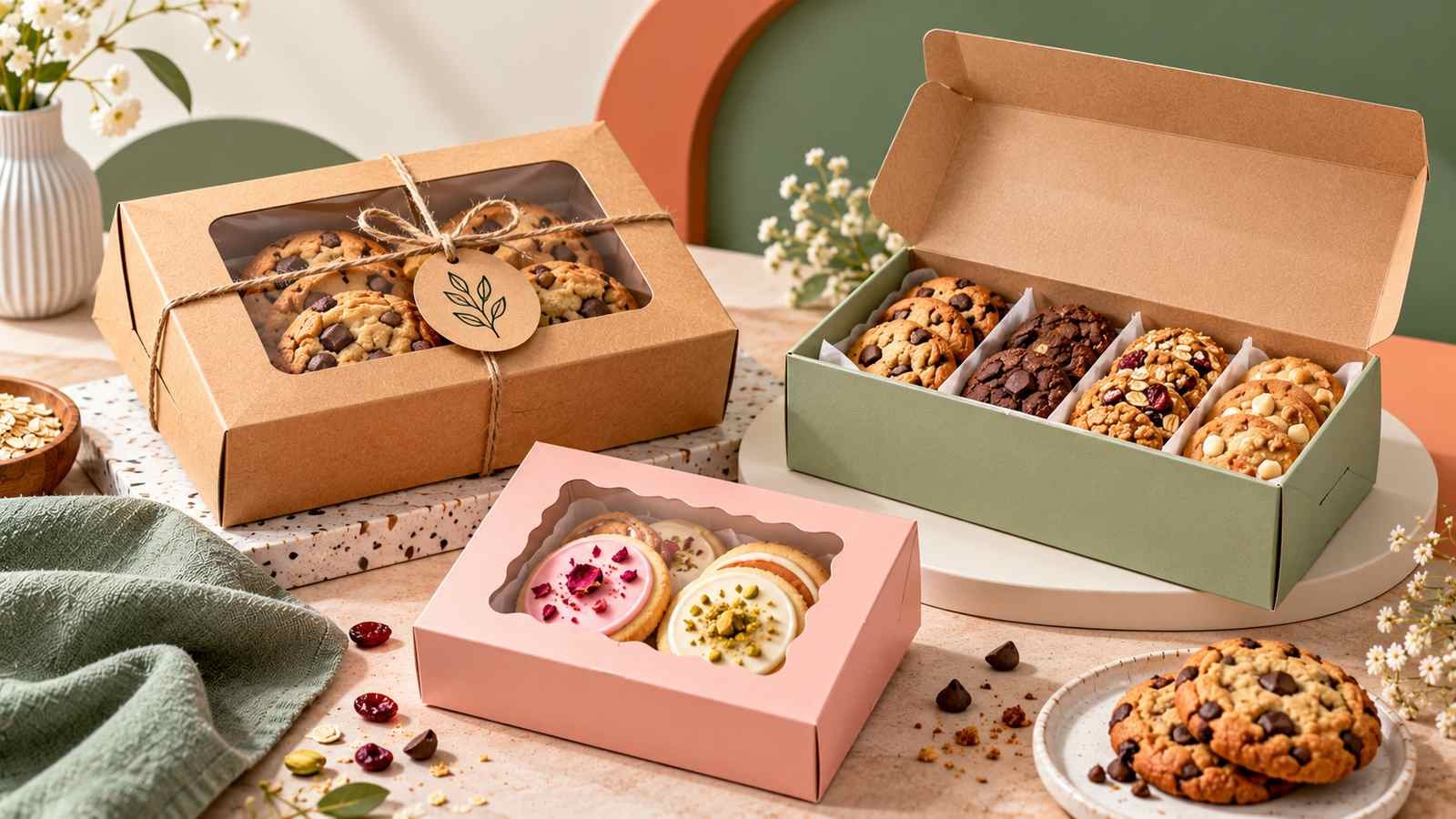
Kraft cookie boxes offer a simple, natural appearance that suits artisan bakeries, gourmet cookie brands, farmers market sellers, and small businesses. Their neutral color works with minimalist typography, colorful labels, illustrated designs, or a printed logo.

Plain kraft packaging can create an understated presentation, while custom printed designs help customers recognize your brand. You can use a consistent design across different cookie flavors and introduce small color variations to distinguish each product.

For a branded packaging solution, explore custom kraft cookie boxes for bakeries. Consider your cookie dimensions, quantity, box construction, and desired print area before selecting a packaging format.

2. Use Window Boxes to Showcase Your Cookies

Cookies are often purchased based on their appearance. A window box allows customers to see the product without opening the package, which can be useful for decorated sugar cookies, colorful macarons, chocolate chip cookies, and assorted cookie collections.

Window packaging may work particularly well for retail displays, bakery counters, and gift assortments. The visible product can support your design, so the remaining printed area can focus on the logo, product name, and essential details.

Before selecting a window style, consider these points:

  • Make sure the window reveals the cookies clearly.
  • Choose a box size that limits unnecessary movement.
  • Check that the window material and construction suit the intended food packaging application.
  • Leave enough space for branding and product information.
  • Test how the package performs during normal handling and storage.

If you want a visible product display, consider custom kraft cookie boxes with windows and confirm the available styles with your packaging supplier.

3. Create Custom Printed Cookie Boxes

Custom printing can turn a standard cookie box into a recognizable part of your brand. A logo, brand colors, product name, and carefully chosen artwork can make your packaging look cohesive across retail shelves, online orders, and gift collections.

You do not need an overly complicated design to create a strong impression. Start with a clear visual hierarchy: make the brand recognizable, keep the cookie variety easy to identify, and use decorative elements that suit the style of your business.

  • Minimalist branding: Use a small logo, clean typography, and plenty of open space.
  • Artisan style: Combine kraft textures with simple illustrations or hand-drawn details.
  • Premium presentation: Use a restrained color palette and carefully balanced typography.
  • Playful packaging: Choose bright accents and friendly graphics for colorful cookie collections.
  • Seasonal designs: Adapt colors or artwork for holidays and special occasions while retaining recognizable brand elements.

When planning custom printed kraft cookie boxes, check artwork dimensions, print placement, color consistency, and text readability before approving production.

4. Design Packaging for Cookie Gifts

Gift packaging should feel intentional and organized. Customers buying cookies for birthdays, holidays, thank-you gifts, celebrations, or corporate gifting often appreciate a package that looks ready to present.

Consider these approaches for gift-ready cookie packaging:

  • Assorted cookie boxes: Combine different flavors in a layout that looks organized.
  • Decorated cookie packaging: Use a box that protects icing, lettering, and decorative details.
  • Small favor boxes: Choose compact packaging for events, parties, and customer giveaways.
  • Premium assortments: Use dividers or inserts to keep varieties separated.
  • Seasonal collections: Use coordinated artwork and colors for holiday or limited-edition ranges.

For gift assortments, check that cookies remain separated and do not rub against the lid. If the cookies are individually wrapped, account for the additional space required by the wrapping.

5. Match the Box to the Type of Cookie

Not every cookie needs the same packaging. Thin, crisp cookies may break if they move around, while decorated cookies need enough space to protect their icing. Soft cookies may require careful stacking and separation to avoid sticking or smudging.

Cookie type Packaging idea Main consideration
Chocolate chip cookies Compact kraft carton Limit movement and breakage
Decorated sugar cookies Roomy box with a suitable insert Protect icing and decorations
Assorted gourmet cookies Compartmentalized gift box Keep flavors and varieties organized
Thin or crisp cookies Snug carton with suitable support Reduce shifting and breakage
Soft or filled cookies Box with sufficient space and separation Avoid compression and sticking
Seasonal cookie sets Printed gift box or window box Presentation and secure arrangement

Use this table as a starting point. Test your own recipes and cookie sizes because thickness, toppings, fillings, and decorations can change the packaging requirements.

6. Select the Right Cookie Box Size

Box size affects product protection, appearance, storage, and packing efficiency. A box that is too tight can damage cookies or make packing difficult. A box that is too large may allow products to move around during handling.

Follow these steps when choosing a size:

  1. Measure the cookies at their widest and tallest points.
  2. Consider toppings, icing, individual wrappers, or other additions.
  3. Decide how many cookies the package should hold.
  4. Confirm the usable internal dimensions of the box.
  5. Arrange the cookies in a sample box and check the fit.
  6. Close the package and test it during normal handling.

For assorted boxes, measure the full arrangement rather than estimating based on a single cookie. Inserts and dividers also take up space and should be included in the fit test.

Sizing tip

Before ordering a large quantity, test a sample with the actual cookies you intend to sell. Check the fit, closure, presentation, and ease of packing instead of relying only on measurements from a screen.

7. Make Retail Cookie Packaging Easy to Shop

Retail packaging needs to work for both customers and staff. Products should be easy to identify, store, display, and replenish. A consistent package design can help customers recognize your brand when they see multiple flavors or product varieties together.

For retail-ready cookie packaging, focus on:

  • Clear product identification: Make the cookie variety easy to recognize.
  • Consistent design: Use a repeatable layout across the product range.
  • Readable information: Reserve space for applicable product and business details.
  • Practical storage: Consider how filled boxes will be stacked and stored.
  • Display appeal: Decide whether a window or an illustrated design better presents the product.

Check the labeling requirements that apply to your product and sales location. Depending on the product and applicable rules, packaging may need details such as ingredients, allergen information, net quantity, or business information. Confirm the requirements rather than assuming the same rules apply to every cookie product.

8. Choose Materials and Liners Carefully

The outer box is only one part of cookie packaging. Depending on the recipe and how the cookies will be handled, an inner liner, individual wrap, or insert may help keep the products organized and reduce contact with the box.

When comparing kraft cookie boxes, consider:

  • Whether the box structure is suitable for the cookie’s weight and shape.
  • Whether the product needs a liner or individual wrapping.
  • Whether oils, crumbs, or moisture could affect the packaging.
  • Whether the material and any coatings are suitable for the intended food application.
  • Whether the complete package can be stored and handled as intended.

Do not assume that every kraft box is greaseproof, moisture-resistant, or suitable for direct food contact. Ask the supplier to confirm the material specifications and intended use for your product.

9. Use Seasonal Packaging Without Losing Brand Identity

Seasonal cookie packaging can support holiday collections, celebrations, limited editions, and special promotions. You can update colors, illustrations, or a small printed message without redesigning the entire package.

For example, a bakery might use the same box structure throughout the year and change an accent color or printed sleeve for a seasonal range. This approach can help keep the product recognizable while allowing the design to feel relevant to a specific occasion.

Before producing seasonal packaging, consider how long the design will be used, how much stock you can realistically sell, and whether unused boxes would become outdated after the season ends.

10. Order Wholesale and Bulk Cookie Boxes Strategically

Wholesale or bulk ordering may help cookie businesses maintain a consistent supply of packaging and standardize their branding. However, a larger order is not automatically the best option for every bakery. Your sales volume, storage capacity, cash flow, and frequency of design changes should all influence the quantity.

Before ordering wholesale custom kraft cookie boxes, prepare the details your supplier needs:

  • Box style and intended cookie type.
  • Internal dimensions and required quantity per box.
  • Whether windows, inserts, or dividers are needed.
  • Logo files, print artwork, and preferred colors.
  • Material specifications and intended food packaging use.
  • Delivery expectations and available storage space.

Compare the full order cost, including any setup, production, storage, and shipping considerations that apply. A practical reorder plan can help prevent running out of packaging without tying up too much money in unused stock.

If you sell across the United States, confirm production timelines, shipping arrangements, and order specifications before buying custom kraft cookie boxes in the USA.

Give Your Cookies a Branded Presentation

Explore custom cookie box options for retail displays, bakery orders, and gift assortments. Consider the size, style, printing, and quantity that suit your products.

Explore Custom Kraft Cookie Boxes

11. Test Your Packaging Before Production

A digital design proof can show how your packaging may look, but a physical sample helps you assess the actual fit and usability. Testing before a larger order can reveal problems with the dimensions, closure, inserts, or printed layout.

Use this simple checklist when reviewing a sample:

  • Do all cookies fit without being crushed?
  • Can the box close without touching decorations?
  • Do cookies stay organized during normal handling?
  • Is the package easy for staff to assemble and fill?
  • Are the logo and product details readable?
  • Does the box suit the intended retail or gifting purpose?
  • Have the material and intended-use specifications been confirmed?

Once the sample is approved, save the dimensions and artwork details for future orders. This can make repeat purchases more consistent and reduce the risk of ordering the wrong box style.

Cookie Packaging Checklist

  • Identify the cookie type, size, and quantity.
  • Choose a suitable box structure and internal dimensions.
  • Decide whether a window, liner, insert, or divider is needed.
  • Plan branding and product information.
  • Confirm material specifications with the supplier.
  • Test a sample with actual cookies.
  • Proofread artwork before production.
  • Choose an order quantity that matches demand and storage capacity.

Frequently Asked Questions

What are kraft cookie boxes used for?

Kraft cookie boxes are used to package and present cookies for bakery sales, retail displays, takeaway orders, and gifts. The right design depends on the cookies’ size, fragility, quantity, and presentation needs.

Can cookie boxes be printed?

Custom cookie boxes may be available with printed logos, brand colors, product names, and other artwork, depending on the supplier and box style. Confirm printing options, artwork requirements, and minimum quantities before ordering.

Can I add a window to a cookie box?

Some cookie box styles offer windows that let customers see the product without opening the package. Check available window designs, material specifications, and the protection required for your cookies before selecting this feature.

What sizes are available for cookie boxes?

Available sizes depend on the box style and supplier. Measure the cookies, include any wrappers or inserts, and confirm the usable internal dimensions. Custom sizing may be available for suitable orders.

Can I order wholesale kraft cookie boxes?

Wholesale or bulk orders may be available depending on the supplier, design, and quantity. Confirm minimum order quantities, pricing, production timing, shipping, and material specifications before placing your order.

Final Thoughts

The best cookie packaging ideas balance protection, presentation, and practicality. Kraft boxes provide a versatile starting point, windows can showcase attractive products, and custom printing helps your bakery build a recognizable identity. For gifts and assorted cookies, suitable inserts and thoughtful layouts can make the package feel organized and ready to present.

Start with the cookies themselves, choose a box that fits, and test the finished package before ordering in bulk. With the right packaging plan, your bakery can create a more consistent experience for retail customers and gift buyers alike.

Find Packaging for Your Cookie Range

Plan your cookie box sizes, printed design, and order quantity around the products you sell.
View Custom Cookie Box Options

How to Choose Bakery Packaging for Different Baked Goods

Choosing the right bakery packaging is about more than putting baked goods in a box. Packaging needs to protect delicate products, maintain a neat presentation, support convenient handling, and communicate your bakery’s brand. A box that works well for cookies may not be suitable for a frosted cake, delicate pastries, or freshly baked bread.

For bakeries, cafes, home-based baking businesses, and wholesale pastry suppliers, the best packaging depends on the product’s size, texture, toppings, moisture, and delivery requirements. This guide explains how to choose bakery packaging for different baked goods, compare box styles, select suitable sizes, and decide when custom printing or wholesale ordering makes sense.

Quick takeaway

Match bakery packaging to the product first, then consider branding and cost. Cookies and brownies often need compact cartons, cupcakes require enough height to protect frosting, and cakes need a sturdy base with sufficient clearance. Custom kraft bakery boxes can provide a consistent presentation across different products when sizes and designs are selected carefully.

1. Understand What Your Bakery Products Need

Before selecting a box, consider how the baked good will be stored, handled, displayed, and delivered. Delicate decorations, sticky toppings, crumbs, and moisture can all affect packaging performance. The box should fit the product without squeezing it or leaving so much empty space that it shifts during transport.

  • Product dimensions: Measure the length, width, and height of the finished baked good.
  • Fragility: Consider whether frosting, icing, decorations, or flaky layers can be damaged by contact.
  • Moisture and grease: Determine whether the product needs a suitable liner or grease-resistant packaging component.
  • Presentation: Decide whether customers should see the product through a window or open the box to reveal it.
  • Distribution: Consider whether the box will be used for counter sales, catering, takeaway orders, or shipping.

These requirements help narrow down box styles and materials before you invest in a large order.

2. Choose Packaging for Cakes and Celebration Cakes

Cakes often need more clearance and structural support than smaller baked goods. Packaging that is too short can damage frosting or decorations, while an oversized box may allow the cake board to move. Choose a box that accommodates the cake board, decoration height, and any additional support required.

For round cakes, confirm the internal width and height. For sheet cakes and rectangular cakes, measure both sides and check that the box closes without touching the icing. A stable base and a secure fit can help reduce movement during short-distance delivery.

For decorated cakes, test the complete packed product before using the box for customer orders. If the cake is delivered by vehicle, consider how the package will be carried and positioned during transport.

3. Select Boxes for Cupcakes and Muffins

Cupcakes need packaging that protects frosting, sprinkles, and other toppings. A box with enough vertical clearance helps prevent decorations from rubbing against the lid. For multiple cupcakes, inserts or individual cavities can keep products separated and reduce movement.

  • Measure the cupcake across its widest point, including frosting.
  • Check the height from the base to the top of the decoration.
  • Choose inserts that hold each cupcake securely.
  • Confirm that the insert and lid fit together without compressing toppings.
  • Test the box with the actual cupcake size and decoration style.

For seasonal assortments or branded bakery collections, printed boxes can create a consistent look across single-cupcake, multi-cupcake, and gift-pack formats.

4. Use Suitable Packaging for Cookies and Brownies

Cookies, brownies, blondies, and bars are often easier to pack than decorated cakes, but the right box still matters. Fragile cookies may crumble when they move around, while soft brownies can leave grease marks on unsuitable packaging.

Choose a carton that keeps the products organized without pressing them together. Dividers, inserts, or parchment-style liners may be useful depending on the product and presentation. For assorted cookies, a shallow box can help display the range neatly, while a deeper box may suit stacked products if the cookies can withstand the arrangement.

For brownies and other rich baked goods, test the packaging with the actual recipe. Grease resistance and product separation may be important, particularly when the products are sold in gift sets or placed together in a larger assortment.

5. Choose Packaging for Pastries and Delicate Baked Goods

Croissants, Danish pastries, turnovers, tarts, and similar products can be delicate and may lose their shape when compressed. Packaging should provide enough space for the pastry while helping protect its outer layers and toppings.

For individual pastries, a suitably sized carton can make packing and takeaway handling easier. For assorted pastries, arrange the products so they do not press against one another. Consider whether a tray, insert, or divider would improve stability.

If a pastry contains cream, custard, or another temperature-sensitive filling, the box alone does not provide temperature control. Follow appropriate food storage and handling practices for the product.

6. Select Packaging for Bread, Rolls, and Loaves

Bread packaging should reflect the type of bread and how customers receive it. A crusty artisan loaf, soft sandwich loaf, dinner rolls, and sweet bread may have different packaging requirements. Consider the loaf’s dimensions, crust, moisture, and intended storage conditions before selecting a carton or other packaging format.

Boxes can help create a polished retail presentation and protect the loaf from some handling damage. However, packaging should not trap unwanted moisture or interfere with the product’s intended cooling and storage process. Test the packaging with your bakery’s actual workflow.

For bakeries offering several bread varieties, a consistent packaging layout with clear product labels can make products easier to identify while keeping the brand presentation cohesive.

7. Compare Bakery Packaging Options

Different packaging styles offer different benefits. The most suitable choice depends on product protection, display preferences, brand identity, and how the bakery operates.

Baked good Packaging to consider Main consideration
Celebration cakes Tall cake cartons with a stable base Decoration clearance and stability
Cupcakes and muffins Boxes with suitable inserts Frosting protection and separation
Cookies Compact cartons or assortment boxes Breakage and product movement
Brownies and bars Shallow cartons or divided boxes Grease marks and stacking
Pastries and tarts Roomy cartons or boxes with inserts Delicate layers and toppings
Bread and rolls Suitable cartons or bakery bags Product texture and storage

This comparison is a starting point, not a substitute for product testing. The same baked good may require a different format depending on its size, recipe, toppings, and sales channel.

8. Consider Custom Kraft Bakery Boxes

Kraft packaging offers a natural, understated appearance that can suit artisan bakeries, neighborhood cafes, home baking businesses, and specialty food brands. Its neutral look can be paired with simple typography, a bakery logo, illustrations, or accent colors.

Custom kraft bakery boxes for small bakeries can help create a consistent packaging style across cookies, pastries, and other baked goods. The key is to select a box structure and size that suit each product rather than trying to fit every item into one carton.

When comparing kraft bakery packaging, review the material specification, dimensions, construction, printing options, and suitability for the intended food application. Do not assume that every paperboard box is automatically greaseproof, moisture-resistant, or suitable for direct food contact. Confirm the specifications with your packaging supplier.

Packaging tip

If your bakery sells several product types, consider a small family of box sizes with a shared visual design. This can help maintain brand consistency while accommodating different products more appropriately.

9. Decide Whether You Need a Window

A window can let customers see the baked goods without opening the package. This may be useful for cookies, pastries, cupcakes, and selected gift assortments where product appearance is part of the buying decision.

  • Does the visible product make the package more appealing?
  • Will the window placement leave enough room for branding and product information?
  • Does the package still provide the protection the baked good needs?
  • Are the window material and box construction suitable for the intended use?
  • Can the finished package be stacked, carried, and stored safely?

Window designs vary by box style and supplier. Confirm available options and specifications before preparing final artwork.

10. Use Custom Printing to Build Brand Recognition

Custom printing helps your bakery packaging look recognizable and consistent. A logo, product name, brand colors, and a simple graphic system can distinguish your packaging from generic cartons without making the design cluttered.

For custom printed kraft bakery boxes, consider these design principles:

  • Keep the logo visible: Choose a placement that remains noticeable when the box is displayed.
  • Prioritize readability: Make product names and important information easy to read.
  • Use consistent colors: Apply a shared palette across different box sizes and product lines.
  • Leave breathing room: Avoid filling every surface with text or graphics.
  • Proof the final artwork: Check spelling, colors, dimensions, and print placement before production.

A good design system can use the same basic layout across the bakery range, with small variations for product names, flavors, or seasonal collections.

11. Choose the Right Box Size

Box dimensions affect product fit, presentation, and handling. A box that is too small can compress the product or make packing difficult. A box that is too large may allow delicate goods to shift and can waste storage space.

  1. Measure the finished product at its widest and tallest points.
  2. Include frosting, decorations, liners, boards, or inserts in your measurements where relevant.
  3. Confirm the box’s usable internal dimensions with the supplier.
  4. Pack a sample product and check how easily it can be placed inside and removed.
  5. Test the closed package for movement, stacking, and normal handling.

For products with irregular shapes, test several samples if possible. A box that works for one cookie size may not fit a larger decorated cookie or a pastry with toppings.

12. Plan Wholesale and Bulk Bakery Packaging Orders

As a bakery grows, buying packaging in larger quantities may help maintain consistent branding and simplify replenishment. However, the right order quantity depends on sales volume, storage space, available cash flow, and how frequently the menu or packaging design changes.

Before ordering wholesale custom kraft bakery boxes, prepare a clear specification:

  • Box style and intended baked good.
  • Required internal dimensions and any inserts or windows.
  • Artwork, logo files, print colors, and finishing preferences.
  • Quantity needed for each size or design.
  • Material and intended-use requirements to confirm with the supplier.
  • Delivery timing, storage capacity, and reorder expectations.

Compare the total cost and practical requirements, not just the unit price. A large order may be less economical if designs change often or unused boxes take up valuable storage space.

If you serve customers across the United States, confirm shipping arrangements, lead times, and specifications before placing an order for custom bakery boxes in the USA.

Ready to plan your bakery packaging?

Compare box styles, sizes, and branding options for your baked goods before choosing packaging for your bakery.

Explore Custom Kraft Bakery Boxes

13. Test Your Packaging Before Ordering

Even a well-designed box should be tested with the actual baked good. A sample helps you identify fit problems, difficult closures, insufficient height, or issues that may not be obvious in a digital design proof.

  • Does the product fit without being squeezed?
  • Can staff pack it quickly and consistently?
  • Does the lid close securely without touching decorations?
  • Does the product remain in position during ordinary handling?
  • Are labels and printed details readable?
  • Does the packaging suit the intended storage and distribution process?

Keep a record of approved box dimensions and artwork. This makes future reorders easier and helps your team use the correct packaging for each product.

Bakery Packaging Checklist

  • Identify the baked good and its protection needs.
  • Measure the finished product and decorations.
  • Choose a suitable box style, material, and size.
  • Check whether inserts, dividers, liners, or windows are needed.
  • Keep branding clear and product information readable.
  • Confirm material specifications and intended-use suitability.
  • Test a sample before approving a large order.
  • Compare quantity, storage needs, and total cost.

Frequently Asked Questions

What are kraft bakery boxes used for?

Kraft bakery boxes are used to package and present baked goods such as cookies, pastries, brownies, and selected cakes. The appropriate style depends on the product’s size, fragility, and intended handling. Always confirm that the chosen box specifications suit the intended use.

Can bakery boxes be printed?

Yes, custom bakery boxes may be available with printed logos, brand colors, product names, and other artwork, depending on the supplier and box style. Confirm print areas, available colors, minimum quantities, and artwork requirements before ordering.

Can I add a window to a bakery box?

Some bakery box styles offer window options that allow customers to see the product. Availability depends on the box design and supplier. Consider product protection, window placement, presentation, and intended use before selecting this feature.

What sizes are available for bakery boxes?

Available sizes vary by supplier, style, and product range. Measure the baked good, decorations, and any insert or base, then confirm the usable internal dimensions. Custom sizing may be available for suitable orders.

Can I order wholesale kraft bakery boxes?

Wholesale or bulk ordering may be available depending on the supplier, box style, and quantity. Before placing an order, confirm pricing, minimum quantities, production timing, shipping, and the specifications of the packaging.

Final Thoughts

The right bakery packaging protects the product, supports convenient handling, and creates a consistent presentation for your brand. Cakes need adequate clearance and support, cupcakes benefit from suitable inserts, and cookies and pastries need a fit that reduces unnecessary movement. Bread packaging should also suit the product’s storage and handling requirements.

Start with product measurements and practical testing, then choose the material, window, printing, and quantity that fit your business. With a clear packaging plan, your bakery can create a cohesive customer experience without using the same box for every baked good.

Create a consistent look for your baked goods

Explore packaging options and plan box sizes and printed designs around the products your bakery sells.

View Custom Bakery Box Options

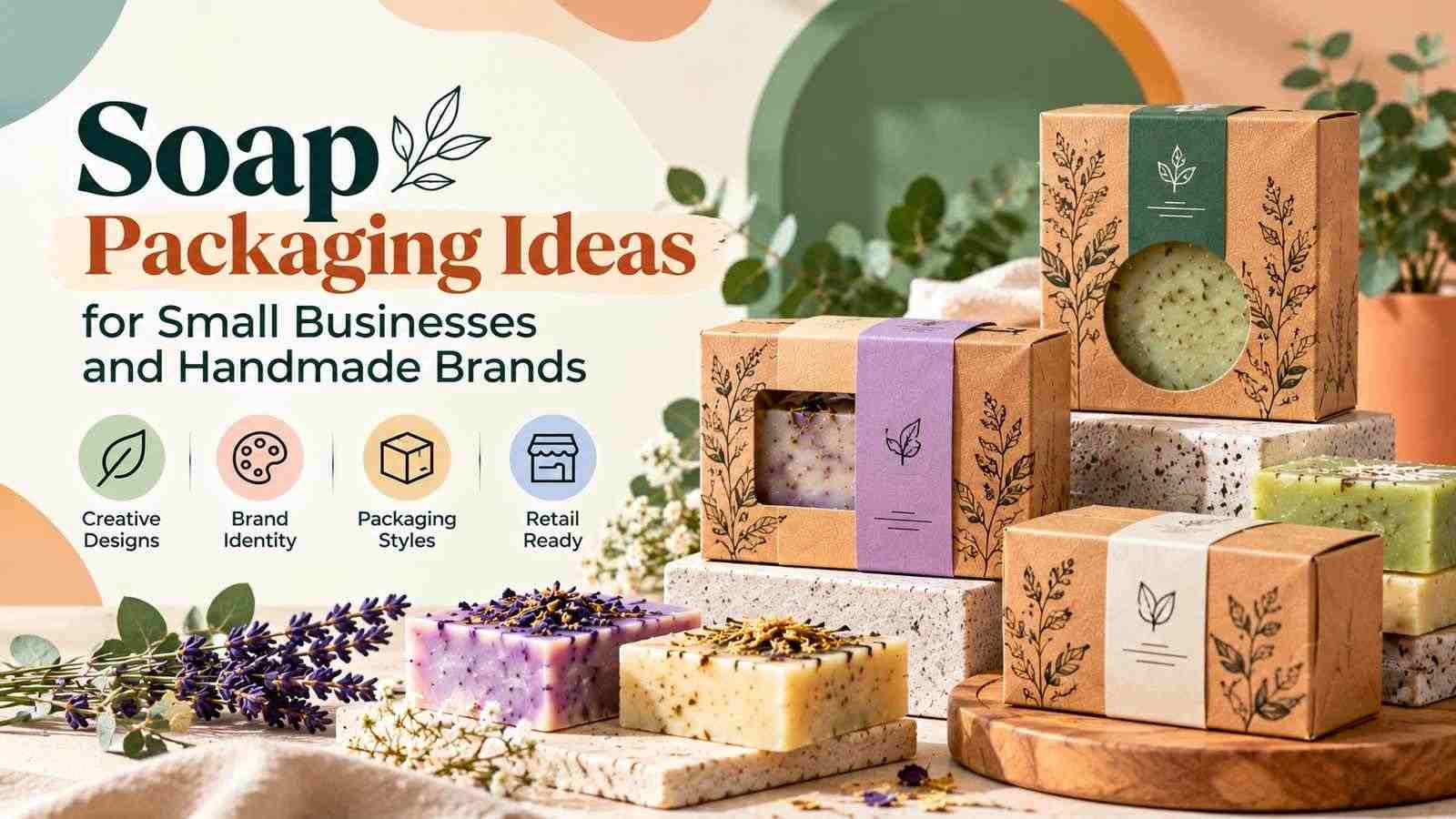
Soap Packaging Ideas for Small Businesses and Handmade Brands

Great soap packaging does more than protect a bar. It helps customers recognize your brand, understand the product, and feel confident choosing it for themselves or as a gift. For small businesses and handmade soap brands, the right packaging can also make a simple product look consistent and retail-ready without making the packaging process unnecessarily complicated.

These soap packaging ideas cover kraft boxes, custom printing, minimalist designs, scent-based color systems, sleeves, gift packaging, and practical ways to choose a box that suits your product and budget.

Quick takeaway

Choose soap packaging that fits the bar, communicates your brand, and presents essential product information clearly. Kraft boxes are a versatile starting point for handmade brands, while custom printing and coordinated colors help create a more recognizable product range.

1. Use kraft soap boxes for a natural, versatile look

Kraft packaging has a warm, understated appearance that works well for handmade soaps, botanical collections, artisan products, and brands that prefer a simple visual identity. Its neutral brown surface can complement earthy colors, black typography, botanical illustrations, or a small brand mark.

Plain kraft boxes can create a clean look, while printed kraft boxes help your products stand out with a logo, scent name, product details, or decorative artwork. If you are comparing options, explore custom kraft soap boxes for handmade soap and consider the dimensions, board style, and finish that suit your bars.

2. Add custom printing to build brand recognition

Packaging is often one of the first brand touchpoints a customer sees. A consistent logo, readable product name, and repeatable layout can help your soap line look cohesive across scents and collections. You do not need to cover every surface with graphics; a well-placed logo and a clear product name can be enough.

  • Place your logo where it is easy to notice.
  • Use one or two typefaces consistently.
  • Keep scent names prominent and easy to read.
  • Use a repeatable design grid across the product range.
  • Check that small text remains legible at the final box size.

Custom printed kraft soap boxes can combine a natural material appearance with branding that feels specific to your business.

3. Try a minimalist design

Minimalist soap packaging relies on space, simple typography, and a limited color palette. This approach can be useful for modern, premium, spa-inspired, or unisex product lines. Avoid adding decorative elements simply to fill empty space. Instead, make the product name, scent, and brand mark the focus.

Design tip

Before approving a minimalist layout, print a sample at actual size. Fine lines and small text can look clear on a large screen but become difficult to read on a compact soap box.

4. Use colors to organize scents and collections

If your range includes several fragrances, a simple color system helps shoppers distinguish products quickly. Keep the main packaging structure consistent and assign a small accent color to each scent or collection.

Collection type Possible accent Design direction
Lavender or floral Muted purple Soft, calm, botanical
Citrus Warm yellow Fresh, bright, energetic
Charcoal or mineral Slate or black Bold, simple, modern
Oatmeal or unscented Cream or sage Quiet, natural, understated

Use color as a navigation aid, not the only way to identify a product. Keep the scent name or product variant printed clearly as well.

5. Consider sleeves and paper bands

A paper sleeve or band can provide space for branding while leaving part of the soap visible, if that suits the product and your display needs. Sleeves may also work for seasonal runs, limited editions, or a simple packaging refresh. Check that the band stays in place and that any exposed soap is appropriate for the conditions in which it will be stored and sold.

Compare sleeves with a full box based on protection, presentation, handling, and the amount of information you need to display. The lowest-material option is not automatically the best choice if the product needs more coverage or a more secure retail presentation.

6. Make gift-ready soap packaging

Gift packaging can help handmade soap fit holiday collections, event favors, thank-you gifts, and curated gift sets. You can create a gift-ready feel through coordinated colors, a neat label, a simple insert, or a box designed to hold more than one bar.

  • Use a consistent visual theme across the set.
  • Check that multiple bars fit without excessive movement.
  • Make the scent and product variants easy to identify.
  • Choose decorative details that suit your price point and sales channel.

For gift sets, test the complete package—not just the individual soap box—so the products stay organized during storage, display, and delivery.

7. Keep product information clear

Packaging should be attractive, but customers also need to understand what they are buying. Depending on your product and applicable requirements, you may need to include information such as the product name, ingredients, net weight, business details, directions, or cautions. Confirm the labeling rules that apply to your particular soap and where you sell it; requirements can vary by product claims and jurisdiction.

Plan the information area before finalizing the artwork. Do not shrink essential text simply to fit an overly complicated design. Leave enough contrast between the lettering and the background, and proofread all product details before approving production.

8. Choose a box size that fits the soap

A box that is too tight can be difficult to pack and may damage the packaging. A box that is too large can allow the bar to shift and make the product look less finished. Measure the soap after it has completed any curing or drying process relevant to your product, then test the intended fit.

  1. Measure the bar’s length, width, and height.
  2. Account for the product’s shape and any wrap or insert.
  3. Confirm the box’s usable internal dimensions.
  4. Pack a sample and check insertion and removal.
  5. Test how the packed product handles storage and shipping.

When planning custom kraft soap boxes for small businesses, share accurate product measurements and ask for a sample or prototype when available.

9. Balance presentation with practical packaging choices

Consider how your soaps will reach customers. Products sold at markets may need packaging that looks appealing on a table and is easy to restock. Retail products need a tidy, repeatable appearance and clear product information. Ecommerce orders may require additional outer packaging to protect the soap boxes during transit.

If sustainability is part of your brand message, describe materials and disposal guidance accurately. Do not assume every paper-based component is recyclable in every location; coatings, adhesives, inks, and local collection systems can affect disposal options.

10. Order packaging in a way that supports growth

Small businesses can start by standardizing box styles and using controlled variations for different scents. Before placing a larger order, approve the artwork, check dimensions, confirm print colors, and review a physical sample if possible. Compare unit cost alongside storage needs, minimum quantities, setup costs, and the risk of changing the design later.

Wholesale or bulk orders may help maintain consistency as demand grows, but the right quantity depends on sales velocity, available storage, cash flow, and how often your branding or product range changes. For a custom order, prepare the box dimensions, quantity, artwork, and finishing preferences before requesting a quote.

Ready to plan your soap packaging?

Explore box options for your handmade soap range and consider the size, print design, and quantity that fit your product.

Explore Custom Kraft Soap Boxes

Soap packaging checklist

  • Measure the finished soap accurately.
  • Choose a box or sleeve style that suits the product and sales channel.
  • Keep your logo, scent name, and key details legible.
  • Use a consistent visual system across scents.
  • Review material and disposal claims for accuracy.
  • Proofread artwork and check a sample before a larger order.
  • Plan quantities around realistic demand and storage capacity.

Frequently asked questions

What packaging works well for handmade soap?

Kraft boxes, printed cartons, paper sleeves, and bands can all work, depending on the product, brand style, protection needs, and retail requirements. Select a format that fits the soap and allows essential information to be displayed clearly.

Can soap boxes be custom printed?

Yes. Custom printing can add a logo, scent name, brand colors, illustrations, and product information. Check the print area and legibility at the final box size before approving artwork.

Can I choose a custom size for soap boxes?

Custom sizing may be available depending on the supplier and box style. Provide the soap’s length, width, and height, and confirm the internal dimensions and fit with a sample where possible.

Are kraft boxes suitable for small soap businesses?

Kraft boxes can be a versatile option for small brands because their neutral appearance suits many design styles. Compare available sizes, printing options, order quantities, and the protection your product needs.

Should I order soap boxes in bulk?

Bulk ordering may reduce unit costs, but consider demand, storage, cash flow, and the possibility of changing your design. Approve a sample and confirm all specifications before committing to a large quantity.

Final thoughts

The best soap packaging ideas bring together a suitable fit, clear information, and a recognizable brand style. Whether you choose natural kraft boxes, minimalist printing, scent-based colors, or gift-ready packaging, test the finished package and make sure it works for the way your customers shop and receive your products.

Give your soap range a consistent look

Review your product dimensions, brand artwork, and order quantity before choosing packaging for your next collection.

View Custom Soap Box Options

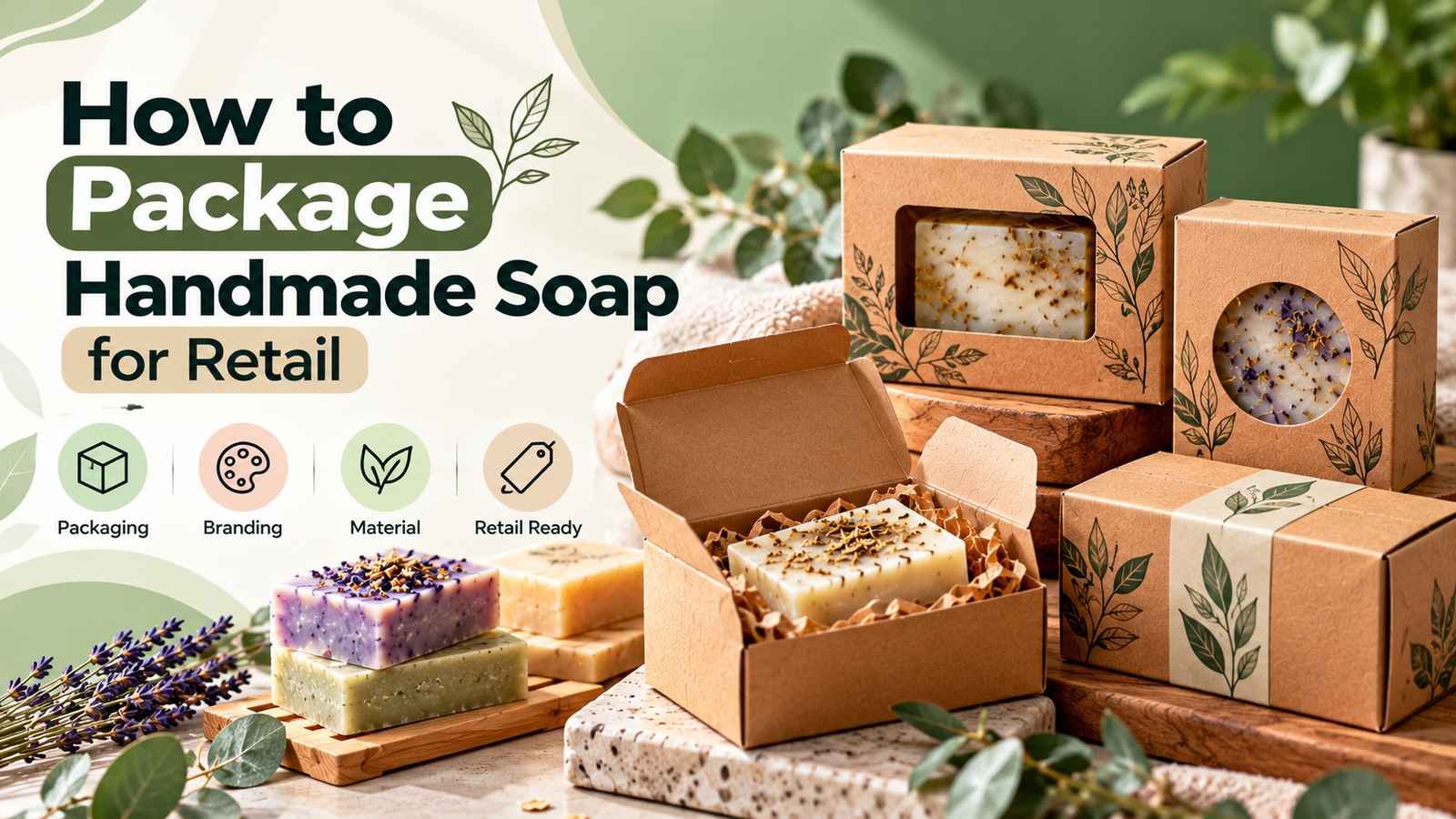
How to Package Handmade Soap for Retail

Knowing how to package handmade soap for retail involves more than choosing a box that fits the bar. Your packaging should protect the soap, communicate important product information, reflect your brand, and make the product appealing to customers. Whether you sell handmade soap online, at craft fairs, in boutiques, or through retail stores, the right packaging can help create a more professional and consistent presentation.

From selecting suitable materials to adding your logo and choosing the correct box dimensions, every packaging decision should support the product’s appearance and practical requirements.

Quick answer: Package handmade soap for retail by allowing the soap to cure fully when required by your soap-making process, selecting a suitable wrapping or box, choosing dimensions that fit the bar, adding necessary product information, and designing consistent branding. Test the packaging under realistic storage and handling conditions before ordering in bulk.

Why Retail Packaging Matters for Handmade Soap

Handmade soap often has distinctive colors, textures, shapes, scents, and ingredients. Packaging helps present these qualities while giving customers useful information about the product and its maker.

Good retail packaging can help keep bars organized, reduce unnecessary handling, and create a recognizable appearance across your product range. The exact packaging requirements depend on the soap formula, moisture characteristics, sales environment, and applicable labeling rules.

Packaging Element Why It Matters
Box or wrap Helps present and handle the soap
Material Influences appearance and suitability for the product
Size Helps provide a neat fit without unnecessary movement
Printed design Supports brand recognition and product presentation
Product label Communicates the required product details

Step 1: Prepare the Soap Before Packaging

Before selecting packaging, consider the type of soap you make and its condition when it is ready for sale. Cold-process soap, for example, generally requires an appropriate curing period before packaging. The exact timing depends on the formulation and process.

Packaging soap too early or choosing a material that does not suit its moisture characteristics can contribute to presentation or storage problems. Follow your established soap-making process and test how the finished bars behave in the intended packaging.

  • Confirm that the soap is ready for sale.
  • Check that the bars have consistent dimensions.
  • Inspect the surface for imperfections before packing.
  • Consider the soap’s scent, oils, and moisture characteristics.
  • Choose packaging appropriate for the expected storage environment.
Practical tip: Test your intended packaging with the actual soap over time. A material that looks attractive on day one may not be suitable for the product’s storage conditions.

Step 2: Choose the Right Packaging Style

There is no single packaging style that works for every handmade soap brand. Your choice should depend on the bar’s dimensions, retail display requirements, branding goals, and the level of coverage or protection needed.

Packaging Style Potential Use
Paper band or sleeve Displays selected product information while leaving parts of the bar visible
Kraft soap box Creates a structured package with room for branding
Printed carton Supports a more graphic or color-led retail design
Gift-style packaging Presents individual bars or soap sets as gifts

For brands seeking a natural, understated appearance, custom kraft soap boxes offer a way to combine a kraft-style look with packaging designed around the bar and brand.

Step 3: Measure the Soap and Select the Right Box Size

Correct sizing is essential when designing custom soap boxes. Measure the finished bar rather than relying only on the mold dimensions, because the final size may vary depending on the soap-making process.

Record the length, width, and height of the bar. Then consider the room required for any inner wrap, paper band, insert, or other component you plan to include.

Measurement What to Check
Length The longest side of the finished bar
Width The bar’s second horizontal dimension
Height The thickness of the bar
Extra clearance Space required for wraps or inserts

A box that is too tight may make packing difficult, while an oversized box can allow the bar to move around. The aim is a practical fit that supports neat presentation and efficient packing.

Step 4: Select Kraft Soap Packaging That Fits Your Brand

Kraft packaging is often chosen for its natural paper appearance and versatility. It can work well for brands with rustic, botanical, minimalist, artisan, or understated visual identities.

However, the material should be selected for the soap’s actual needs rather than appearance alone. Consider the bar’s moisture characteristics, intended shelf life, storage conditions, handling, and whether the packaging will be used for shipping as well as retail display.

Kraft soap packaging can be customized with different artwork and box dimensions, subject to the available packaging specifications. If you want a cohesive retail range, use a consistent visual system across your different scents and soap varieties.

Step 5: Design Your Logo and Printed Soap Boxes

Packaging is an opportunity to make your soap brand recognizable. Your logo, colors, typography, product name, and supporting graphics should work together to communicate a clear identity.

Printed soap boxes can display brand graphics, scent names, product descriptions, decorative patterns, and other relevant details. Before finalizing the artwork, decide which information customers should notice first.

  • Place the brand name or logo where it is easy to see.
  • Give each scent or variety a clear product name.
  • Use typography that remains readable at the finished box size.
  • Choose colors that fit the brand and product range.
  • Leave sufficient space for required product information.
  • Review the final artwork at actual print size before approval.

For example, a botanical soap line might use restrained colors and plant illustrations, while a bright, playful range may use bolder colors to distinguish different scents.

What Information Should Handmade Soap Packaging Include?

Retail packaging should communicate useful product details and meet the labeling requirements that apply to your product and market. Requirements can differ depending on how a soap is formulated, marketed, and regulated.

Depending on the product and applicable rules, packaging or an accompanying label may need information such as:

  • Brand or business name
  • Product identity or name
  • Net quantity or weight, where required
  • Ingredients or other required disclosures, where applicable
  • Business contact or responsible-party information, where required
  • Warnings or directions, where applicable

In the United States, the regulatory treatment of soap depends on factors including its composition and intended claims. Products marketed as cosmetics or drugs may be subject to different requirements than products that meet the applicable definition of soap. Check the rules relevant to your particular product before printing large quantities of packaging.

Are Kraft Soap Boxes Suitable for Handmade Soap?

They can be suitable, provided the box construction and material are appropriate for the soap’s characteristics and storage conditions. Handmade soaps vary in formulation, moisture content, shape, and fragrance, so it is important to test the packaging with the actual product.

A kraft box can provide a structured surface for branding and product information. Depending on the soap and packaging design, an inner wrap or other suitable component may also be needed.

For makers selling several scents or bar sizes, custom kraft soap boxes for handmade soap can help create a consistent packaging format across a product line.

Ready to Create Custom Packaging for Your Handmade Soap?

Explore soap packaging designed around your bar dimensions, brand style, and retail presentation.

Explore Custom Kraft Soap Boxes →

Custom Soap Boxes for Small Businesses

Small soap businesses often need packaging that looks consistent without making the production process unnecessarily complicated. A useful starting point is to standardize packaging for your most popular bar sizes and build a repeatable design system for different scents or collections.

Custom kraft soap boxes for small businesses can be planned around the products you sell most often, your brand artwork, and your retail requirements.

Before committing to a large order, consider your sales volume, available storage, number of product variations, and how frequently you expect to reorder. These factors can help you avoid accumulating packaging that no longer matches your product range.

Can I Choose Custom Sizes for Soap Boxes?

Custom dimensions can be considered when standard box sizes do not fit your soap bars properly. A custom size may be useful for unusually shaped bars, multi-bar sets, gift collections, or products that require an inner component.

Provide accurate measurements and, where possible, test a sample with the finished soap. Check that the box closes correctly, the product is easy to insert and remove, and the packaging presents well on a retail shelf.

Wholesale and Bulk Kraft Soap Boxes

As a soap business grows, buying packaging in larger quantities may help maintain consistency across recurring production runs. However, wholesale ordering works best when the design, dimensions, and product range are reasonably stable.

Before ordering wholesale custom kraft soap boxes, confirm:

  • Finished soap dimensions and packaging style
  • Approved artwork and print specifications
  • Quantity required for each scent or product variation
  • Storage space and expected reorder frequency
  • Any labeling updates needed for future batches

Businesses searching for wholesale kraft soap boxes USA should also consider production schedules, delivery timelines, and how packaging inventory will be managed as the product range changes.

Common Handmade Soap Packaging Mistakes to Avoid

  • Packaging before the soap is ready: Follow the appropriate preparation and curing process for your formula.
  • Choosing the wrong box size: Measure the finished bar and account for any inner wrap.
  • Ignoring storage conditions: Test the material with the actual soap over time.
  • Overcrowding the design: Keep the brand and product name easy to read.
  • Leaving out required information: Check applicable labeling rules before printing.
  • Ordering too much too soon: Confirm dimensions and artwork before committing to a large quantity.
  • Skipping sample testing: Test the complete packaging before using it for every product.

How to Test Your Soap Packaging Before Retail

Before ordering packaging in bulk, pack several bars using the intended box, wrap, and label. Check the fit, closure, print readability, and ease of packing.

Store the packaged samples under conditions similar to those expected in your shop, stockroom, or shipping process. Inspect them over time for changes in appearance, fragrance transfer, moisture-related issues, or other signs that the packaging may not be suitable.

If you sell through ecommerce as well as retail, evaluate the outer shipping package separately. A retail soap box may need additional protection during transit.

Handmade soap packaging checklist:

  • Prepare the soap according to your process.
  • Measure the finished bar.
  • Select a suitable box or wrapping style.
  • Check material compatibility and storage needs.
  • Prepare clear, consistent brand artwork.
  • Review required product information.
  • Test samples before ordering in bulk.
  • Keep packaging consistent across scents and sizes.
Give Your Soap Range a Consistent Retail Look

Create packaging that brings your soap products, printed design, and brand identity together.

Explore Custom Soap Packaging →

Frequently Asked Questions

What are kraft soap boxes used for?

Kraft soap boxes are used to package individual soap bars and soap sets for retail, gifting, or other sales channels. Their suitability depends on the soap’s dimensions, formulation, and packaging requirements.

Can soap boxes be printed?

Yes. Depending on the selected specifications, soap boxes can feature logos, brand colors, product names, illustrations, patterns, and other artwork.

Can I choose custom sizes?

Custom dimensions can be considered when standard box sizes do not fit your finished soap bars or packaging components. Accurate measurements and sample testing are recommended.

Are kraft soap boxes suitable for handmade soap?

They can be suitable when the material, box structure, and storage conditions match the soap’s characteristics. Test the packaging with the actual product before placing a large order.

Can I order wholesale?

Wholesale or bulk ordering may be available depending on the supplier’s product specifications and order terms. Confirm the required dimensions, artwork, quantity, and production details before ordering.

Final Thoughts

Learning how to package handmade soap for retail starts with understanding the product. Choose a suitable box or wrap, measure the finished bars carefully, create readable branding, and make sure the packaging suits the soap’s storage and handling requirements.

For businesses looking to create a consistent kraft-style presentation, custom kraft soap boxes in the USA can be considered as part of a retail packaging strategy. Test the finished design before ordering in bulk so your packaging supports both the product and your brand.

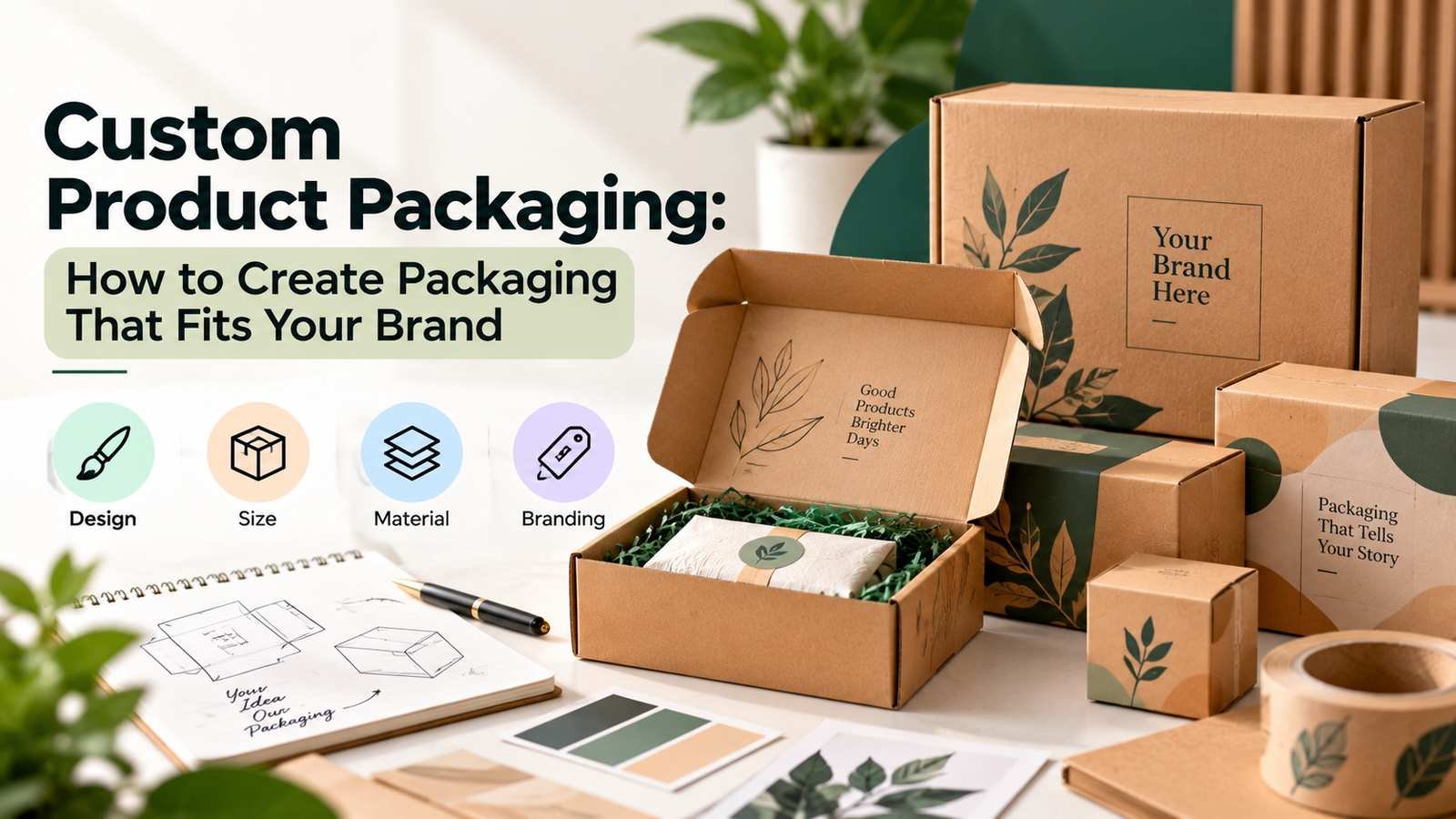
Custom Product Packaging: How to Create Packaging That Fits Your Brand

Your packaging is often one of the first physical experiences customers have with your product. Custom product packaging can help your brand create a consistent presentation, protect the product, and make the unboxing experience more memorable. The right packaging should not only hold your product—it should also fit your brand identity, product dimensions, customer expectations, and selling environment.

Whether you sell through ecommerce, retail stores, boutiques, or direct-to-consumer channels, choosing the right product box can make your packaging feel more intentional and professional.

Quick answer: Create custom product packaging by defining your brand style, measuring your product, selecting the right box structure and material, planning your printing and branding, and testing the finished package before ordering in bulk.

Why Custom Product Packaging Matters for Your Brand

Packaging plays several roles at the same time. It protects the product, communicates information, supports your visual identity, and influences how customers perceive the item before they use it.

Generic packaging can work for basic shipping needs, but it may not communicate what makes your brand different. Custom product boxes allow businesses to create packaging around their actual products and brand requirements.

Packaging Element Brand Benefit
Box structure Creates the right product presentation and functionality
Size Provides a better product fit and reduces unnecessary space
Colors Supports recognizable brand identity
Logo and graphics Makes the packaging easier to associate with your brand
Material Influences appearance, feel, and perceived quality

Step 1: Define Your Brand Packaging Style

Before choosing a box, determine how you want customers to perceive your brand. Packaging should feel like a natural extension of your website, product design, store, and other brand materials.

For example, a minimalist skincare brand may prefer a clean design with restrained graphics, while a children’s product company may use brighter illustrations and more playful elements.

Branding tip: Do not start with colors and graphics alone. Decide what your packaging should communicate first—premium, natural, playful, minimalist, bold, sustainable, practical, or another clear brand characteristic.

Consistency is important. Your logo, typography, colors, imagery, and messaging should work together rather than making every side of the package visually crowded.

Step 2: Choose the Right Product Box Structure

The structure of your packaging should match the product and the way customers interact with it.

Some products need a simple box that opens quickly, while others benefit from a more presentation-focused structure. The packaging may also need to accommodate inserts, multiple products, or additional protective materials.

Product Requirement Packaging Consideration
Single product Focus on precise fit and presentation
Multiple products Allow enough internal space and organization
Fragile product Consider internal protection and secure positioning
Retail product Prioritize shelf presentation and brand visibility
Ecommerce product Balance presentation, protection, size, and shipping requirements

For brands that want a natural-looking presentation, custom kraft product boxes can provide a versatile packaging option for different types of products.

Step 3: Measure Your Product Before Designing the Box

One of the most important parts of creating custom packaging is getting the dimensions right. Measure the product’s length, width, and height in the condition in which it will actually be placed inside the box.

If you plan to use tissue, inserts, protective paper, trays, or other internal components, account for their space as well.

A box that is too small can make packing difficult and may put pressure on the product. A box that is too large can create unnecessary empty space and make the package feel less intentional.

Size checklist:

  • Measure length, width, and height.
  • Include internal packaging or inserts.
  • Consider how the product will be positioned.
  • Test the actual product inside the prototype.
  • Check single-product and multi-product orders when relevant.

Step 4: Select a Material That Matches Your Brand

The material contributes to both the practical performance and visual character of product packaging.

Kraft packaging can be a strong option for brands that want a natural, understated, or versatile appearance. It can also provide a suitable base for printed branding and product information.

When choosing material, consider more than appearance. Think about the product’s weight, required protection, box dimensions, handling conditions, storage, and the overall customer experience.

For brands looking for packaging with a kraft appearance, kraft product boxes can be designed around the product and the desired brand presentation.

Step 5: Plan Your Logo and Printed Design

One of the biggest advantages of custom packaging is the ability to make the package recognizable as soon as customers see it.

Your logo is usually one of the most important elements, but it should not necessarily be the only design element. Consider adding supporting colors, patterns, illustrations, product information, website details, or short brand messaging when appropriate.

Custom printed kraft product boxes can combine the natural visual character of kraft packaging with branded graphics and messaging.

Keep the design organized. Important information should be easy to see, while decorative elements should support rather than compete with the product and brand identity.

Can Product Boxes Be Customized?

Yes. Product boxes can be customized according to the packaging requirements of the product and brand. Customization may include dimensions, structure, printed artwork, colors, branding, and other specifications.

This is especially useful when standard packaging does not provide the right fit or does not reflect the desired brand presentation.

For smaller brands, custom kraft product boxes for small businesses can provide a consistent packaging format that is built around the products being sold.

Ready to Create Packaging That Fits Your Brand?

Build product packaging around your product dimensions, brand identity, and customer experience.

Explore Custom Product Boxes →

How to Make Packaging Consistent Across Your Product Line

If your business sells several products, your packaging should feel like part of the same product family even when box sizes or structures differ.

You can create consistency by maintaining the same core brand elements across different packages. This might include the same logo placement, typography, color system, design language, or messaging style.

Keep Consistent Can Change
Logo treatment Box dimensions
Primary brand colors Internal inserts
Typography Product-specific information
Overall design language Box structure when required

This approach allows different products to have packaging that fits their individual dimensions while still looking like they belong to the same brand.

Custom Product Packaging for Retail Products

Retail packaging has an additional responsibility: it may need to attract attention before the customer ever opens the package.

Custom kraft product boxes for retail products can be designed with product presentation and shelf visibility in mind.

Consider which information customers need to see quickly. Depending on the product, this may include the brand name, product name, key features, usage information, or other relevant details.

At the same time, avoid overcrowding the package. A clear hierarchy usually makes packaging easier to understand at a glance.

Custom Product Packaging for Small Businesses

Small businesses do not need to copy the packaging strategy of large corporations. Instead, packaging should reflect the actual needs and scale of the business.

A practical approach is to identify your most important products, establish a consistent design system, choose appropriate box sizes, and create packaging that can be repeated as your order volume grows.

Businesses ordering custom kraft product boxes in the USA may also want to consider storage requirements, reorder frequency, product variations, and expected sales volume before finalizing packaging specifications.

What Are Kraft Product Boxes Used For?

Kraft product boxes can be used for a wide range of packaged products where a practical box structure and kraft-style appearance are appropriate.

They can be used for retail products, gifts, accessories, cosmetics, apparel-related items, specialty products, and other consumer goods depending on the required dimensions and construction.

The best box depends on the actual product. Consider its size, weight, fragility, presentation requirements, and whether it will be sold in a store, shipped directly to customers, or used in another sales environment.

Can I Add My Logo to Product Boxes?

Yes. Adding a logo is one of the most common ways to make custom packaging recognizable as part of your brand.

However, logo placement should be planned together with the rest of the design. Consider how the package will be viewed when closed, opened, displayed on a shelf, or photographed for ecommerce content.

A simple, well-positioned logo can often communicate the brand more effectively than filling every available surface with graphics.

What Sizes Are Available for Product Boxes?

Product boxes can be produced in different dimensions depending on the product and packaging requirements. There is no single size that works for every product category.

Start by measuring your product and then determine how much space is needed for inserts, protective materials, or multiple items. Custom sizing can be especially useful when standard box dimensions create too much unused space.

The goal is to create a package that fits the product without making packing unnecessarily difficult.

Wholesale and Bulk Custom Product Boxes

Businesses with established packaging requirements may eventually need larger quantities of product boxes. Ordering in bulk can be useful when your box dimensions, artwork, and specifications are already finalized.

Before ordering wholesale custom kraft product boxes, confirm your product dimensions, artwork, expected order volume, storage capacity, and likely reorder schedule.

Businesses searching for wholesale kraft product boxes USA should also consider whether the selected packaging can support future product growth and additional product variations.

Common Custom Packaging Mistakes to Avoid

  • Designing before measuring: Finalize accurate product dimensions before approving the box.
  • Using too much empty space: Excess space can make the packaging less efficient and may require additional filler.
  • Overloading the design: Too many graphics or messages can make the package difficult to understand.
  • Ignoring the opening experience: Think about how customers will interact with the package.
  • Choosing material only by appearance: Consider product weight, protection, handling, and use.
  • Skipping a physical sample: Test the actual product inside the packaging before placing a large order.

How to Test Your Custom Product Packaging

Before ordering packaging in large quantities, create a sample using the actual product and the planned packaging configuration.

Check whether the product fits correctly and whether there is enough room for any inserts or protective materials. Open and close the package several times to make sure the structure works as expected.

If the packaging will be shipped, test the complete shipping configuration as well. A product box that looks excellent on a shelf may require additional consideration when it becomes part of an ecommerce shipping process.

Custom packaging checklist:

  • Define your brand’s packaging style.
  • Measure the product accurately.
  • Choose the right box structure.
  • Select a suitable packaging material.
  • Plan your logo and printed artwork.
  • Check the packaging size and product fit.
  • Test the complete package before ordering in bulk.
  • Keep the design consistent across your product line.
Ready to Build a More Recognizable Product Package?

Create custom packaging that fits your products while giving customers a consistent and memorable brand experience.

Explore Custom Kraft Product Boxes →

Frequently Asked Questions

What are kraft product boxes used for?

Kraft product boxes can be used for a variety of retail, ecommerce, gift, accessory, cosmetic, and specialty products. The appropriate structure and size depend on the product’s packaging requirements.

Can product boxes be customized?

Yes. Product boxes can be customized in dimensions, structure, material, printed artwork, branding, and other specifications depending on the packaging requirements.

Can I add my logo?

Yes. A logo can be incorporated into the printed design of custom product packaging. Placement should be planned as part of the overall packaging design.

What sizes are available?

Product boxes can be produced in different dimensions. The best size depends on the product, inserts, protective materials, and intended use. Custom dimensions can be considered when standard sizes are not suitable.

Can I order wholesale?

Yes. Businesses with recurring packaging requirements can order product boxes in larger quantities. It is best to finalize the dimensions, artwork, material, and specifications before placing a bulk order.

Final Thoughts

Effective custom product packaging starts with the product and works outward to the brand. The right packaging should fit the product, support protection, communicate your visual identity, and create a consistent experience for customers.

Start with accurate measurements, select an appropriate box structure and material, develop a clear printed design, and test the finished package before scaling your order. For brands that want a natural and customizable presentation, custom kraft product boxes in the USA can provide a practical foundation for branded product packaging.

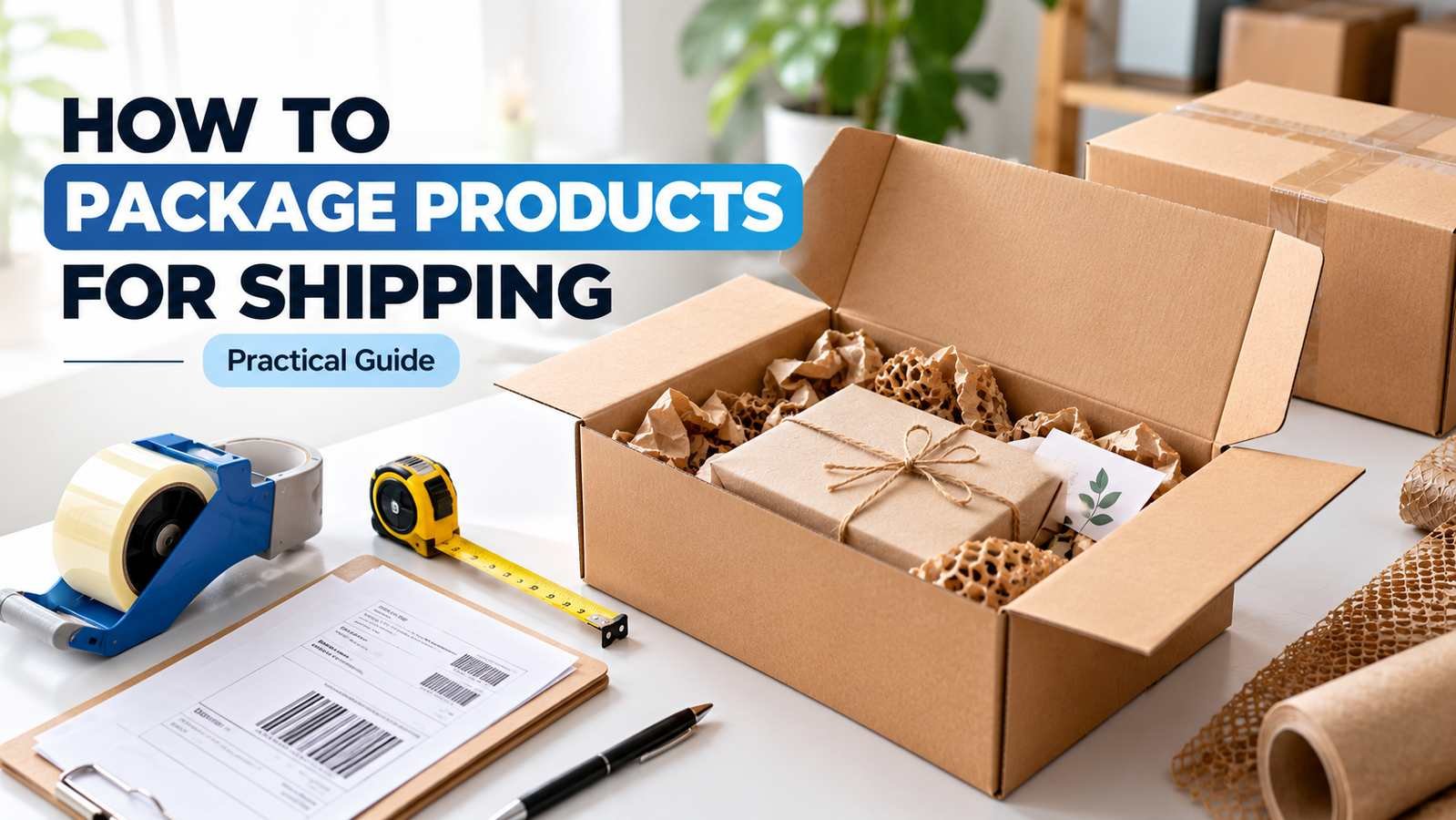
How to Package Products for Shipping: A Practical Guide

Learning how to package products for shipping properly can help reduce product damage, improve fulfillment efficiency, control unnecessary packaging space, and create a better customer experience. Whether you run a small online store or ship products at higher volumes, the right packaging process starts with choosing the right box and protecting the product inside it.

Shipping packaging has to do more than simply hold a product. It needs to keep the contents secure during handling, transportation, and delivery while also fitting your fulfillment process and branding requirements.

Quick answer: Package products for shipping by measuring the product, selecting a properly sized box, adding appropriate protective materials, securing the contents, sealing the package correctly, and testing the finished package before shipping at scale.

Why Proper Product Packaging Matters for Shipping

Products can experience movement, compression, vibration, and repeated handling during the shipping process. Packaging helps create a protective layer between the product and these conditions.

A poorly sized package can allow too much movement inside the box, while an undersized package may place unnecessary pressure on the product. Both situations can increase the chance of damage.

Good shipping packaging should provide a practical balance between protection, product fit, packing speed, appearance, and shipping efficiency.

Packaging principle: The goal is not to use the largest or most heavily protected package possible. The goal is to create a package that fits the product securely and provides the protection it actually needs.

Step 1: Measure the Product Before Choosing a Box

The first step in learning how to package products for shipping is measuring the product accurately. Record the product’s length, width, and height in the condition it will actually be packed.

Measurement What to Check Why It Matters
Length Longest side of the product Helps determine the required box footprint
Width Second horizontal dimension Provides side-to-side clearance
Height Thickness or vertical dimension Allows proper closure and protection

Remember to measure products in their real shipping configuration. If clothing is folded, measure it folded. If a product is already inside a retail package, measure the packaged product. If multiple products are commonly ordered together, test the complete order as well.

Step 2: Choose the Right Shipping Box Size

Once you know the product dimensions, choose a box that provides enough room for the product and the protective materials you intend to use.

The box should not be so tight that the product is forced into position, and it should not be so large that the product moves excessively inside the package.

For ecommerce businesses, custom kraft shipping boxes can be useful when standard dimensions do not provide the right fit. Custom dimensions allow the packaging to be planned around the actual product instead of forcing the product into an oversized generic box.

Step 3: Select Appropriate Protective Materials

The right protective material depends on the product. Not every item requires the same level of cushioning or internal support.

  • Use cushioning around fragile products that can break or crack.
  • Use paper or other protective materials to limit unnecessary movement.
  • Use inserts when products need to remain separated or positioned.
  • Use tissue or wrapping when product presentation is important.
  • Consider additional internal support for products with delicate components.

The objective is to prevent the product from moving excessively while avoiding unnecessary packaging volume.

Ready to Package Your Products More Professionally?

Create shipping packaging that fits your products, supports protection, and gives your brand a consistent presentation.

Explore Custom Shipping Boxes →

Step 4: Position the Product Inside the Box

After selecting your box and protective materials, position the product so it remains stable during transportation.

Try to keep the product centered when appropriate and use internal materials to reduce unnecessary movement. For multiple products, consider how they may contact each other during handling.

If the package contains several items, separate products when needed rather than allowing them to move freely throughout the box.

Step 5: Close and Seal the Package Properly

A properly packed product can still become vulnerable if the package is not securely closed. Follow the closure method appropriate for the selected box structure.

Traditional shipping boxes may require packing tape across the main seams, while certain kraft shipping boxes and mailer-style structures may use integrated folding and locking features.

Check the finished package before it leaves your facility. The box should be fully closed, stable, and ready for labeling.

Step 6: Add the Shipping Label Correctly

Labels should be placed on a flat, visible surface where important information can remain readable throughout the shipping process.

Avoid placing labels across major folds, openings, or heavily curved areas. If your fulfillment process involves automated or repeated handling, create a consistent labeling position for your packages.

For businesses shipping a large number of orders, consistency can make the packing and labeling workflow easier to manage.

How to Package Different Types of Products

The best shipping method depends on the product’s size, weight, fragility, shape, and presentation requirements.

Product Type Packaging Priority
Apparel Compact folding, moisture protection, and presentation
Cosmetics Secure positioning and protection against impact
Accessories Compact fit and controlled internal movement
Fragile products Cushioning, separation, and secure positioning
Multiple products Internal organization and protection between items
Gift sets Protection combined with presentation and branding

Custom Shipping Boxes for Ecommerce

Ecommerce businesses often ship products directly to customers, making packaging both a protective tool and part of the customer experience.

Custom kraft shipping boxes can be designed around the dimensions, weight, presentation, and shipping requirements of the products being sold.

For online stores, custom kraft shipping boxes for ecommerce can provide a consistent packaging format for recurring orders. They can also support a more recognizable branded experience when printed with company graphics or messaging.

Can Shipping Boxes Be Customized?

Yes. Shipping packaging can be customized in terms of dimensions, structure, printed design, branding, and other specifications depending on the packaging requirements.

Customization becomes especially useful when standard boxes leave too much empty space, do not provide the desired presentation, or do not match the product’s dimensions.

For small businesses, custom kraft shipping boxes for small businesses can provide a more consistent packaging solution without requiring the business to rely entirely on generic shipping cartons.

Can Shipping Boxes Be Printed?

Yes. Printed shipping packaging can include logos, brand colors, graphics, product information, messaging, patterns, or other visual elements.

Custom printed kraft shipping boxes can turn the shipping package into an extension of the brand while still serving its primary protective function.

For ecommerce businesses, printed packaging can also make the delivered order feel more intentional and recognizable.

How to Reduce Empty Space Inside Shipping Boxes

Excessive empty space can allow products to move around during transportation and may require additional filler. It can also make the package larger than necessary.

To reduce unnecessary space:

  • Measure products before selecting box dimensions.
  • Consider the packed product rather than the bare product.
  • Choose protective materials based on actual product needs.
  • Test common single-item and multi-item orders.
  • Consider custom dimensions when standard sizes are inefficient.

The right package is usually the one that provides enough room for safe packing without creating large unused areas.

What Sizes Are Available for Shipping Boxes?

Shipping boxes are available in a wide range of dimensions, but the best size depends on what you are shipping.

Instead of selecting a box based only on a product category, measure the actual product and packing configuration. Consider length, width, height, protective materials, inserts, and whether customers commonly purchase multiple units together.

When standard dimensions do not work efficiently, custom shipping packaging can provide a better fit.

Wholesale and Bulk Shipping Boxes

Businesses with recurring shipping requirements may need larger quantities of packaging. Ordering in bulk can make sense when box dimensions, design, and specifications are already established.

Before ordering wholesale custom kraft shipping boxes, confirm your most common product dimensions and packing process.

Businesses looking for wholesale kraft shipping boxes USA or bulk packaging should also consider storage space, reorder frequency, packaging consistency, and expected order volume.

Common Product Shipping Mistakes to Avoid

  • Choosing the box before measuring the product: Start with accurate dimensions.
  • Using excessive empty space: Oversized packaging can create unnecessary movement.
  • Ignoring protective materials: Account for everything that will be packed inside.
  • Using one box for every product: Different products can require different packaging solutions.
  • Skipping a physical test: Test the complete package before ordering large quantities.
  • Forgetting the customer experience: Shipping packaging can also contribute to your brand presentation.

How to Test Your Shipping Package

Before moving to large-scale fulfillment, create a real package using the exact product, box, protective materials, inserts, and closure method you plan to use.

Check whether the product moves inside the package. Confirm that the box closes correctly and that the finished package is practical for your fulfillment team.

It is also useful to test your most common order combinations. A package that works for one product may need a different configuration when customers purchase multiple products together.

Shipping packaging checklist:

  • Measure the product accurately.
  • Select an appropriately sized box.
  • Choose protection based on the product.
  • Position the product securely.
  • Close and seal the package correctly.
  • Apply the shipping label to a suitable flat surface.
  • Test the finished package before ordering in bulk.
Ready to Create Custom Shipping Boxes for Your Brand?

Choose packaging designed around your products, shipping needs, and brand presentation.

Explore Custom Kraft Shipping Boxes →

Frequently Asked Questions

Are kraft shipping boxes suitable for ecommerce?

Yes. Kraft shipping boxes can be suitable for ecommerce when the box dimensions, construction, product fit, and protective materials match the shipping requirements of the product.

Can shipping boxes be customized?

Yes. Shipping boxes can be customized according to dimensions, structure, printed design, branding, and other packaging requirements.

Can shipping boxes be printed?

Yes. Depending on the selected packaging specifications, shipping boxes can incorporate logos, graphics, messaging, patterns, and other brand elements.

What sizes are available?

Shipping boxes can be produced in different dimensions. The appropriate size depends on the product, protective materials, inserts, and order configuration.

Can I order bulk shipping boxes?

Yes. Businesses with recurring packaging requirements can order shipping boxes in larger quantities. It is best to confirm the dimensions, design, and specifications before placing a bulk order.

Final Thoughts

Knowing how to package products for shipping starts with understanding the product and building the packaging around its actual requirements. Measure carefully, choose the right box size, use appropriate protection, secure the product, and test the finished package before scaling your shipping operation.

For businesses that need a more precise or branded solution, custom kraft shipping boxes in the USA can help create packaging that combines product protection, efficient fulfillment, and consistent brand presentation.

How to Choose the Right Mailer Box Size for Ecommerce

Choosing the right mailer box size is one of the simplest ways to improve ecommerce packaging. A box that is too large can create unnecessary movement, extra void space, and higher shipping costs. A box that is too small can crush the product, damage inserts, or make packing frustrating.

For online brands, the goal is not simply to find a box that fits. You want a mailer that protects the product, supports an efficient fulfillment process, looks professional when it reaches the customer, and leaves enough room for any inserts or branded materials you actually use.

Quick answer: Measure the packed product first, then account for protection, inserts, and practical packing clearance. Choose the smallest mailer box that safely accommodates the complete package without forcing or compressing the contents.

Why Mailer Box Size Matters for Ecommerce

Ecommerce packaging has to work across several stages: packing, storage, transportation, delivery, and unboxing. The right dimensions can make each stage more efficient.

If your box has too much empty space, the product may move around during handling and require additional filler. Oversized packaging can also take more warehouse space and may increase dimensional shipping charges depending on the carrier and package characteristics.

On the other hand, a box that is too tight can put pressure on the product or make it difficult for fulfillment staff to close and seal consistently. This is especially important for products with rigid shapes, fragile components, clothing folds, jars, cosmetics, or gift-ready presentations.

Start With Your Product Dimensions

The most reliable starting point is the product itself—not the box you currently use. Measure the item in its normal shipping condition and record its length, width, and height.

Measurement What to measure Why it matters
Length Longest side of the packed product Sets the main internal footprint
Width Second horizontal dimension Determines side-to-side clearance
Height Thickness or vertical dimension Ensures the lid closes without pressure

For products that change shape—such as apparel, soft goods, or products already inside a retail carton—measure the form that will actually go into the mailer. If the product is sold as a bundle, measure the complete bundle rather than an individual item.

Ready to Choose the Right Mailer Box Size for Your Products?

Create packaging that fits your products, protects every order, and supports a smoother ecommerce fulfillment process.

Explore Custom Mailer Boxes →

Account for Protection and Inserts

Your product dimensions are only the beginning. A practical mailer box size also needs room for whatever travels with the product.

  • Protective paper, tissue, or cushioning
  • Product cards, thank-you notes, or care instructions
  • Branded inserts or promotional cards
  • Multiple products packed together
  • Dividers or simple internal protection

Do not automatically add a large amount of empty space. Instead, estimate the thickness of the protection you actually use. The objective is controlled clearance, not a large gap around the product.

Practical tip: Pack one real sample exactly as your fulfillment team would. Measure that complete packed unit before choosing the final mailer dimensions. This catches issues that product-only measurements often miss.

How Much Extra Space Should You Leave?

There is no single clearance number that works for every ecommerce product. The right amount depends on product rigidity, protective materials, presentation requirements, and how tightly the package needs to close.

For a durable product that needs little protection, minimal clearance may be enough. Fragile or presentation-sensitive products may require more room for protective materials. The important point is to calculate the space from your actual packing method rather than choosing a much larger box “just in case.”

Choose the Box Around the Complete Order

If customers frequently order more than one item, test common order combinations before standardizing your packaging. A box that is perfect for a single product may become inefficient when an order contains two or three units.

Order pattern What to test
Single item Fit, protection, closure, and unboxing
Two or more items Stacking, movement, and total packing clearance
Mixed products Different shapes, fragile items, and inserts together
Gift or premium order Presentation space and protective layers

Think About Shipping Efficiency

Mailer boxes are part of your shipping system, so dimensions should be considered alongside carrier requirements and your fulfillment workflow. USPS provides packaging and shipping resources that can help businesses understand package preparation and mailing considerations.

For ecommerce brands, the practical goal is to avoid paying to ship unnecessary volume while still giving the product adequate protection. A compact, repeatable package can also be easier to store, pick, pack, and label.

Mailer Box Size by Product Type

Different products naturally call for different packaging approaches. Use these categories as a starting point, then test your actual product and packing configuration.

Product type Sizing priority
Apparel Folded footprint and protection from crushing
Cosmetics Product arrangement and protective clearance
Small accessories Compact fit with limited unnecessary void space
Subscription products Repeatable fit across the standard monthly assortment
Gift sets Presentation, inserts, and protective layers

Custom Mailer Boxes vs. Standard Sizes

Standard mailer boxes can be useful when your product fits comfortably within an available size. They can simplify purchasing and make sense for brands with straightforward packaging needs.

Custom packaging becomes more valuable when your product dimensions are unusual, your brand needs a precise presentation, or you want to reduce excess space. Custom mailer boxes can be designed around the actual product and packing configuration instead of forcing the product into a generic footprint.

For brands shipping across the United States, custom mailer boxes in the USA can also support a consistent branded presentation across ecommerce orders.

Test Before Ordering in Bulk

Before committing to a large packaging order, create a physical prototype or sample. Put the product inside, add the exact protection and inserts you plan to use, close the box, and inspect the finished package.

Then test the workflow. Can your team pack it quickly? Does the lid close cleanly? Does the product stay in position? Is the label area practical? Does the finished package look the way you want customers to see it?

Size-selection checklist:

  • Measure the product in its real shipping configuration.
  • Account for protection, inserts, and multiple-item orders.
  • Choose enough clearance for reliable closure without excessive empty space.
  • Consider storage, fulfillment, labeling, and shipping efficiency.
  • Test a physical sample before placing a bulk order.

Common Mailer Box Sizing Mistakes

  • Choosing by product name alone: Two products in the same category can have very different dimensions.
  • Ignoring inserts: Cards, tissue, and protective materials need real space.
  • Buying the largest box: More space is not automatically better protection.
  • Testing only one order: Multi-item orders can expose sizing problems.
  • Skipping a physical sample: A theoretical fit can behave differently during real packing.

Final Thoughts

The right mailer box size balances protection, product fit, packing speed, presentation, storage, and shipping efficiency. Start with accurate product measurements, build in only the clearance your packing method needs, and test common order combinations before finalizing the dimensions.

If you want a broader look at ecommerce packaging, see our ecommerce packaging guide. You can also compare structure and use cases in our guide to mailer boxes vs. shipping boxes, or review our kraft box sizes guide for more sizing considerations.

Ready to Create Custom Mailer Packaging for Your Brand?

Turn the right box size into a consistent, branded unboxing experience for your ecommerce customers.

Explore PrintnBox →

Mailer Boxes vs. Shipping Boxes: What’s the Difference?

Choosing the right shipping package can affect product protection, fulfillment, branding, and the customer experience. Two common options for online businesses are mailer boxes and traditional shipping boxes. While both are designed to package products for delivery, their structures and typical applications are different.

Understanding the difference between mailer boxes vs shipping boxes can help you choose a packaging format that fits your product, shipping process, branding goals, and order volume.

What Is a Mailer Box?

A mailer box is a folding box designed with an integrated structure that allows the package to be assembled and closed without relying entirely on separate packing tape. Depending on the style, the box can include locking tabs, tuck-in flaps, dust flaps, and other integrated features.

Mailer boxes are commonly used for ecommerce orders, subscription products, apparel, accessories, gifts, cosmetics, and other products that benefit from a branded presentation.

Key point: Mailer boxes combine a shipping-friendly structure with a presentation-focused opening experience, making them useful for many direct-to-consumer products.

What Is a Shipping Box?

A shipping box is primarily designed to contain and protect products during transportation. Traditional shipping boxes commonly feature separate flaps that are folded over the opening and secured with packing tape.

They are frequently used for larger products, heavier shipments, multiple-item orders, wholesale shipments, and products that require additional protective materials.

The construction of a shipping box can vary depending on its material, board strength, dimensions, product weight, and intended shipping conditions.

Mailer Boxes vs. Shipping Boxes: Quick Comparison

Feature Mailer Boxes Shipping Boxes
Structure Integrated folding and closure design Separate flaps commonly secured with tape
Typical use Ecommerce, subscriptions, gifts, retail products Larger shipments, multiple products, heavier orders
Branding Well suited to branded packaging Can also be customized and printed
Opening experience Often designed around a structured unboxing Primarily focused on access and shipping
Fulfillment Convenient for repeat ecommerce packing Flexible for varied orders and packing configurations

What Is the Main Difference Between Mailer and Shipping Boxes?

The most noticeable difference is the box construction.

Mailer boxes generally have an integrated closure system. Their panels and flaps fold into position to create the finished package. This can simplify packing and give the customer a defined opening sequence.

Traditional shipping boxes generally use four main flaps that fold toward the center. Packing tape is commonly used to secure the package after the product and protective materials have been placed inside.

Neither format is automatically right for every product. The better choice depends on what you are shipping and how your business fulfills orders.

Mailer Boxes vs. Shipping Boxes for Ecommerce

Ecommerce packaging needs to work through several stages: product storage, picking, packing, labeling, shipping, delivery, and customer unboxing.

For businesses shipping similar products directly to consumers, mailer boxes can provide a consistent package format. They can also make the package itself part of the brand experience.

Shipping boxes can offer greater flexibility when orders contain multiple products, heavier items, unusual shapes, or larger amounts of protective material.

Tip: Choose your box according to the way your actual orders are packed and shipped rather than choosing solely based on the appearance of the empty package.
Ready to Choose the Right Packaging for Your Products?

Explore PrintnBox →

When Should You Use Mailer Boxes?

Mailer boxes can be a practical option when you want packaging that combines shipping functionality with a recognizable presentation.

  • Ecommerce products
  • Subscription boxes
  • Clothing and apparel
  • Accessories
  • Beauty products
  • Small consumer products
  • Gift orders
  • Direct-to-consumer shipments

They are particularly useful when the package is part of the customer’s overall product experience.

When Should You Use Shipping Boxes?

Traditional shipping boxes may be more appropriate when flexibility, product protection, or shipment size is the primary concern.

  • Large products
  • Heavy products
  • Multiple-product orders
  • Wholesale shipments
  • Products requiring substantial protective material
  • Irregularly shaped products
  • Orders requiring additional reinforcement

The correct shipping box should provide enough room for the product and necessary protective materials without creating unnecessary empty space.

Mailer Boxes and Branding

Branding is another area where mailer boxes can be useful. A package can become part of the visual identity of an ecommerce business instead of being treated only as a shipping container.

For example, printed kraft mailer boxes can incorporate logos, colors, patterns, messaging, or other brand elements into the package design.

This can help create a more consistent experience between the customer’s online purchase and the physical order they receive.

Are Kraft Mailer Boxes Suitable for Shipping?

Yes, kraft mailer boxes can be suitable for shipping when their construction, dimensions, and material are appropriate for the product being shipped.

The important consideration is not simply whether a box is made from kraft material. You should also consider the product’s weight, dimensions, fragility, internal protection, closure, and shipping requirements.

For ecommerce businesses, kraft mailer packaging can provide a practical format for products that need both shipping functionality and branded presentation.

Custom Kraft Mailer Boxes for Ecommerce

When standard packaging does not provide the right fit or brand presentation, custom kraft mailer boxes can be designed around the needs of the product.

Customization can allow businesses to consider the box dimensions, printed design, branding, closure structure, and overall presentation instead of relying entirely on a generic package.

This can be particularly relevant for custom kraft mailer boxes for ecommerce, where the package is delivered directly to the customer and may form part of the overall brand experience.

Are Mailer Boxes Durable?

Durability depends on the specific box construction, material, dimensions, product weight, and how the package is packed.

A mailer box should be selected according to the demands placed on it during fulfillment and shipping. Fragile products may also require inserts, cushioning, wrapping, or other internal protection.

For products that require additional protection, the packaging should be tested with the actual product before placing a large production order.

Which Box Provides Better Product Protection?

There is no universal answer because protection depends on the complete packaging system rather than the name of the box format alone.

A properly designed mailer box can provide suitable protection for many ecommerce products. A traditional shipping box can also provide reliable protection when its construction and packing method are appropriate.

Protection factor What to consider
Box construction Does the structure suit the product’s weight and handling requirements?
Product fit Is there enough room without allowing excessive movement?
Internal protection Are inserts or cushioning required?
Closure Will the package remain securely closed during handling?

Mailer Boxes vs. Shipping Boxes for Different Products

Product Potential packaging approach
Clothing Mailer packaging can provide a compact branded presentation.
Subscription products Mailer boxes can support consistent packing and repeatable unboxing.
Accessories Choose a compact box with sufficient internal protection.
Multiple products Shipping boxes can provide flexibility for mixed orders.
Heavy products Evaluate structural strength and the complete shipping setup.
Gifts Mailer boxes can support a more presentation-focused opening experience.

What Sizes Are Available?

Both mailer and shipping boxes can be produced in different dimensions. The appropriate size depends on the product and any materials that need to be placed inside the package.

Before selecting a size, measure the product’s length, width, and height. Then account for tissue paper, inserts, cushioning, or other protective components.

Choosing the right dimensions can help avoid unnecessary empty space while still making packing straightforward.

Mailer Boxes and the Unboxing Experience

The customer’s interaction with packaging does not end when the package arrives. Opening the package is part of the overall experience.

Mailer boxes can support a defined opening sequence where the customer sees the packaging design, inserts, product, and brand messaging in a planned order.

This makes them useful for businesses that want their packaging to feel like an extension of the product rather than simply an outer shipping container.

Custom Printed Kraft Mailer Boxes for Shipping

For brands that want packaging to combine shipping functionality and visual identity, custom printed kraft mailer boxes for shipping can be considered.

The design can be planned around the product, package dimensions, brand identity, and desired customer presentation. Before ordering in bulk, test the actual finished package with the product inside.

How Do Shipping Requirements Affect Your Choice?

Shipping requirements should be considered before selecting the final box. Think about the packed dimensions, product weight, internal protection, labeling area, storage, and how the package moves through your fulfillment process.

A box that works perfectly for a small lightweight order may not be appropriate for a heavier multi-product shipment.

Packaging rule: Select the format after considering the complete packed order—not just the empty box. Product fit, protection, fulfillment, branding, and shipping should all be evaluated together.

What About Wholesale and Bulk Orders?

Businesses shipping a consistent volume of products may need packaging in larger quantities. In this situation, the decision should include not only the box design but also storage, packing speed, product consistency, and reorder requirements.

For brands evaluating wholesale custom kraft mailer boxes, it is useful to confirm the required dimensions and packaging specifications before committing to a larger order.

If your business is considering wholesale kraft mailer boxes USA or other bulk packaging options, compare the packaging requirements of your most common products rather than selecting a size based on one product alone.

Common Mistakes When Choosing Between Mailer and Shipping Boxes

  • Choosing the box before measuring the product.
  • Assuming one packaging format works for every order.
  • Focusing on appearance while overlooking protection.
  • Ignoring the fulfillment workflow.
  • Using excessive empty space.
  • Ordering in bulk before testing the finished package.
  • Forgetting to consider the customer’s unboxing experience.

How to Choose Between Mailer Boxes and Shipping Boxes

Ask these questions before selecting your packaging:

  • What are you shipping? Consider size, weight, shape, and fragility.
  • How is the order packed? Determine whether you normally ship one product or multiple products together.
  • How important is branding? If packaging is part of the customer experience, a custom mailer format may be useful.
  • How much protection is required? Account for inserts, cushioning, wrapping, or other protective materials.
  • How will the package be opened? Consider the customer’s complete unboxing experience.
  • What quantities do you need? Consistent ecommerce orders may benefit from standardized packaging.
  • Have you tested it? Test the actual finished package before ordering in large quantities.

Mailer Boxes vs. Shipping Boxes: Decision Checklist

Consideration Question to Ask
Product fit Does the box fit the product and protective materials?
Protection Can the finished package provide appropriate protection?
Fulfillment Can your team pack and close it efficiently?
Branding Does the format support your desired printed design?
Shipping Have you considered the packed dimensions and weight?
Unboxing Does the package create the customer experience you want?
Order quantity Does the packaging work for your expected order volume?

Frequently Asked Questions

What is the difference between mailer boxes and shipping boxes?

Mailer boxes typically feature an integrated folding and closure structure designed for convenient packing and presentation. Traditional shipping boxes commonly use separate flaps that are secured with packing tape and can provide flexibility for larger or varied shipments.

Are kraft mailer boxes suitable for shipping?

Kraft mailer boxes can be suitable for shipping when their construction, dimensions, product fit, and internal protection are appropriate for the shipment.

Can kraft mailer boxes be custom printed?

Yes. Custom mailer packaging can incorporate printed branding, graphics, messaging, and other design elements depending on the selected packaging specifications.

Are kraft mailer boxes durable?

Durability depends on the specific material, construction, dimensions, product weight, and packing method. The complete packaging system should be evaluated according to the product being shipped.

What sizes are available for mailer boxes?

Mailer boxes can be produced in different dimensions. The appropriate size depends on the product and the space required for any inserts, wrapping, or protective materials.

Can I order kraft mailer boxes in bulk?

Yes. Businesses can plan packaging quantities around their expected order volume. Before placing a larger order, it is useful to confirm the required dimensions, design, and packaging specifications.

Ready to Create Custom Mailer Packaging for Your Brand?

Explore PrintnBox →

Final Thoughts

The difference between mailer boxes and shipping boxes is mainly related to their structure, closure, fulfillment process, product requirements, and role in the customer experience.

Mailer boxes can work well for ecommerce brands that want a convenient shipping format with a recognizable presentation. Traditional shipping boxes can offer flexibility for larger, heavier, or more varied shipments.

The right choice should be based on the actual product, dimensions, protection requirements, fulfillment workflow, branding goals, shipping process, and order volume.

When a branded mailer format fits your needs, custom kraft mailer boxes USA can be considered as part of your packaging strategy. Testing the finished package before moving to a larger order can help ensure that the selected format works for both your business and your customers.

Ecommerce Packaging Guide: How to Choose Packaging for Online Products

Ecommerce packaging plays a major role in how online orders are protected, shipped, opened, and remembered. The right packaging should fit the product, support the fulfillment process, control unnecessary space, and present the brand professionally.

This ecommerce packaging guide explains how to choose packaging for online products, from selecting the right format and dimensions to improving protection, branding, shipping, and the unboxing experience.

What Is Ecommerce Packaging?

Ecommerce packaging is the packaging used to prepare products for storage, fulfillment, shipping, delivery, and customer unboxing. Unlike packaging designed only for a retail shelf, ecommerce packaging must perform throughout the shipping journey.

Key point: Good ecommerce packaging balances product protection, practical shipping, efficient sizing, branding, and a positive customer experience.

Why Ecommerce Packaging Matters

Online orders can pass through several handling points before reaching the customer. Packaging therefore needs to protect the product while remaining practical for packing and shipping.

  • Helps protect products during handling and transportation.
  • Creates a consistent presentation for every order.
  • Can make packing faster when the format fits the fulfillment process.
  • Supports recognizable branding when customers receive the order.
  • Can improve the opening experience and encourage repeat recognition.

Start With the Product You Sell

The product should determine the packaging strategy. Consider its dimensions, weight, shape, fragility, surface finish, and how it needs to be presented after delivery.

Product consideration Packaging question
Size and shape What packaging dimensions fit without excessive empty space?
Weight What level of structural support is appropriate?
Fragility Does the product need inserts or additional cushioning?
Presentation Should the package emphasize branding or a premium opening experience?

Choose the Right Ecommerce Packaging Format

Format Common use
Mailer Boxes Clothing, subscription products, accessories, gifts, and compact ecommerce orders.
Shipping Boxes Larger, heavier, or multi-item orders that need additional shipping protection.
Product Boxes Individual products where presentation and branding are important.
Custom Bags Soft goods, merchandise, apparel, and selected lightweight products.
Protective Inserts Products that need positioning, separation, or additional protection inside the outer package.

Consider the Entire Fulfillment Process

Packaging should work for the people who prepare orders as well as the customers who receive them. Think about storage, picking, packing, sealing, labeling, carrier handoff, and delivery.

Tip: If your team packs hundreds of orders, small improvements in box setup, closure, labeling, or product placement can make the workflow easier to repeat.

Get the Package Dimensions Right

Packaging that is too large can create unnecessary empty space, while packaging that is too tight can make packing difficult or put pressure on the product. Measure the product and consider any insert, wrap, or protective material that will be inside.

For products that need a branded presentation, custom dimensions can help create a more intentional fit instead of relying on a generic package.

Design for Product Protection

Online packaging should account for movement and handling between fulfillment and delivery. The appropriate approach depends on the product, package structure, and shipping conditions.

  • Keep the product positioned securely inside the package.
  • Use suitable inserts when products can shift during transit.
  • Avoid unnecessary empty space that allows excessive movement.
  • Consider the package’s closure and structural strength.
  • Test the finished package before committing to a large production run.

Make the Packaging Easy to Open

Customers should be able to understand how the package opens without fighting with excessive tape, complicated closures, or an oversized outer package. A simple opening sequence can make the delivery feel more considered.

Use Branding to Make Online Orders Recognizable

Branding can be applied through printed logos, colors, messaging, patterns, labels, inserts, or other design details. The goal is consistency: the package should look like it belongs to the same brand as the website and product.

Consider Custom Kraft Mailer Boxes

For many online products, custom kraft mailer boxes can combine a practical mailer format with a branded presentation. They can be customized around product dimensions and visual requirements while giving an ecommerce order a distinct package format.

Businesses serving customers across the United States can also consider custom kraft mailer boxes in the USA when planning branded ecommerce packaging.

Think About the Unboxing Experience

The unboxing experience starts before the customer opens the package. Package appearance, closure, product positioning, printed messaging, inserts, and the condition of the product after delivery all contribute to the overall presentation.

Tip: Design the opening sequence from the customer’s point of view. Decide what they see first, how the product is revealed, and where brand messaging naturally fits.

Plan Packaging Around Your Shipping Process

Before selecting a package, understand how orders move through your operation. Consider the carrier process, shipping labels, storage space, order volume, packing stations, and the mix of products in a typical order.

Balance Packaging Quality With Cost

The lowest-cost package is not always the most efficient option. A useful packaging decision considers the total process: material use, packing time, product protection, shipping efficiency, presentation, and the cost of replacing products damaged in transit.

Test Ecommerce Packaging Before a Large Order

Testing gives you an opportunity to identify fit, closure, protection, labeling, and presentation issues before committing to a large production quantity.

Testing checklist

  • Pack the actual product.
  • Check the fit and empty space.
  • Test the closure.
  • Apply the intended shipping label.
  • Review the package from the customer’s perspective.
  • Repeat the test with different product configurations when needed.

Ecommerce Packaging in the USA

For U.S.-focused ecommerce brands, packaging decisions should reflect the way products are fulfilled and shipped to customers across different locations. Consistent dimensions, repeatable packing procedures, clear labeling, and reliable product protection can help create a more predictable fulfillment process.

Common Ecommerce Packaging Mistakes to Avoid

  • Choosing packaging before measuring the product.
  • Using excessive empty space without a reason.
  • Ignoring how the package will be packed and sealed.
  • Focusing only on appearance and overlooking protection.
  • Adding branding without considering the complete customer experience.
  • Ordering large quantities before testing the finished package.

Ecommerce Packaging Checklist

Check Question
Product fit Does the package fit the product and required protective materials?
Protection Is the product secure throughout the shipping process?
Fulfillment Can the package be packed consistently and efficiently?
Branding Does the packaging match the brand’s visual identity?
Opening Is the package easy and intuitive to open?
Testing Has the finished package been tested before a large order?

Frequently Asked Questions

What is the best packaging for ecommerce?

The appropriate ecommerce packaging depends on the product, dimensions, weight, fragility, fulfillment process, shipping requirements, and desired presentation.

What should I consider when choosing ecommerce packaging?

Consider product fit, protection, packaging format, dimensions, fulfillment workflow, branding, opening experience, shipping process, cost, and testing.

Are kraft mailer boxes suitable for ecommerce?

Kraft mailer boxes can be suitable for many ecommerce products, particularly when a business wants a structured mailer format with customizable branding and dimensions.

Can ecommerce packaging be customized?

Yes. Depending on the packaging format, businesses can customize dimensions, printing, branding, structure, and other design elements.

Should ecommerce packaging be tested before ordering in bulk?

Yes. Testing the actual product inside the finished packaging can reveal fit, protection, closure, labeling, and presentation issues before a large production run.

Final Thoughts

The right ecommerce packaging should do more than hold a product. It should support the fulfillment workflow, protect the order, fit the product appropriately, represent the brand, and create a straightforward customer experience from delivery to unboxing.

Start with the product and fulfillment process, choose a suitable packaging format, confirm dimensions, test protection and opening, and then refine the branding and presentation.

How to Design Custom Packaging for Small Businesses

Designing custom packaging for small businesses is about more than putting a logo on a box. Good packaging should protect the product, communicate the brand, fit the customer’s expectations, and work within the business’s budget. For a small business, every packaging decision matters because unnecessary complexity can increase costs without improving the customer experience.

The most effective approach is to design packaging around the product and the customer journey first, then add branding, printing, and finishing elements that support those goals. This guide explains how small businesses can plan and design custom packaging from the initial concept through production.

Quick Answer: To design custom packaging for a small business, start with the product and customer experience. Define the packaging purpose, select an appropriate structure and material, determine dimensions, create a simple brand hierarchy, prepare print artwork, consider shipping and storage, and order a sample or proof before committing to a larger production run.

Why Custom Packaging Matters for Small Businesses

Small businesses often compete with larger brands that have established visual identities and extensive marketing resources. Packaging gives smaller brands another physical touchpoint where they can communicate who they are.

A well-designed package can help create a consistent experience from the moment a customer receives the product until they open it. It can also make products easier to recognize when customers see them again online or in a retail environment.

  • Creates a recognizable brand presentation
  • Protects the product during handling and transportation
  • Improves the customer’s first physical impression
  • Makes product information easier to communicate
  • Supports a consistent brand identity
  • Can make products more suitable for retail or e-commerce

However, custom packaging does not automatically mean complicated packaging. A small business can achieve a professional result with a relatively simple structure and a carefully planned visual identity.

1. Define What Your Packaging Needs to Do

Before opening a design program or choosing colors, define the main purpose of the package. Different products require different packaging priorities.

Ask these questions first:

  • What product will the package hold?
  • Will the package be sold in a store or shipped directly?
  • Does the product need additional protection?
  • Will customers see the packaging before purchasing?
  • Does the package need to support an unboxing experience?
  • Will the packaging need inserts, dividers, or other components?
  • What information must appear on the package?

This first step prevents a common mistake: designing attractive packaging before determining whether the structure actually works for the product.

Design Tip: Think about packaging as a functional product first and a marketing surface second. Once the structure works, the visual design becomes much easier to develop.

2. Understand Your Customer

Packaging should reflect the expectations of the people buying your product. A handmade candle company, boutique clothing brand, specialty food business, and cosmetics company may all need very different packaging experiences.

Consider:

  • Who is buying the product?
  • Where will they receive or purchase it?
  • What type of visual style appeals to them?
  • Is the product positioned as everyday, premium, handmade, natural, playful, or professional?
  • What will customers expect when they open the package?

The answers should influence the packaging design without forcing the brand into unnecessary trends.

3. Choose the Packaging Structure Before the Artwork

One of the most important design decisions is the physical structure of the package. The structure determines how the product is inserted, removed, protected, displayed, and transported.

Packaging Format Potential Use Design Priority
Folding Boxes Retail products, cosmetics, gifts Presentation and product fit
Mailer Boxes E-commerce and subscription products Shipping and unboxing
Kraft Boxes Retail, gifts, handmade products, food packaging Material appearance and branding
Shipping Boxes E-commerce and transportation Protection and handling
Custom Bags Retail stores, events, boutiques Brand visibility and usability

If you are still deciding between different kraft packaging structures, our Kraft Packaging Guide provides additional information about kraft packaging types and applications.

4. Measure the Product Accurately

Packaging dimensions should be based on the actual product rather than an approximate measurement. Measure the product’s length, width, and height and consider any components that need to fit inside the package.

Also consider:

  • Protective materials
  • Inserts
  • Dividers
  • Lids or closures
  • Product movement inside the package
  • How the customer will remove the product

The goal is not simply to create the smallest possible package. The package should provide enough room for the product and any necessary protection while avoiding excessive unused space.

For a deeper explanation of dimensional planning, see our Kraft Box Sizes Guide.

5. Build a Simple Brand Hierarchy

Once the structure is established, move to the visual design. The most important elements should be easy to identify without making the package feel crowded.

A basic hierarchy can include:

  1. Brand logo: Establishes immediate brand recognition.
  2. Product name: Tells customers what the product is.
  3. Key message: Communicates an important benefit or positioning statement.
  4. Supporting information: Provides useful product details.
  5. Contact information: Helps customers reconnect with the business.

You do not need to place every piece of information on the front panel. Different sides of the package can have different purposes.

Design Tip: Use visual hierarchy instead of making every element the same size. Your customer should know where to look first, second, and third.

6. Select Colors That Fit Your Brand

Color should reinforce the identity of your business rather than simply making the package look attractive. Start with the colors already used across your website, logo, social media, and marketing materials.

A small packaging system may only need a few consistent colors:

  • One primary brand color
  • One secondary color
  • A neutral background or packaging material color
  • A contrasting text color

When printing on natural kraft material, remember that the brown surface can influence the appearance of printed colors. Artwork should therefore be prepared with the actual packaging material in mind.

7. Decide What Information Belongs on the Package

Packaging can communicate more than a logo. Depending on the product, customers may need product details, instructions, ingredients, care information, contact details, or other relevant information.

Before finalizing the design, make a complete list of the information that needs to appear on the packaging. Then organize it according to importance.

This avoids the common problem of trying to squeeze additional information into the design after the artwork has already been completed.

8. Design for Shipping and Storage

A package can look excellent in a product photograph but still be unsuitable for shipping. If your small business sells online, think about what happens after the product leaves your facility.

Consider:

  • Handling during transportation
  • Stacking
  • Storage conditions
  • Product weight
  • Potential impacts or compression
  • Available shipping space
  • Whether additional protective packaging is required

If your packaging will be used for shipping, structural requirements should be considered before the visual design is finalized.

For more information about how material choice affects packaging applications, you can also review Kraft Boxes vs. Cardboard Boxes.

9. Use Custom Kraft Packaging When It Fits Your Brand

For businesses that want a natural, understated, or handmade visual identity, kraft packaging can be a useful design direction. The material itself can become part of the brand presentation instead of simply acting as a blank surface.

Custom kraft packaging can be developed around different products and brand styles. Depending on the packaging format, businesses can incorporate logos, artwork, product information, patterns, structural features, and other branding elements.

For small businesses interested in this approach, explore custom kraft packaging for packaging options designed around different product and branding requirements.

10. Plan the Unboxing Experience

For e-commerce brands, the packaging is part of the product experience. Customers may see the exterior before opening the package and then discover additional details as they unpack the product.

A simple unboxing experience can include:

  • Clear exterior branding
  • Easy-to-open packaging
  • Organized product placement
  • Interior branding
  • Thank-you cards
  • Product information cards
  • Protective inserts

The goal is to make opening the package feel intentional without adding features that do not provide value.

11. Keep the Design Practical for Production

A packaging design has to work not only on screen but also during manufacturing and assembly. Very complicated structures, excessive finishing, or unnecessarily detailed artwork may make production more difficult.

Before approving the final design, review:

  • Artwork dimensions
  • Bleed and safe areas
  • Logo placement
  • Text readability
  • Color requirements
  • Die-cut areas
  • Folding and assembly points
  • Closure or opening mechanisms
Production Tip: Always review the final dieline and artwork carefully before production. A small correction before manufacturing is much easier than correcting a finished packaging order.

12. Order a Sample Before a Large Production Run

A digital design does not always show exactly how packaging will look or function in real life. A physical sample can reveal issues with dimensions, colors, opening mechanisms, product fit, and overall appearance.

Use the sample to check:

  • Does the product fit correctly?
  • Is there too much empty space?
  • Is the packaging easy to open?
  • Is the product adequately protected?
  • Does the printed artwork look correct?
  • Is the logo positioned properly?
  • Does the package match the intended brand appearance?
  • Does the finished structure feel appropriate for the product?

Testing before a larger order gives a small business an opportunity to refine the design before committing to a larger quantity.

Custom Packaging in the USA for Small Businesses

Businesses serving customers in the United States may have different packaging requirements depending on whether products are sold through retail stores, online marketplaces, direct-to-consumer websites, events, or other sales channels.

When evaluating custom packaging in the USA, small businesses should consider the product category, packaging dimensions, material, printing requirements, order quantity, shipping method, and customer experience.

If you are looking for packaging designed around your brand and product requirements, explore custom packaging in the USA and compare suitable packaging options.

Common Packaging Design Mistakes Small Businesses Should Avoid

Good packaging design is not only about what you include. It is also about knowing what to avoid.

  • Designing before measuring: Artwork cannot solve an incorrect package size.
  • Adding too much information: Crowded packaging can be difficult to understand.
  • Ignoring the customer experience: Packaging should be practical as well as attractive.
  • Choosing materials based only on appearance: The material must also meet the product’s functional needs.
  • Forgetting shipping: E-commerce packaging may face considerably different conditions from retail packaging.
  • Changing the brand completely: Packaging should reinforce the existing brand identity.
  • Skipping physical testing: A sample can reveal problems that are not obvious on screen.
  • Adding unnecessary features: Every additional feature should have a purpose.

Custom Packaging Design Checklist

  • ☐ Product dimensions have been measured
  • ☐ Packaging purpose has been defined
  • ☐ Target customer has been considered
  • ☐ Packaging structure has been selected
  • ☐ Material requirements have been reviewed
  • ☐ Brand colors and typography are consistent
  • ☐ Logo placement is clear
  • ☐ Product information is organized
  • ☐ Shipping and storage requirements have been considered
  • ☐ Artwork has been checked carefully
  • ☐ A physical sample has been reviewed
  • ☐ Final packaging works within the business budget

Frequently Asked Questions About Custom Packaging for Small Businesses

What is custom packaging for small businesses?

Custom packaging is packaging designed around a business’s specific product, brand identity, dimensions, and customer experience. It can include custom boxes, mailers, bags, inserts, and other packaging formats.

How should a small business start designing packaging?

Start by defining the product’s packaging requirements, measuring the product, understanding the target customer, selecting the appropriate packaging structure, and establishing the brand’s visual direction.

What should be printed on custom packaging?

Common elements include the business logo, product name, brand messaging, product information, and other information relevant to the product. The exact requirements depend on the packaging and product category.

Is custom packaging expensive for a small business?

Packaging costs depend on factors such as material, dimensions, structure, printing, finishing, quantity, and production requirements. Small businesses can control costs by prioritizing the packaging features that provide the greatest functional and branding value.

Is kraft packaging suitable for small businesses?

Kraft packaging can be suitable for businesses that want a natural or understated visual style and packaging customized around their products. The appropriate structure still depends on the product’s functional requirements.

Should I test custom packaging before ordering?

Yes. Reviewing a physical sample can help identify problems with product fit, structure, artwork, printing, opening, and overall presentation before a larger production run.

Final Thoughts

Designing custom packaging for small businesses starts with understanding the product and ends with creating a package that works for both the customer and the business. The strongest designs balance function, branding, protection, usability, production, and cost.

Rather than adding every available packaging feature, focus on the elements that make the package easier to recognize, use, ship, and remember. A simple structure with thoughtful branding can create a professional customer experience without making the packaging unnecessarily complicated.

For businesses interested in a natural packaging style, custom kraft packaging can be designed around different products, brand identities, and packaging requirements.

If you are planning packaging for a small business in the United States, explore custom packaging in the USA and consider how the packaging structure, dimensions, branding, and customer experience can work together.