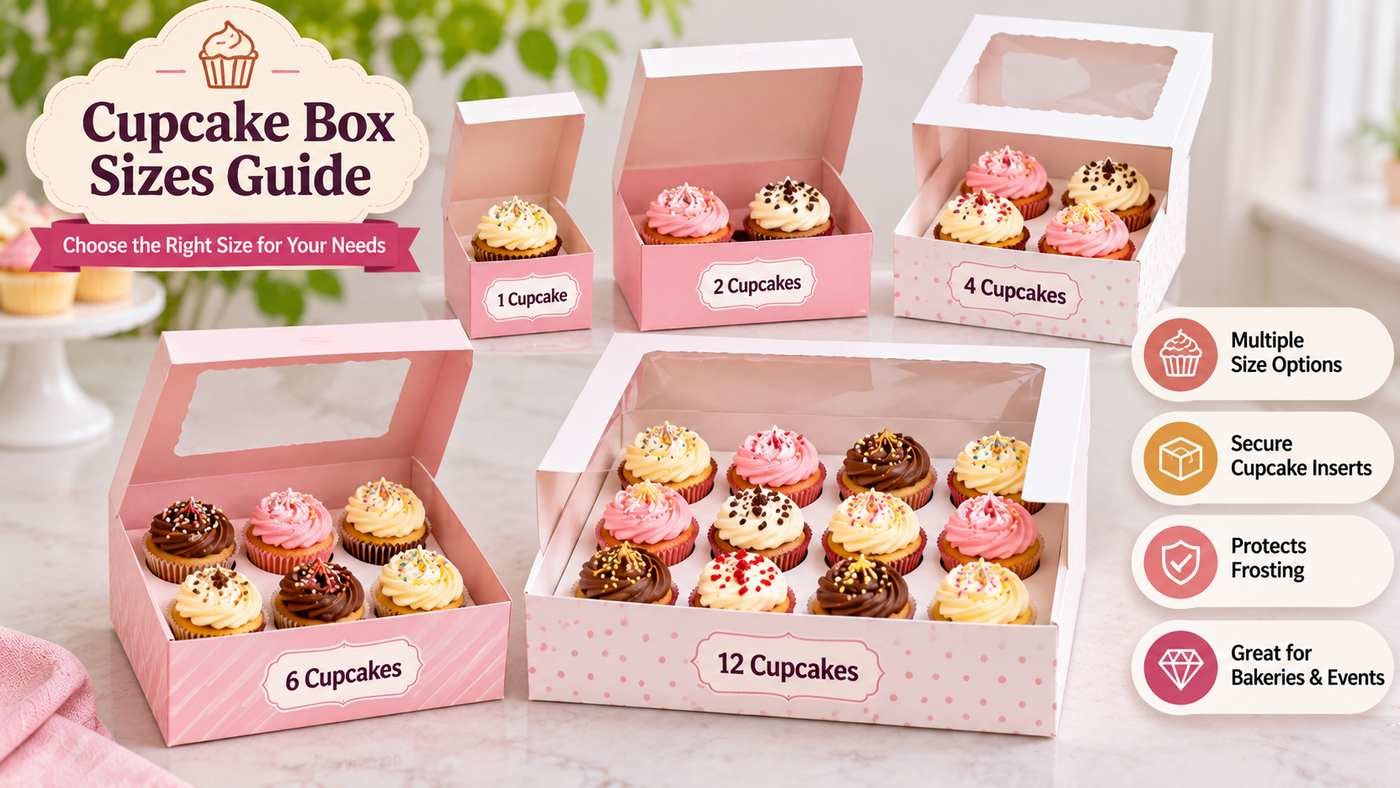
Choosing the right cupcake box is about more than fitting a certain number of cupcakes inside. The box needs to hold each cupcake upright, leave enough room for frosting and decorations, and keep the treats from shifting during pickup or delivery. This cupcake box sizes guide explains what to consider when choosing packaging for 1, 2, 4, 6, and 12 cupcakes.
The ideal dimensions depend on the cupcake liner, frosting height, toppings, insert design, and the amount of clearance needed around each piece. Use the quantities below as a starting point, then confirm the finished box dimensions with a sample before ordering in bulk.
Measure the widest part of the cupcake, the full height including frosting, and the spacing needed between pieces. Match the insert cavities to the cupcake bases, provide enough headroom under the lid, and test the complete box with decorated cupcakes before approving production.
Why choosing the correct cupcake box size matters
A box that is too small can press frosting against the lid or squeeze cupcakes together. A box that is too large can allow the cupcakes to slide, tilt, or collide during transport. A suitable box balances protection, presentation, storage, and ease of handling.
- Frosting protection: Enough vertical clearance helps prevent icing, toppers, and decorations from touching the lid.
- Stable placement: Inserts or individual cavities help keep cupcakes upright.
- Less movement: Appropriate spacing helps reduce shifting during carrying and delivery.
- Neat presentation: A well-planned layout creates an organized display when the box is opened.
- Practical handling: The box should be easy for bakery staff to assemble, fill, close, and carry.
- Efficient storage: Choosing a size that fits your common order quantities can simplify packaging inventory.
Cupcake box sizes for 1, 2, 4, 6, and 12 cupcakes
Box dimensions are not universal because cupcake sizes and insert styles vary. The following table describes common layout approaches rather than fixed industry-standard measurements. Ask your packaging supplier for the internal dimensions and cavity specifications of the exact box you plan to order.
1-cupcake boxes: Individual treats and gift orders
A single-cupcake box is useful for individual gifts, party favors, event samples, bakery counters, and promotional treats. The cupcake is usually positioned in a centered insert or base support.
When choosing a one-cupcake box, check:
- The cavity holds the cupcake liner or base without squeezing it.
- The insert keeps the cupcake upright when the box is moved.
- The lid has enough height for the frosting swirl, topper, or decoration.
- The cupcake can be placed inside and removed without touching the icing.
- The box closes securely without pressing down on the cupcake.
For tall or elaborately decorated cupcakes, prioritize internal height over a compact outer appearance. A slightly taller box may be more suitable than a standard-height design.
2-cupcake boxes: Small gifts and paired orders
Two-cupcake packaging is a practical option for small gifts, couples, tasting sets, and customers who want more than one flavor without purchasing a full box. A side-by-side layout is common, although the final arrangement depends on the box shape and cupcake dimensions.
Make sure there is enough room between the two cupcakes. The widest frosting edges should not touch when the cupcakes are seated in the insert. Check that the insert supports both bases and that neither cupcake can lean into the other during transport.
4-cupcake boxes: A compact assortment
Four-cupcake boxes are often arranged in a two-by-two grid. This format can work well for small family treats, sampler packs, and assorted bakery flavors.
- Check the distance between all four cavities, including the diagonal corners.
- Make sure frosting peaks and decorations have enough clearance.
- Choose an insert that stays flat and does not lift when cupcakes are removed.
- Confirm that the box can be carried without the cupcakes shifting in their spaces.
If the assortment includes different cupcake heights, size the box for the tallest decoration and test the full arrangement rather than measuring only one standard cupcake.
6-cupcake boxes: Everyday bakery orders
A six-cupcake box commonly uses two rows of three. It can be suitable for regular bakery purchases, mixed-flavor packs, and small celebrations. Because the layout is wider, insert stability and the strength of the box base become especially important.
Check that the tray supports each cupcake evenly and that the box does not flex excessively when lifted from the base. If cupcakes have tall frosting or toppers, confirm the lid height across the entire box, not just at the center.
12-cupcake boxes: Larger orders and celebrations
A twelve-cupcake box is commonly arranged in three rows of four. This larger format can serve party orders, office treats, events, and family celebrations. The increased footprint makes carrying strength, insert rigidity, and lid stability important considerations.
- Check that the base supports the full weight of the cupcakes.
- Look for an insert that holds all twelve cupcakes in position.
- Make sure the outer box does not bow when lifted or carried.
- Check the lid for sufficient clearance over every row.
- Test how the box behaves when carried from the intended handholds or base.
- Consider whether a larger order needs additional outer packaging for delivery.
For delivery or event orders, test the fully loaded box using the same handling method your staff or delivery team will use.
How to measure cupcakes before ordering boxes
Accurate measurements are more useful than choosing a box based only on its stated cupcake count. Cupcake count tells you how many pieces the package is intended to hold, but it does not guarantee a fit for every recipe or decoration.
- Measure the base: Record the diameter of the cupcake liner or the widest part of the baked base.
- Measure the frosting: Measure the widest point of the icing, including piped edges and toppings.
- Measure the total height: Include the cupcake base, frosting, picks, toppers, and decorations.
- Check cavity dimensions: Compare the base measurement with the insert opening and depth.
- Plan spacing: Leave enough room so neighboring frosting and decorations do not touch.
- Check internal box dimensions: Confirm usable length, width, and height after the insert is installed.
- Test the closure: Close the box and verify that the lid does not touch the tallest cupcake.
Measure several cupcakes from a normal production batch. Handmade cupcakes can vary in size, and the packaging should accommodate realistic variation without being excessively loose.
Choose the right cupcake box insert
The insert is what helps keep cupcakes upright and separated. A box with the correct outer dimensions can still perform poorly if its insert does not match the cupcake bases.
Paperboard inserts
Paperboard inserts can be designed with circular openings or shaped supports for cupcake bases. They can be coordinated with the outer carton and may be supplied flat or assembled, depending on the design. Check stiffness, fit, and whether the material is suitable for the intended food-packaging use.
Molded or formed inserts
Formed inserts can provide shaped cavities that help position cupcakes. Evaluate cavity depth, surface finish, stability, and food-contact suitability. Make sure the insert does not mark or damage the liner or cupcake base.
Individual cavity supports
Individual supports help separate cupcakes and can be useful for assorted orders. Check that the opening holds the base securely while allowing staff to place and remove cupcakes easily.
Material and construction considerations
Cupcake boxes are available in different paperboard grades, finishes, and constructions. The right choice depends on the product, weight, handling, storage, and presentation requirements.
- Board strength: The box should maintain its shape when loaded with the intended quantity.
- Food-contact suitability: Confirm that the material, coatings, inks, and adhesives are appropriate for their intended use.
- Base support: The bottom panel should remain stable when the box is lifted.
- Window design: A window can display the cupcakes, but the structure must still protect the product and keep the lid clear of decorations.
- Assembly: Consider how quickly staff can fold, load, and close the box during busy periods.
- Storage: Flat-packed boxes may reduce storage space, depending on the design and supplier.
How to choose cupcake boxes for delivery
Delivery creates additional movement that may not occur when a customer carries a box directly from the counter. A suitable box should keep cupcakes upright and prevent the insert from shifting inside the carton.
- Use cavities that fit the cupcake bases and prevent excessive movement.
- Choose enough box height for frosting and decorations.
- Check the base and side walls for rigidity under the full load.
- Keep the lid securely closed without compressing the cupcakes.
- Place the box on a level surface in the delivery bag or vehicle.
- Test the package over a representative delivery route before using it for regular orders.
For larger deliveries, consider how the cupcake box will be supported inside an outer carrier or shipping carton. Do not assume a retail presentation box alone is designed for parcel shipping.
Custom cupcake boxes for bakery branding
Custom cupcake boxes can be planned around your cupcake count, dimensions, insert layout, and bakery identity. A consistent box style across single, small, and larger assortments can help create a recognizable presentation.
Printed cupcake boxes can display your logo, brand colors, bakery name, and selected artwork. Check how the design appears on the assembled box and ensure that important graphics do not fall across folds, tabs, or window openings.
When comparing wholesale cupcake boxes, review the internal dimensions, insert design, material, print options, minimum order quantity, sample availability, lead time, and shipping. Branded cupcake boxes should be tested with actual decorated cupcakes before approving a large order.
Bakeries sourcing custom cupcake boxes in the USA should provide the supplier with cupcake measurements, typical frosting height, quantity options, and intended use. Confirm food-contact suitability for the exact packaging components and request a sample before production.
Cupcake box sample checklist
- Does the box fit the selected cupcake quantity and layout?
- Do the cavities hold the bases without squeezing them?
- Is there enough clearance for frosting and decorations?
- Can cupcakes be loaded and removed without damaging the icing?
- Does the insert remain stable when the box is moved?
- Does the base support the full loaded weight?
- Does the lid close without touching the cupcakes?
- Can staff assemble and pack the box efficiently?
- Are the material and components suitable for the intended food-packaging use?
- Does the printed design look clear on the finished package?
Frequently asked questions
What size box do I need for one cupcake?
Choose a box with a cavity that supports the cupcake base and enough internal height for its frosting and decorations. Measure the finished cupcake and check the actual internal dimensions before ordering.
What is the common layout for a 4-cupcake box?
A two-by-two layout is common. The insert should keep each cupcake separated and upright, with enough room for frosting and toppings.
How are 6-cupcake boxes usually arranged?
A two-row, three-column layout is commonly used. Check the insert’s stability and the lid clearance across all six positions.
What layout is used for 12-cupcake boxes?
A three-by-four arrangement is a common option. The box needs a stable base and insert, sufficient height, and enough strength to support the full assortment during carrying.
How much space should be above cupcake frosting?
There is no single clearance measurement for every cupcake. Allow enough headroom so the lid does not touch the tallest frosting or decoration, and confirm the fit with a physical sample.
Should cupcake boxes have inserts?
Inserts are useful because they help keep cupcakes upright and separated. Choose cavity sizes that support the bases without making cupcakes difficult to remove.
Should I test cupcake boxes before ordering wholesale?
Yes. Test the exact box and insert with fully decorated cupcakes. Check fit, lid clearance, movement, base strength, assembly, and presentation before approving bulk production.
Find the right box for your cupcake range
Plan packaging around your cupcake sizes, frosting height, order quantities, and bakery branding. Explore custom options and request a sample to check the fit with your actual products.