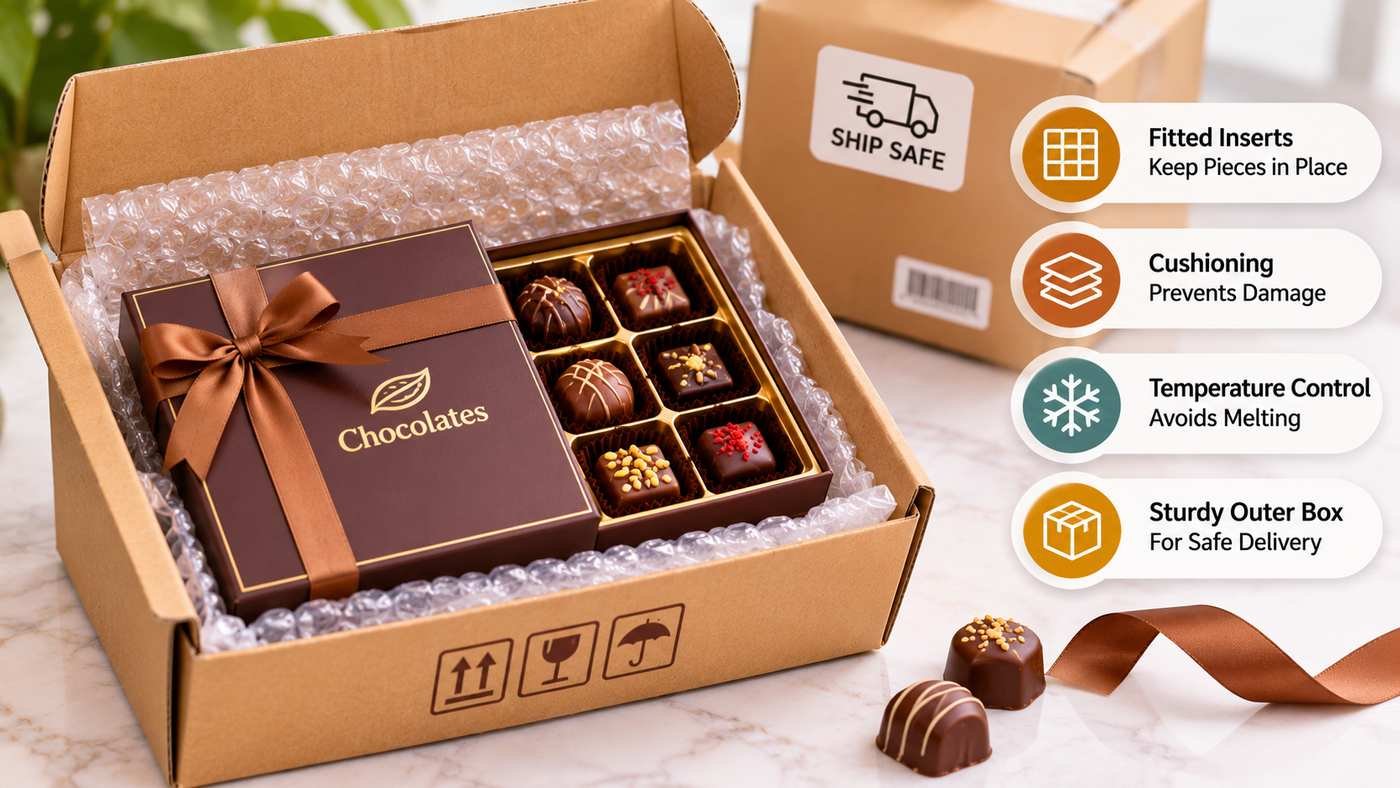
Shipping chocolate requires more planning than placing a box of sweets inside a mailer. Individual pieces can chip, lose their shape, rub against one another, or be affected by temperature changes during transit. Good chocolate packaging for shipping combines a well-fitted inner presentation box, suitable inserts, protective cushioning, and an outer shipping carton designed for the journey.
The right setup depends on the type of chocolate, assortment, destination, season, carrier handling, and expected transit time. This guide explains how to build a packaging system that helps protect chocolate pieces while keeping the unboxing experience attractive.
Use packaging in layers: protect each chocolate in a suitable cavity or wrap, secure the assortment inside a sturdy inner box, cushion that box within a properly sized shipping carton, and validate the complete package with transit-style testing. For temperature-sensitive products, assess insulation and temperature-control needs separately from impact protection.
Why chocolate needs careful shipping protection
Chocolate is vulnerable to several conditions that can occur between dispatch and delivery. The risks vary by recipe, shape, coating, packaging, and transit environment.
- Impact and vibration: Drops, jolts, and repeated movement can chip pieces or damage decorative details.
- Movement inside the box: Loose chocolates can collide with one another or rub against the lid and walls.
- Temperature changes: Heat can soften or melt chocolate, while fluctuating conditions may affect its appearance and texture.
- Moisture and condensation: Changes in temperature and humidity can contribute to surface issues or moisture inside the package.
- Pressure and stacking: Heavy parcels or poorly supported cartons can crush the inner box.
- Odors and contamination: Unsuitable packaging or poor storage can expose chocolate to unwanted odors or contaminants.
Packaging should be selected for the actual product and route. A short local delivery of solid chocolate bars may need a different setup from a long-distance shipment of decorated pralines during warm weather.
1. Protect individual chocolates inside the assortment
The first layer of protection is the space immediately around each piece. The goal is to limit movement and prevent delicate surfaces from rubbing against neighboring chocolates.
Use a fitted insert
A tray or insert with individual cavities can help keep chocolates in their intended positions. Match each cavity to the piece’s maximum width, length, and height, including coatings, toppings, and decorative elements. Provide enough clearance for easy placement and removal without allowing excessive movement.
For mixed assortments, consider different cavity shapes or a layout designed around the individual pieces. Avoid forcing a large chocolate into a small cavity or leaving a delicate piece unsupported in an oversized well.
Our guide to choosing chocolate box inserts for different assortments explains cavity styles, material options, and sizing considerations.
Consider individual cups or wraps
Paper cups, suitable wrappers, or other food-contact-compatible components may provide an additional separation layer for some chocolate styles. They can help keep pieces organized and reduce direct contact between surfaces. Confirm that every component is appropriate for the intended food-contact use and does not transfer odor or mark the chocolate.
Protect delicate decorations
Chocolates with piped details, molded shapes, nuts, sprinkles, or fragile decorations may need deeper cavities or additional headroom. Check the clearance between the top of each piece and the closed lid. The lid should not press against the chocolate when the box is shut.
2. Choose a sturdy inner chocolate box
The inner box holds the assortment together and creates the presentation customers see when opening the shipment. It should retain its shape during handling and provide a secure fit for the insert.
- Board strength: Select a construction that resists bending and crushing under expected handling conditions.
- Correct dimensions: The insert should sit securely without bowing the box walls or shifting freely.
- Secure closure: The lid should remain closed during handling without putting pressure on the chocolates.
- Clean interior: Surfaces and components should be suitable for the intended food packaging use.
- Presentation: Coordinate the box, insert, and any protective wrap so the assortment looks organized when opened.
A premium gift box can be attractive, but appearance alone does not establish shipping strength. Treat the presentation box as one layer in a larger protective system, not as a substitute for an outer shipping carton.
3. Add cushioning between the inner box and shipping carton
The space around the inner chocolate box needs to be managed so the presentation box does not move freely inside the parcel. Use cushioning that suits the product’s weight, carton dimensions, and shipping conditions.
Depending on the package design, options may include paper cushioning, corrugated pads, molded supports, or other protective materials. The material should hold the inner box in position and help absorb handling shocks without transferring excessive pressure to the chocolates.
- Choose an outer carton that leaves practical room for protective cushioning.
- Prevent the inner box from sliding from side to side or striking the carton walls.
- Support the top and bottom where needed, without crushing the presentation box.
- Fill voids consistently so the parcel remains stable during movement.
- Avoid loose materials that can shift away from the areas needing support.
Do not overfill the carton. Excessive packing pressure can deform the inner box, while too little cushioning can allow the product to move. Test the complete arrangement to find an appropriate balance.
4. Select the right outer shipping carton
The outer carton is the main protective shell during carrier handling. It should be appropriate for the parcel’s total weight, dimensions, stacking exposure, and route.
Match carton strength to the shipment
Consider the weight of the chocolates, inner box, and cushioning together. Ask the carton supplier about suitable board construction and performance specifications for the intended shipment. A carton that is too weak may collapse, while an unnecessarily large or heavy carton can increase shipping volume and cost.
Minimize unused space
Choose a carton that accommodates the inner box and cushioning without leaving large empty areas. A well-planned fit can reduce movement and help make packing more consistent.
Seal the carton securely
Use a closure and sealing method appropriate for the carton and parcel weight. Check that seams stay closed and that labels are placed on a clear, visible surface. Follow carrier instructions for labeling and parcel preparation.
5. Plan for heat and temperature-sensitive shipping
Impact protection does not prevent chocolate from melting. Temperature management must be considered separately, especially for shipments traveling through warm regions, sitting in delivery vehicles, or spending time outdoors.
Depending on the product and route, a shipper may evaluate insulated liners, thermal mailers, temperature-control packs, or expedited shipping. These options should be selected and tested for the actual chocolate, season, destination, and expected transit time.
- Know the product’s limits: Different chocolate recipes and fillings may respond differently to heat.
- Review the route: Consider seasonal temperatures, transit duration, warehouse conditions, and possible delivery delays.
- Evaluate insulation: Insulation can slow temperature changes but does not actively cool a parcel on its own.
- Assess cooling materials carefully: If using temperature-control packs, prevent direct contact that could cause moisture or condensation problems.
- Test the complete system: Monitor representative shipments or use suitable temperature testing to understand performance.
- Set dispatch schedules: Consider avoiding dispatch timing that could leave parcels in uncontrolled conditions over weekends or holidays.
Do not assume that a generic insulated mailer will keep chocolate within a particular temperature range. Ask packaging and logistics suppliers for evidence relevant to your shipment conditions and validate the system before scaling up.
6. Consider moisture, condensation, and storage
Temperature changes can create moisture-related issues, particularly when a cold package is exposed to warmer, humid air. Packaging choices should be considered alongside how the chocolates are stored before dispatch and after delivery.
- Use clean, dry packaging components stored according to supplier recommendations.
- Confirm that any liners, wraps, and inserts are suitable for the product and intended conditions.
- Avoid introducing damp cushioning or materials that may transfer moisture or odor.
- Assess whether the shipping design needs a moisture barrier, based on the product and route.
- Follow the chocolate maker’s storage and handling instructions before packing and after receipt.
Moisture barriers and sealed packaging do not replace appropriate temperature control. Test for condensation and surface changes under realistic shipping conditions.
7. Build the package in protective layers
A layered approach makes it easier to identify the role of each component and check whether anything is missing from the packing process.
- Chocolate layer: Place each piece in a suitable cavity, cup, or food-contact-compatible wrap.
- Presentation layer: Secure the insert inside a fitted inner chocolate box.
- Protective layer: Add cushioning or support around the inner box to limit movement.
- Shipping layer: Place the protected inner box inside a suitable corrugated shipping carton.
- Climate layer, if needed: Add a validated insulation or temperature-control solution for the route and season.
- Dispatch check: Close, seal, label, and inspect the parcel before handing it to the carrier.
8. Test packaging before shipping customer orders
A package that looks secure on a packing table may behave differently after drops, vibration, stacking, and temperature changes. Test a representative shipment before using the design for a large volume of orders.
Check fit and movement
Pack a full assortment and gently assess whether the chocolates move in their cavities, whether the insert shifts inside the inner box, and whether the inner box moves inside the shipping carton. Check that closures remain secure and decorations are not touching the lid.
Simulate handling conditions
Use a suitable package-testing procedure or a controlled trial that reflects the handling risks of your shipping route. Inspect the carton, cushioning, presentation box, insert, and individual chocolates after testing. For larger operations, consider professional transit testing based on relevant distribution standards.
Evaluate temperature performance
If heat is a concern, test the actual insulated package and temperature-control components under representative conditions. Record the conditions and duration, and check both the chocolate and packaging for softening, condensation, or other changes.
Record and improve
Photograph the package before and after testing, record any damage, and change one design element at a time where practical. Repeat tests after making changes so the final packing specification is based on observed performance.
9. Keep branding and unboxing presentation intact
Shipping protection and presentation should work together. The customer may be buying chocolate as a gift, so the inner box should arrive clean, aligned, and ready to open.
Custom chocolate boxes can be planned around the assortment, insert, and brand identity. Consider how the lid opens, where the logo appears, and how the chocolates are revealed once the protective shipping carton is removed.
Printed chocolate boxes can carry brand colors, logos, and gift messaging. Protect the printed presentation box from scuffing or pressure by selecting suitable outer cushioning and carton dimensions.
When comparing wholesale chocolate boxes, review insert fit, material specifications, sample availability, order quantity, lead time, and shipping. Branded chocolate boxes should be tested as part of the complete shipping setup, not only as an empty display box.
Chocolate businesses sourcing custom chocolate boxes in the USA should confirm the suitability of all food-contact materials and components for their intended use. Share product dimensions, assortment details, destination, and shipping conditions when requesting packaging specifications.
Common chocolate shipping packaging mistakes
- Using the presentation box as the only shipping protection.
- Leaving too much space around chocolates or the inner box.
- Choosing insert cavities that are too large, too shallow, or too tight.
- Allowing the lid to touch decorated or delicate chocolate pieces.
- Assuming cushioning alone will prevent melting in warm conditions.
- Using insulation without testing the expected temperature and transit duration.
- Ignoring condensation, odor transfer, or storage conditions.
- Ordering large quantities before testing a complete packed shipment.
Frequently asked questions
What is the best packaging for shipping chocolates?
A reliable setup usually combines individual protection or a fitted insert, a sturdy inner chocolate box, cushioning, and a suitable outer shipping carton. Temperature-control materials may also be needed depending on the chocolate and route.
How do you stop chocolates from breaking during shipping?
Use cavities or wraps that keep pieces separated, prevent movement inside the inner box, and cushion the inner box within the shipping carton. Test the complete package under representative handling conditions.
How can I ship chocolate in hot weather?
Assess the product’s temperature sensitivity, route, season, and transit duration. Insulated packaging and temperature-control components may help when properly selected and tested, but insulation alone does not actively cool the parcel.
Do chocolate boxes need inserts for shipping?
Inserts are useful for many assortments because they help separate pieces and limit movement. The insert should match the chocolates’ dimensions and fit securely inside the inner box.
Can custom chocolate gift boxes be shipped safely?
Yes, when the presentation box is protected by an appropriate outer shipping system. Do not rely on a decorative gift box alone; add cushioning and a suitable shipping carton and test the complete package.
Should I test chocolate packaging before bulk shipping?
Yes. Test a representative assortment and complete parcel for movement, impact protection, closure, temperature performance where relevant, and presentation after transit-style handling.
Plan custom chocolate packaging for shipping
Choose packaging around your chocolate assortment, insert layout, brand presentation, and delivery conditions. Explore custom box options and prepare a sample for a complete shipping test.