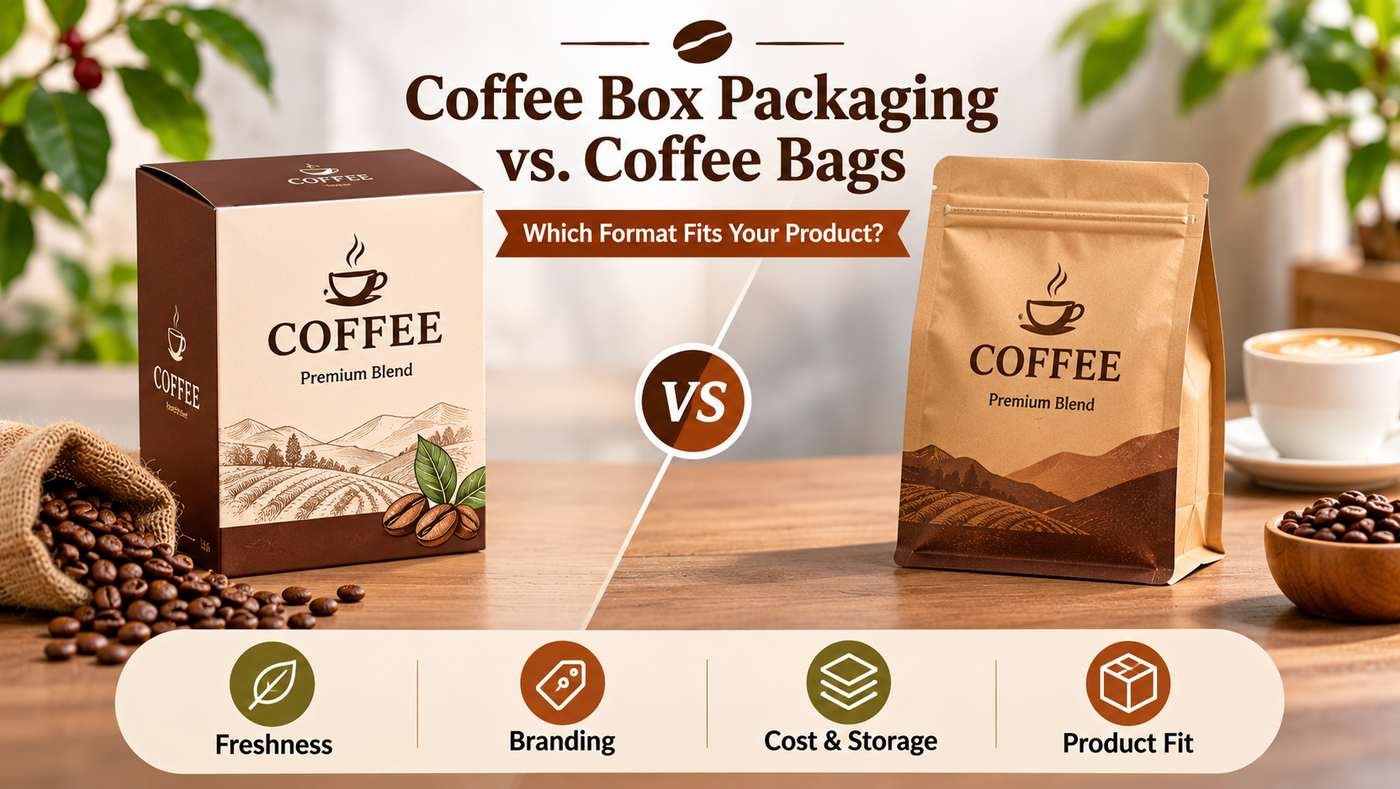
Choosing between coffee box packaging and coffee bags affects more than the appearance of your product. The format influences how coffee is protected, displayed, stored, shipped, and experienced by customers. A retail box can create a structured presentation and support gift-ready assortments, while a coffee bag is often a compact format for holding beans or ground coffee close to the point of sale. The right choice depends on your coffee type, portion size, sales channel, shelf strategy, and packaging requirements.
If you are building a retail range or refreshing your presentation, custom coffee boxes can be developed around your product format and brand identity. In some product lines, a box and an inner sealed bag work together rather than serving as competing options.
Coffee box packaging vs. coffee bags: the key differences
Coffee bags and coffee boxes are not always direct substitutes. A flexible coffee bag can be the primary container that holds the product. A paperboard box may act as the primary package for individually wrapped portions or as secondary packaging around a sealed pouch. Understanding this difference helps you compare the formats fairly.
When coffee bags are the better fit
Coffee bags are often a practical primary package when the product is sold by weight and customers open, use, and reseal the pack over time. Their flexible construction can reduce the amount of unused space around the coffee, and common bag formats can be designed with features such as resealable closures or degassing valves where appropriate to the coffee and packaging specification.
Whole-bean and ground coffee
For everyday retail coffee, a purpose-designed pouch can hold the product directly. The barrier layers, closure, and seal should be selected for the coffee, intended shelf life, and distribution conditions. Do not assume all bags provide the same protection: ask the packaging supplier for the material structure and performance information relevant to your product.
Refill formats and repeat purchases
Flexible pouches can suit refill-oriented ranges where customers already have a storage container at home. The pack should be easy to open and, if intended to be resealed, should close reliably after use. Clear labeling of roast, grind, origin, weight, and preparation details can help shoppers compare options.
Compact fulfillment
Because bags can conform more closely to their contents than rigid cartons, they may be convenient for some storage and fulfillment setups. However, flexible packaging can be more vulnerable to punctures, crushing, or scuffing depending on the material and shipping method. Test the filled pack through your actual handling and delivery process.
When coffee boxes make more sense
A box is useful when shape, structure, and presentation are important parts of the product experience. Cartons can hold multiple components together, provide a defined front-facing panel, and create a consistent format across a product range. They can also be paired with a sealed inner pouch when the coffee itself needs a dedicated freshness barrier.
Gift sets and premium collections
Gift packaging often needs room for more than one item. A box can organize a coffee pouch with a mug, tasting notes, accessories, or several smaller packs. Inserts or dividers can help position each component and keep the presentation orderly. Measure every item before finalizing the internal dimensions.
Sampler kits and variety packs
If customers are comparing roast profiles or trying different origins, a box can group several individually sealed portions into one collection. The outer carton creates a clear overview of the range, while each inner pack can carry its own product identification. Make sure the layout allows customers to remove packs without damaging the remaining presentation.
Drip coffee and single-serve formats
Boxes can be suitable for individually wrapped drip coffee bags, sachets, or other single-serve formats. The individual sachet or pouch remains responsible for its own product containment and protection. Choose a carton size that fits the number of servings and keeps the packs arranged without excessive movement.
Retail shelf consistency
Cartons keep a defined shape and can create a uniform block on shelves when dimensions are planned consistently. Their front, sides, and back provide separate spaces for brand identity, product details, brewing guidance, and required information. A well-designed carton should remain easy to handle and should not be oversized simply to create more print area.
Can you combine a coffee bag and a box?
Yes. For many products, combining formats can provide a useful balance: the inner pouch holds and protects the coffee, while the outer carton adds structure, information, and presentation. This is especially relevant for premium gift products, sampler collections, and coffee ranges where a branded box is part of the shelf experience.
When combining the two, make sure the outer box is designed around the filled inner pack—not just an empty pouch. Account for the pouch seal, gusset, valve, closure, and any changes in shape after filling. If the carton includes an insert, test the complete package to ensure that it holds the pouch without compressing seals or making removal difficult.
For product lines that need a more polished retail appearance, printed coffee boxes can carry the visual identity while a suitable inner pack handles direct coffee containment. Confirm the intended role of each layer with your packaging supplier.
Freshness and protection: what matters most?
Coffee quality can be affected by exposure to oxygen, moisture, light, heat, and handling. The packaging system should be selected for the coffee type, roast, grind, expected storage period, and distribution conditions. A printed paperboard box can shield an inner pouch from some light and handling, but it should not be treated as a substitute for a properly specified sealed barrier package.
- Barrier performance: Ask for details on the inner pack’s oxygen and moisture barrier suitability.
- Sealing: Check seal integrity and confirm that the closure is compatible with the filling process.
- Degassing: For freshly roasted whole-bean coffee, discuss whether a one-way valve is appropriate for the product and pack design.
- Light exposure: Consider whether the coffee needs an opaque inner pack or additional protection from light.
- Handling: Test filled packs for punctures, crushing, leakage, and damage during storage and transit.
Ask the coffee processor and packaging supplier to validate the package specification for your product. Shelf-life expectations should be based on suitable product and packaging testing, not on the outer appearance of a carton or pouch.
Compare branding and print opportunities
Both formats can carry a strong brand identity, but they offer different design surfaces. A coffee bag may use a front label or printed flexible film, with design limitations shaped by gussets, seals, and the way the pouch stands. A box provides flat panels that can make it easier to organize a logo, roast name, origin story, brewing instructions, and product information.
With branded coffee boxes, you can create a consistent look across roast varieties, seasonal collections, and gift assortments. Keep the most important information visible on the primary display panel and avoid placing critical text across folds or glued seams. Request a print proof to review color, readability, and panel alignment.
Finishes such as matte or gloss coating, foil details, embossing, or spot effects can help establish a particular visual style. Choose them according to the brand and budget, and make sure they do not interfere with required product information or the practical opening of the box.
Cost, storage, and shipping considerations
There is no universal rule that boxes or bags will always cost less. Compare the complete pack specification: material, size, print method, closures, valves, inserts, assembly, filling process, storage footprint, order quantity, and shipping configuration. A low unit price may not represent the best overall value if the format adds labor, requires extra protection, or creates unused space.
When sourcing wholesale coffee boxes, request a quotation based on exact dimensions, board or material specification, print coverage, finishing, quantity, and packing requirements. If the box is intended to hold an inner pouch, provide a filled sample or accurate pouch dimensions so the fit can be checked before production.
For shipping, consider the full journey from packing line to customer. A retail box may need a separate corrugated shipping carton and cushioning, while a bag may need protection against punctures and compression. Conduct practical transit tests with the actual filled product and shipping configuration.
Which format fits your coffee product?
A checklist before choosing your coffee packaging
- Will the package hold whole beans, ground coffee, sachets, or a gift assortment?
- Is the box or bag the primary product container, or will the two be used together?
- What barrier, sealing, valve, and closure features does the coffee require?
- How much product will each pack contain, and what are the filled dimensions?
- Does the format suit your filling equipment and packing workflow?
- Will the product be sold online, on retail shelves, as a gift, or through more than one channel?
- Have you checked artwork, labeling space, opening, storage, and shipping protection?
- Have you tested a filled sample under realistic storage and handling conditions?
Frequently asked questions
Are coffee boxes better than coffee bags?
Neither format is automatically better. Bags are often practical for directly holding beans or ground coffee, while boxes are useful for structured presentation, sampler kits, and gift sets. Some products use both, with a sealed pouch inside a printed carton.
Do coffee boxes keep coffee fresh?
A paperboard carton by itself is not generally a substitute for a sealed barrier package. It can provide structure and some external protection, but freshness depends on the inner package, seal, material barrier, and storage conditions.
Can I put a coffee bag inside a custom box?
Yes. A box can be sized to hold a filled coffee pouch or several smaller packs. Measure the filled pouch, including its gusset and closure, and test the complete package before production.
Which packaging is suitable for coffee gift sets?
A box with a suitable insert can organize coffee pouches, sample packs, mugs, or accessories. Choose the structure after measuring every item and checking the combined weight and presentation.
Are coffee bags suitable for ground coffee?
They can be, provided the bag material, seal, and closure are specified for the coffee and its expected storage conditions. Ask your supplier about the barrier properties and test the filled pack.
What should I compare when ordering coffee boxes wholesale?
Compare dimensions, board specification, print coverage, finishing, inserts, order quantity, assembly, packing, and delivery requirements. If the carton holds an inner pouch, provide its filled dimensions for a fit check.
Can custom coffee boxes be printed with my brand design?
Custom cartons can be planned around your logo, colors, product range, and information layout. Review a print proof and a physical sample before approving the production run.
Build a coffee box around your product
Whether you need a carton for sampler packs, drip coffee, or a pouch-based gift set, choose a structure that supports the product and gives your brand a clear presentation. Explore custom coffee boxes and plan your packaging around your product dimensions and retail goals.