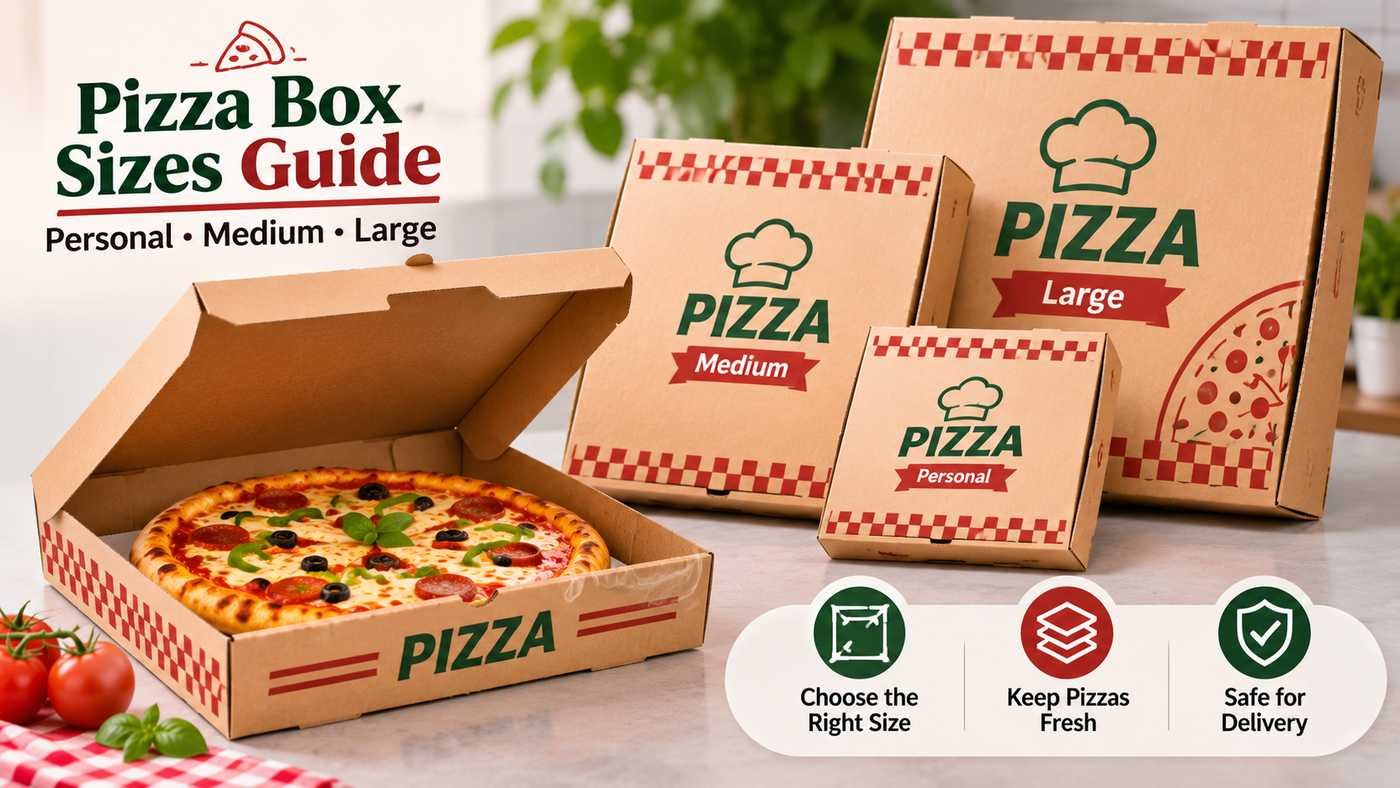
Choosing the right pizza box size helps protect the crust, keep toppings in place, and present each order neatly from the oven to the customer. This pizza box sizes guide explains what to consider when packaging personal, medium, and large pizzas, including internal dimensions, box depth, board strength, and delivery handling.
If you are already comparing packaging options, explore custom pizza boxes for packaging that can be planned around your pizza sizes and brand. You can also compare printed pizza boxes, wholesale pizza boxes, and branded pizza boxes when planning your packaging order.
For pizzerias sourcing custom pizza boxes in the USA, the most useful starting point is to measure the finished pizza and confirm the usable internal dimensions of the box—not just its advertised size.
Match the box’s internal length and width to the pizza diameter, allow practical clearance for loading and removal, and choose a depth that suits the crust and toppings. Test the complete box with a freshly prepared pizza before placing a bulk order.
Why pizza box size matters
A pizza box that is too tight can catch the crust or toppings when the pizza is placed inside or removed. An oversized box can allow the pizza to slide during carrying and delivery. The right fit helps balance product protection, presentation, and practical handling.
- Crust protection: Adequate clearance helps prevent the edges from rubbing against the box walls.
- Topping protection: A suitable fit reduces unnecessary movement that can disturb toppings.
- Stacking: The box should maintain its shape when handled with other orders, within the limits of its construction.
- Heat and moisture: Box design and ventilation influence how steam is managed during holding and delivery.
- Storage: Consistent sizes can simplify inventory and make flat-packed boxes easier to organize.
- Brand presentation: A correctly sized box gives the pizza a neat presentation when the customer opens it.
Pizza box sizes for personal, medium, and large pizzas
Pizza sizing conventions vary between restaurants and markets. The labels personal, medium, and large are not universal measurements. Use your actual pizza diameter and compare it with the supplier’s stated internal box dimensions. The table below is a general planning reference, not a fixed industry standard.
*These ranges are illustrative only. Your menu’s size definitions and supplier’s actual internal dimensions should determine the final box selection.
Personal pizza boxes: Compact packaging for individual orders
Personal pizzas are often ordered as individual meals, lunch portions, or single-serving menu options. A compact box can be convenient for counter service and delivery, but the pizza should not be squeezed into the carton.
When choosing a personal pizza box, check:
- The internal base dimensions accommodate the widest part of the baked pizza.
- The crust does not catch on the walls when the pizza is loaded.
- The lid closes without touching raised toppings or cheese.
- The base remains stable when staff lift the packed order.
- The box is practical to store and assemble during busy service periods.
If your personal pizzas include deep crusts, stuffed edges, or generous toppings, check box height and internal clearance as well as diameter.
Medium pizza boxes: Everyday takeaway and delivery
Medium pizzas are common in family meals, shared lunches, and smaller group orders. The box should provide enough room around the pizza while maintaining a practical footprint for storage, carrying, and delivery.
Check that the pizza sits centrally and does not shift excessively when the box is moved. Consider the stiffness of the base and lid, particularly if staff stack multiple orders for a short period. If your menu includes several medium pizza styles, test the largest or tallest version that will use the same carton.
Large pizza boxes: More space and stronger support
Large pizza boxes have a wider footprint and may require more attention to board strength, base support, and handling. The box should stay reasonably rigid when a large pizza is loaded and carried.
- Check the base for flex when the box is lifted from its normal carrying position.
- Make sure the lid does not sag onto toppings or cheese.
- Confirm that the box can be stacked as intended without excessive compression.
- Check whether the carton fits your delivery bags, shelves, and storage area.
- Test the fully loaded box over a representative delivery route.
For extra-large or specialty pizzas, do not assume a standard large box will fit. Measure the finished product and request a sample in the required dimensions.
How to measure a pizza for the right box
Measuring the actual pizza is more reliable than selecting a carton based only on a menu label. Use a representative pizza prepared using your normal recipe and baking process.
- Measure the diameter: Measure across the widest point of the finished pizza, including the outer crust.
- Check shape consistency: If pizzas are handmade, measure several from a normal batch to understand size variation.
- Review toppings and crust: Note raised edges, stuffed crusts, or toppings that may need additional clearance.
- Confirm internal dimensions: Ask for the usable inside length and width of the box, not only the outside dimensions.
- Check depth: Measure the tallest part of the pizza and ensure the lid has suitable clearance.
- Test loading and removal: Confirm staff can place and remove the pizza without catching the crust on the walls.
- Test carrying: Move the closed box as it would be handled during pickup or delivery and check for shifting.
Do not add an arbitrary amount of extra space without testing. Too little clearance can damage the pizza, while too much may allow it to slide. A physical sample helps establish a practical fit.
Choose the right pizza box depth
Diameter is only one part of box sizing. The depth should suit the crust profile, toppings, and any menu items that may be packed in the same style of box.
Thin-crust pizzas
Thin-crust pizzas may fit in a shallower design, provided the box remains rigid and the lid does not contact the toppings. Check the finished pizza rather than relying on the dough style alone.
Thick-crust and pan pizzas
Thicker crusts need more vertical clearance. Confirm the height of the finished crust and toppings, and make sure the lid closes without compressing the product.
Specialty pizzas
Stuffed crusts, piled toppings, and specialty finishes can change the required internal space. Test the tallest or widest version that will be packed in the box.
Pizza box materials and construction
Pizza boxes are commonly made from corrugated paperboard or other paper-based constructions designed for food packaging. The material grade, flute structure, board weight, coatings, and box design all affect performance. Ask suppliers for the specifications of the exact finished box.
- Rigidity: The base and lid should resist unwanted bending during normal handling.
- Food-contact suitability: Confirm that materials, coatings, inks, and adhesives are appropriate for the intended use.
- Grease management: Consider how the box performs with the oil and moisture associated with your menu.
- Ventilation: Openings and design features may influence steam release; test the finished box with your pizza.
- Assembly: Choose a style staff can fold and close consistently.
- Storage: Consider flat-packed dimensions and the space available in your kitchen.
Do not assume every paper-based box is greaseproof, recyclable, compostable, or suitable for every food-contact condition. Request relevant documentation and check local disposal requirements before making material claims.
How ventilation affects pizza box performance
Freshly baked pizza releases heat and steam. A box design may include ventilation features to help manage moisture, but the right balance depends on the pizza, holding time, and delivery conditions.
Too much trapped steam can affect crust texture, while excessive ventilation may allow the pizza to cool more quickly. Evaluate the complete packaging design with your actual product and typical delivery interval. Compare the crust condition, temperature, condensation, and box strength after realistic handling.
Custom pizza boxes for restaurant branding
Custom pizza boxes can be planned around your menu sizes, box construction, and restaurant identity. If you offer personal, medium, and large pizzas, decide whether one design can serve multiple sizes or whether each size needs its own carton dimensions.
Printed pizza boxes can display your logo, brand colors, promotional artwork, and customer information. Check the artwork on the supplier’s dieline and review a printed sample to make sure important elements remain clear after folding.
When comparing wholesale pizza boxes, review the internal dimensions, board specifications, printing, minimum order quantity, sample availability, lead time, and shipping costs. Branded pizza boxes should be tested as finished cartons with the actual pizza, not approved only from a flat artwork proof.
Restaurants sourcing custom pizza boxes in the USA should share their menu size definitions and confirm food-contact suitability for the specified materials and components. Request samples before authorizing a larger production run.
Pizza box sample checklist
- Does the internal base fit the finished pizza diameter?
- Is there enough room for the crust without excessive movement?
- Does the lid clear the tallest toppings?
- Does the base remain stable when loaded and carried?
- Does the box perform as expected with grease and moisture?
- Is the ventilation suitable for your pizza and delivery time?
- Can staff assemble and close the box efficiently?
- Does the printed artwork look clear on the assembled carton?
- Are the materials and components appropriate for the intended food use?
- Does the box fit your delivery bags and storage setup?
Frequently asked questions
What size pizza box do I need for a personal pizza?
Measure the finished pizza across its widest point and compare it with the box’s internal base dimensions. Check crust clearance, lid height, and whether the pizza can be loaded and removed easily.
What size box is used for a medium pizza?
Medium pizza dimensions vary by restaurant. Use your menu’s actual pizza diameter and confirm the supplier’s internal box dimensions rather than relying only on the word “medium.”
How do I choose a box for a large pizza?
Measure the finished pizza, check the internal base dimensions, and evaluate the carton base and lid for rigidity. Test the loaded box during carrying and delivery.
Should a pizza box be larger than the pizza?
It needs enough clearance for loading and removal without allowing excessive movement. The ideal fit depends on the crust, pizza shape, box construction, and handling conditions, so test a sample.
Does pizza box depth matter?
Yes. The depth should provide clearance for the crust and toppings without letting the lid press against the pizza. Consider specialty and thick-crust styles separately.
Are all pizza boxes greaseproof?
No. Grease performance depends on the material, construction, and any barrier treatment. Ask the supplier for the relevant specifications and test the finished box with your menu.
Should I test pizza boxes before ordering wholesale?
Yes. Test a sample with a freshly prepared pizza. Check fit, lid clearance, strength, grease and moisture performance, ventilation, handling, and printed presentation before ordering in bulk.
Find the right box for your pizza menu
Plan pizza packaging around your personal, medium, and large sizes, crust styles, delivery needs, and brand identity. Explore custom options and request a sample to check the fit with your actual pizzas.