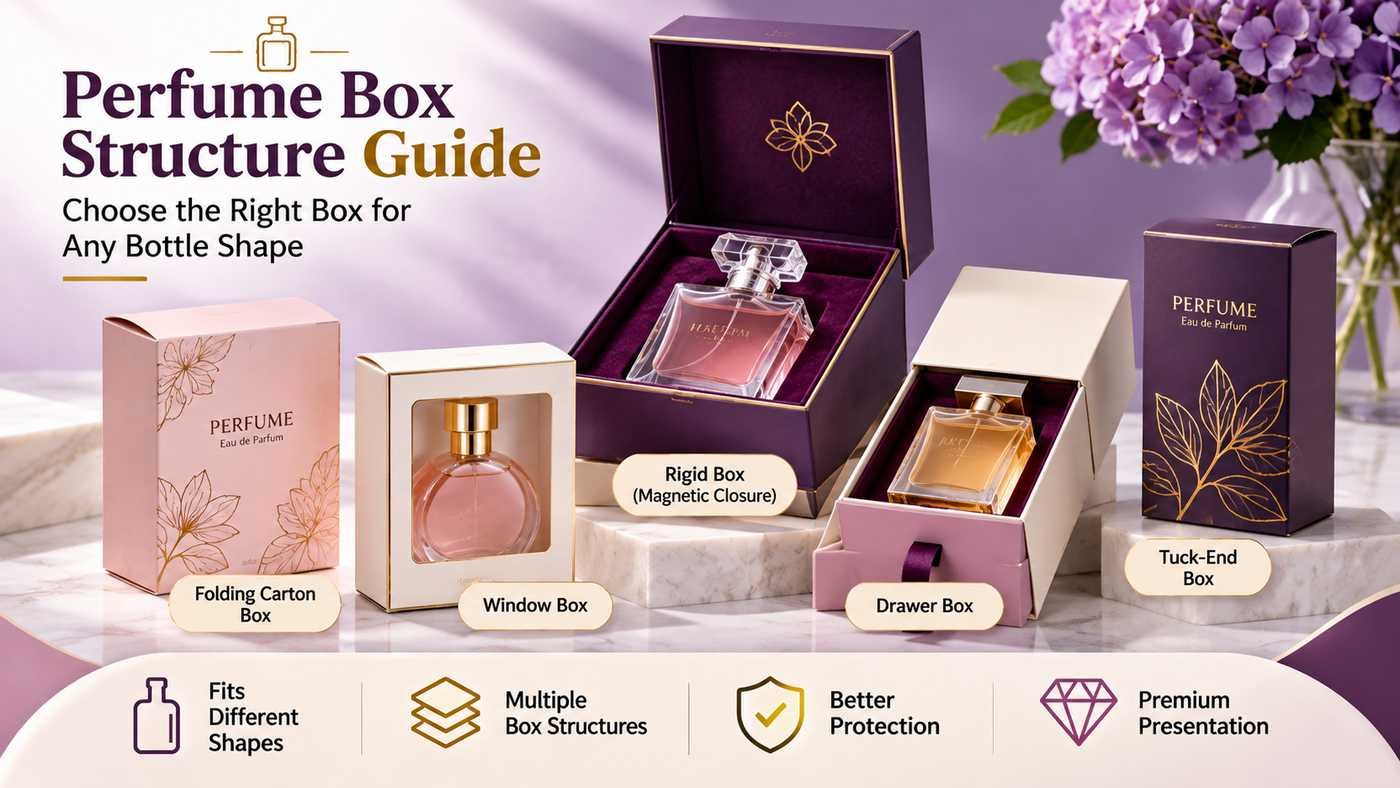
Perfume bottles come in many forms, from slim rectangular flacons and rounded glass bottles to tall cylindrical designs and unusually shaped statement pieces. The right perfume box structure should accommodate the bottle securely, present it attractively, and make the unboxing experience feel consistent with the fragrance brand. Before choosing a style, consider the bottle’s dimensions, weight, cap, outer finish, and how the product will be stored, displayed, or shipped.
If you are developing retail packaging, explore custom perfume boxes designed around your bottle and brand. The structure is only one part of the decision: printed artwork, protective inserts, and finishing details should work together rather than compete for attention.
Why perfume bottle shape matters when choosing a box
A box that looks right on screen may not fit the product correctly. Bottle shoulders, curved sides, thick bases, oversized caps, and decorative collars all affect the space required inside the package. A bottle can fit by height and width but still be difficult to remove, or it may move around during handling if the insert does not support it properly.
Start by measuring the complete bottle, including its cap and any raised decorative details. Then consider the bottle’s widest point, base footprint, and center of gravity. Heavier glass bottles may need a stronger board grade and more supportive insert than a small, lightweight fragrance bottle.
Common perfume box structures and when to use them
There is no single structure that suits every fragrance line. The following options cover common packaging approaches; the best choice depends on product weight, budget, retail positioning, and distribution requirements.
Match the structure to different bottle shapes
1. Rectangular and square perfume bottles
Flat-sided bottles are generally straightforward to measure, but thick glass bases and broad shoulders still need clearance. A folding carton with a correctly sized inner support can be a practical retail option. For premium lines, a rigid box with a shaped platform can frame the bottle and create a more substantial presentation. Avoid sizing the cavity exactly to the glass: allow suitable clearance for the insert and easy placement.
2. Round and cylindrical bottles
Round bottles can rotate inside a rectangular cavity if the insert does not locate them securely. Consider a circular or contoured insert opening, with support around the lower body. A rigid presentation box can work well for heavier cylindrical bottles, while a carton can suit lighter formats when its insert is designed and tested for the bottle’s diameter.
3. Tall, slim bottles
Tall bottles need attention to stability as well as height. A narrow base can make a package more prone to tipping if the insert does not hold the bottle upright. Measure the full height with the cap attached, and check the internal depth so the closure does not press against the top panel. A close-fitting insert with a stable base is especially important for this shape.
4. Curved, oval, or sculptural bottles
Unusual silhouettes often require a custom-shaped insert rather than a standard rectangular cavity. Map the widest points and curves, then create a sample insert that supports the bottle without putting pressure on delicate glass features. The outer box can remain a familiar rectangular format while the internal fit is tailored to the product.
5. Heavy bottles with oversized caps
For substantial glass bottles or decorative caps, evaluate the full package as a system. The base, side walls, closure, and insert all contribute to the finished feel and protection. A rigid structure may be appropriate for a premium presentation, but the board, insert material, and assembly should be selected after checking the actual packed weight and handling conditions.
How to measure a perfume bottle before ordering
Accurate measurements reduce the risk of a box that is too tight, too loose, or awkward to assemble. Record dimensions in the same unit and use the actual production bottle whenever possible.
- Measure total height: Include the cap, spray top, collar, and any raised details.
- Measure maximum width: Check the widest point, which may be above the bottle’s center.
- Measure depth or diameter: For round bottles, record the maximum diameter; for flat bottles, measure front-to-back depth.
- Check the base: Note its footprint, thickness, and whether it is flat or curved.
- Record the packed weight: Include the filled bottle and cap, not just the empty glass.
- Test insertion and removal: Confirm that the bottle can be placed in and lifted out without catching or excessive force.
Do not simply add a fixed amount to every dimension. The required clearance depends on the insert material, box construction, and how the bottle is held. Ask for a dieline or structural sample based on your measured product.
Choosing the right insert for a secure fit
The insert connects the bottle to the outer structure. It can help keep the product centered, reduce movement, and improve the way the bottle is revealed when the box is opened. Common approaches include paperboard supports, shaped card platforms, and foam-style inserts. The appropriate option depends on the bottle’s weight, shape, presentation goals, and material requirements.
- Paperboard insert: Can coordinate with a folding carton and support lighter bottles when properly engineered.
- Die-cut card support: Useful for locating a bottle in a defined position and creating a neat presentation.
- Foam-style insert: Can be shaped around unusual contours, but confirm material suitability and the desired brand experience.
- Multi-bottle tray: For sets, keep each bottle separated and check that caps and shoulders do not collide.
For any insert, check whether it touches the glass, label, cap, or decorative finish. The contact points should hold the bottle securely without scratching or applying concentrated pressure.
Printed design and finishing should support the structure
Once the structure and insert are selected, plan the artwork around the available panels. The front panel usually carries the fragrance name and core brand identity, while side or back panels can hold product details and required information. Keep important text away from folds, seams, and areas covered by the lid or insert.
For a cohesive retail presentation, printed perfume boxes can coordinate colors, typography, and brand graphics with the bottle itself. If the fragrance is positioned as a premium gift, consider whether a tactile finish or a layered rigid construction adds value without making the package unnecessarily complicated.
Finishes such as matte or gloss coating, foil details, embossing, or spot effects should be chosen to complement the design and production budget. Request a print proof and inspect small text, color consistency, and alignment before approving a full run.
Consider retail, gifting, and shipping needs
A box designed mainly for a retail shelf may not be sufficient as a shipping package. Retail packaging prioritizes shelf presentation, product information, and a good unboxing experience. Shipping adds further requirements: the perfume box may need an outer shipping carton and suitable cushioning to limit impact and movement during transit.
If your business orders larger quantities, compare wholesale perfume boxes by reviewing the complete specification—not only the unit price. Ask suppliers to clarify material, dimensions, insert construction, print coverage, finishing, minimum order quantity, and sample availability. For a consistent brand experience across stores and online orders, branded perfume boxes should be checked against the same approved sample and artwork version.
Brands selling across the American market can also evaluate custom perfume boxes in the USA as part of their packaging sourcing plans. Confirm applicable product-labeling, transport, and material requirements for your particular fragrance and sales channel with the relevant specialists; packaging dimensions alone do not establish regulatory compliance.
A practical checklist before production
- Have you measured the actual filled bottle, cap, and decorative details?
- Does the chosen structure suit the bottle’s weight and retail positioning?
- Does the insert support the bottle without scratching or squeezing it?
- Can the product be inserted and removed comfortably?
- Are the artwork, folds, seams, and opening direction correctly aligned?
- Has a physical sample been tested with the actual bottle?
- Have you checked the packed box for movement and damage risks during handling?
- Are material, print, finish, quantity, and delivery specifications confirmed in writing?
Frequently asked questions
What is the best box structure for perfume bottles?
There is no universal best structure. Folding cartons can suit many standard retail bottles, while rigid boxes are often selected for premium presentation and gift sets. The bottle’s weight, dimensions, insert, budget, and distribution method should guide the choice.
Do round perfume bottles need a special insert?
They often benefit from a shaped or contoured insert that limits rotation and keeps the bottle centered. The final design should be tested with the actual bottle to confirm a secure fit without pressure on the glass.
How much space should be left around a perfume bottle?
The clearance depends on the box structure and insert material. Rather than using one standard allowance, create a sample using the measured bottle and check placement, removal, and movement.
Are rigid perfume boxes better than folding cartons?
They serve different purposes. Rigid boxes provide a more substantial presentation, while folding cartons can be practical for many retail applications. Compare the total packaging specification, including insert, weight, storage, and shipping needs.
Can one perfume box fit different bottle shapes?
A shared outer box may be possible for bottles with similar dimensions, but each shape may need a different insert. Test every bottle variation rather than assuming one cavity will hold all formats securely.
Should perfume packaging be tested before bulk ordering?
Yes. A physical sample helps verify dimensions, insert fit, opening and closing, print quality, and handling. Approve the sample using the actual bottle and final artwork before proceeding with a production run.
Create a perfume box around your bottle
The right perfume packaging starts with the product itself. Choose a structure that fits the bottle, supports it with a suitable insert, and gives your brand a clear, consistent presentation. Explore custom perfume boxes and plan your packaging around your bottle dimensions and brand requirements.