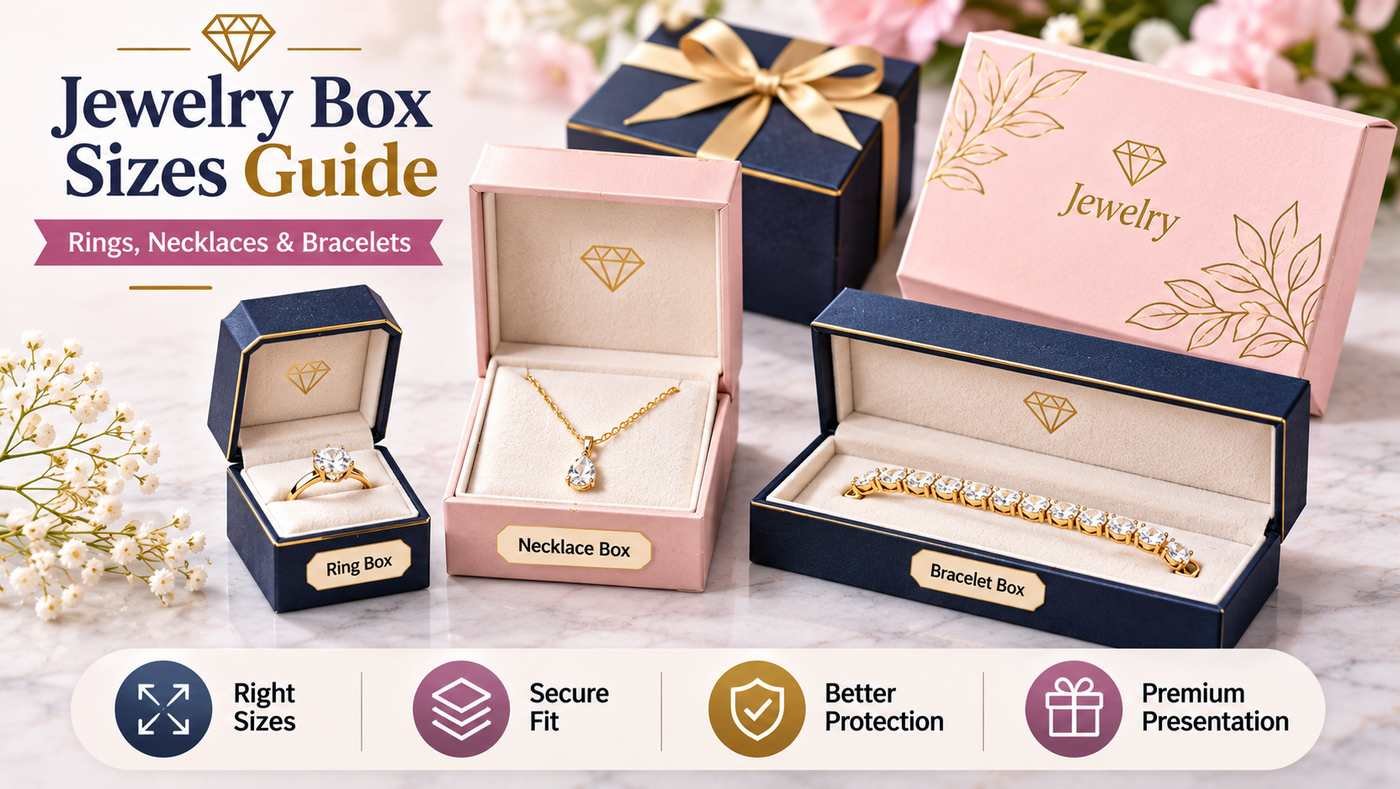
Choosing the right jewelry box size helps protect delicate pieces, keeps each item neatly presented, and creates a more considered unboxing experience. Rings, necklaces, and bracelets have different shapes and storage needs, so one standard box rarely works equally well for every product. The ideal size should accommodate the jewelry and its insert, keep the piece in place, and leave enough room for customers to remove it comfortably.
If you are planning packaging for a jewelry collection, custom jewelry boxes can be designed around your pieces, presentation style, and brand identity. Begin with the dimensions of the actual jewelry, then select an insert and outer structure that work together.
Why jewelry box size matters
Jewelry is often delicate, small, and highly visual. A box that is too loose may let a piece shift during handling, while a box that is too tight can make it difficult to position or remove the item. Incorrect proportions can also affect how the jewelry looks when the customer opens the package.
Size affects more than protection. It influences storage, shipping dimensions, insert design, material use, and the amount of space available for branding. A well-planned box should feel proportionate to the jewelry rather than oversized or cramped.
How to measure jewelry before choosing a box
Measure the finished piece in the form in which it will be packed. Include components that are easy to overlook, such as clasps, extender chains, pendant drops, earring backs, and decorative settings.
- Measure the full length: Include the complete chain, bracelet, or drop length where relevant.
- Measure the widest point: Check the largest setting, pendant, charm, clasp, or decorative feature.
- Measure the height: Include raised stones, settings, and any part that sits above the base.
- Consider the jewelry layout: Decide whether the item will lie flat, hang from a support, or sit in a shaped insert.
- Account for the insert: Measure the insert and its cutouts as part of the internal packaging design.
- Test removal: Make sure customers can lift the jewelry out without pulling, bending, or tangling it.
For necklaces and chains, also decide how the chain will be secured. A box may have enough overall space but still allow a loose chain to knot if it is not held in place. For handmade or one-of-a-kind pieces, measure several examples if dimensions vary.
Jewelry box sizes for rings
Rings are compact, but their settings can vary significantly. A slim band, a wide statement ring, and a ring with a raised stone do not occupy the same space. The insert is particularly important because it keeps the ring upright and visible when the box is opened.
Single ring boxes
A single ring box usually uses a small cavity with a slit or cushioned slot to hold the band. Check that the ring sits securely without forcing the band into the insert. Tall settings need enough clearance between the insert and lid so the stone or setting does not press against the top.
Ring pairs and sets
For wedding bands, matching rings, or small sets, plan separate slots or a shaped insert that keeps pieces from rubbing against one another. Measure the combined layout, not just the dimensions of one ring. Make sure the arrangement remains balanced when the box is opened.
Statement and oversized rings
Large stones, wide bands, and sculptural designs may need a wider or deeper insert opening. Use the maximum dimensions of the ring setting to determine the cavity, and test the lid clearance with the actual piece in place.
Jewelry box sizes for necklaces
Necklace packaging needs to accommodate both the pendant and the chain. A pendant may need a visible central position, while the chain needs a way to stay organized and avoid tangling. The right layout depends on whether the necklace is short, long, delicate, layered, or designed with a large pendant.
Fine chains and minimalist necklaces
Fine chains can move easily inside a box. Consider an insert with small securing points or slots to hold the chain ends, along with a central area for the pendant. The box should provide enough width for the chain to lie neatly without being sharply folded.
Pendant necklaces
Measure the pendant’s width and height, including raised settings or decorative edges. The insert should position the pendant where it can be seen when opened and prevent it from sliding into the chain area. Check that the pendant does not press against the lid.
Long or layered necklaces
Long chains may need a larger internal layout or a method for securing excess chain behind the display area. For layered pieces, test the complete necklace arrangement to ensure chains do not overlap awkwardly or become tangled during removal.
Jewelry box sizes for bracelets
Bracelets vary from slim chains to rigid bangles and wide cuffs. A bracelet box should match the shape of the item and the way it will be displayed. A soft cushion may suit some chain bracelets, while a flat or contoured insert may be better for rigid pieces.
Chain and charm bracelets
Allow enough length for the bracelet to sit around a small cushion or lie in a shaped channel without being stretched. If the bracelet has dangling charms, check that they have room to rest without catching on the insert or lid.
Bangles and rigid bracelets
Measure the outer diameter or widest span of the bangle, as well as its height. The cavity must accommodate the full shape and allow the piece to be lifted out. For multiple bangles, consider separators to prevent pieces from knocking against one another.
Cuffs and wide statement bracelets
Wide cuffs may need a larger footprint and a deeper insert. Consider the opening or gap in the cuff when planning how it will sit in the box. A sample helps confirm that the bracelet can be placed and removed without catching.
Quick comparison: box sizing by jewelry type
These are layout guidelines, not universal standard dimensions. Exact box measurements depend on the jewelry design, insert construction, and chosen outer structure.
Choose the right insert for a secure presentation
The insert is what positions the jewelry inside the box. It can help prevent movement, support the piece, and make the product easier to see when the lid is opened. The best insert depends on the shape, weight, finish, and display requirements of the jewelry.
- Foam or cushioned inserts: Can provide a soft, shaped support for rings and selected small pieces. Confirm the surface is suitable for the jewelry finish.
- Velvet or fabric-covered inserts: Create a soft presentation and can be designed with slots or shaped cavities.
- Paperboard inserts: Can be formed into supports or compartments and coordinated with the outer packaging.
- Custom die-cut supports: Useful when the piece has a distinctive shape or needs a specific position.
Do not assume that a soft insert is automatically suitable for every metal, plating, stone, or finish. Check material compatibility and test for lint, abrasion, discoloration, and contact marks where relevant.
Match the box structure to your jewelry range
Jewelry boxes are available in different constructions, including folding cartons, rigid setup boxes, drawer boxes, and lid-and-base styles. A folding carton may suit lightweight retail packaging, while a rigid box can create a more substantial gift presentation. The correct choice depends on the product, brand positioning, order quantity, and how the jewelry will be stored or delivered.
For a premium unboxing experience, a rigid structure with a fitted insert can help present the piece neatly. For a coordinated collection, you may use a consistent outer style and adjust the insert dimensions for each jewelry type. This can create a recognizable packaging family without forcing every product into the same internal layout.
When planning printed jewelry boxes, allow for folds, seams, and closure panels in the artwork. Keep logos and important text away from crease lines, and review a print proof before production.
Branding and finishing for jewelry boxes
Jewelry packaging often communicates the brand before the customer sees the item. A clear logo, balanced typography, and a restrained color palette can make the box feel consistent with the jewelry collection. Use the front or lid for the main brand identity and reserve other panels for supporting details when needed.
Finishes such as matte or gloss coating, foil stamping, embossing, and debossing can add texture or emphasis. Choose finishes that suit the brand and production budget, and confirm how they will appear on the selected board or wrap material. For a consistent product range, branded jewelry boxes should follow an approved design and packaging specification.
Ordering jewelry boxes wholesale
Before requesting a bulk quote, prepare measurements for every jewelry style and identify which products can share an outer box size with different inserts. This makes it easier to compare specifications and avoid ordering one box size that does not fit the full range.
When sourcing wholesale jewelry boxes, confirm the internal and external dimensions, board or wrap material, insert type, print coverage, finish, minimum order quantity, assembly, and delivery terms. Ask for a physical sample with the actual jewelry or a dimensionally accurate mock-up before approving production.
Jewelry businesses serving customers across the American market may also consider custom jewelry boxes in the USA as part of their packaging plans. Check any product information, labeling, and material requirements relevant to your particular products and sales channels with the appropriate specialists.
A practical jewelry box sizing checklist
- Measure the actual jewelry, including clasps, settings, pendants, and charms.
- Choose whether the piece will lie flat, hang, or sit on a cushion.
- Allow enough internal room for the insert and comfortable removal.
- Check lid clearance for raised stones and tall settings.
- Prevent chains and multiple pieces from tangling or rubbing together.
- Confirm insert materials are suitable for the jewelry finish.
- Review print placement around folds, seams, and closures.
- Test a physical sample before approving a bulk order.
Frequently asked questions
What size jewelry box do I need for a ring?
Choose a box based on the ring’s band, setting, and overall height. The insert should hold the ring securely while leaving clearance for raised stones and allowing the customer to remove it comfortably.
How do I choose a box size for a necklace?
Measure the full necklace and pendant, then plan how the chain will be secured. The box and insert should keep the pendant visible and reduce the chance of the chain tangling during handling.
What type of box is suitable for bracelets?
It depends on the bracelet. Chain bracelets may sit on a cushion or in a channel, while bangles and cuffs need a cavity that accommodates their outer shape and allows easy removal.
Can one jewelry box size fit rings, necklaces, and bracelets?
A shared outer box may work for pieces with compatible dimensions, but different inserts are often needed. Test each jewelry type with its intended insert rather than assuming one internal layout will suit every piece.
Why is the insert important in a jewelry box?
The insert positions the jewelry, limits movement, and improves presentation. Its shape and material should suit the jewelry’s dimensions, finish, and method of display.
Should I order a sample before buying jewelry boxes in bulk?
Yes. A sample lets you check the actual fit, insert, lid clearance, opening experience, print quality, and handling before committing to a larger order.
Can custom jewelry boxes include my brand logo?
Yes. Custom packaging can be planned around your logo, brand colors, and artwork. Review a print proof and physical sample to check placement, finish, and overall presentation.
Find the right box for every jewelry piece
From ring slots to necklace displays and bracelet cushions, the right size starts with accurate measurements and a tested insert. Explore custom jewelry boxes and plan packaging that reflects your collection and brand.