Great burger packaging has to do more than look attractive. It needs to protect the burger, stay practical during takeaway and delivery, and make your restaurant recognizable when a customer opens the order. Learning how to design burger packaging means balancing structure, material, dimensions, ventilation, usability, and visual identity in one package.
A design that works on a screen may not work in a busy kitchen or delivery bag. The best approach is to start with the food and the customer journey, then build the graphics around a tested box structure.
Start with burger dimensions and delivery conditions. Select a food-suitable material and practical structure, test the assembled box with your menu, and then finalize the logo, colors, typography, and printed details.
1. Start with the burger and its journey
Before choosing colors or artwork, identify what the packaging must hold and how it will be used. A slider, a classic single-patty burger, and a tall gourmet burger do not necessarily need the same box design.
- Measure the assembled burger: Record its length, width, and height, including toppings and any items that extend beyond the bun.
- Consider the recipe: Note whether the burger contains oily patties, melted cheese, wet vegetables, or generous sauces.
- Define the service type: Dine-in takeaway, pickup, delivery, catering, and multi-item orders may have different handling requirements.
- Estimate travel conditions: Consider typical delivery time, stacking, carrying, and the other hot items packed alongside the burger.
- Identify customer needs: Think about easy opening, secure closure, convenient handling, and clear product presentation.
These details form the packaging brief. They also help a supplier recommend a suitable material and structure rather than choosing a box based on appearance alone.
2. Choose a box structure that protects the burger
The structure determines how the burger sits inside the package, how the lid closes, and how the box behaves during handling. It should be easy for staff to assemble and practical for customers to open.
Check internal dimensions
Measure the usable inside space, not just the outside of the box. Allow enough room for the burger without compressing the bun or toppings. A box that is much too large can allow the burger to slide, while one that is too tight can damage its shape.
For additional sizing guidance, read how to choose burger box sizes for different burger styles.
Review the lid and closure
The lid should close securely and stay in place during normal handling. Check that it does not press down on taller burgers or shift when boxes are stacked. A tuck-in tab or other closure should be easy for kitchen staff to use consistently.
Consider ventilation
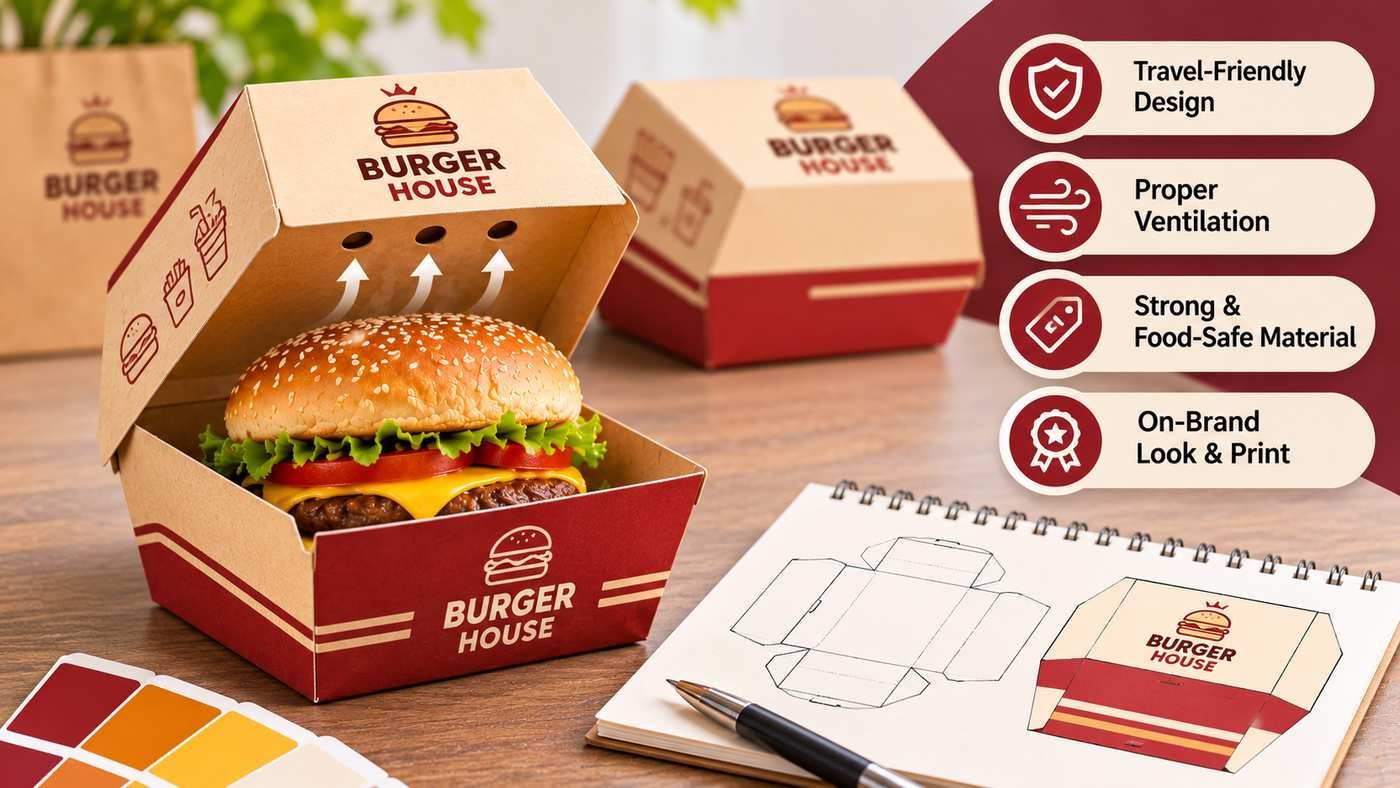
Hot burgers release steam. Depending on the recipe and delivery conditions, a carefully tested ventilation pattern may help manage moisture inside the package. However, more openings are not automatically better: excessive ventilation can allow heat to escape. Test the complete box with the actual food and expected travel time.
Plan for practical assembly
Packaging should fit the pace of your kitchen. Consider whether boxes arrive flat, how quickly staff can fold them, whether the base stays open during filling, and how easily packed orders can be stacked and carried.
3. Select a suitable packaging material
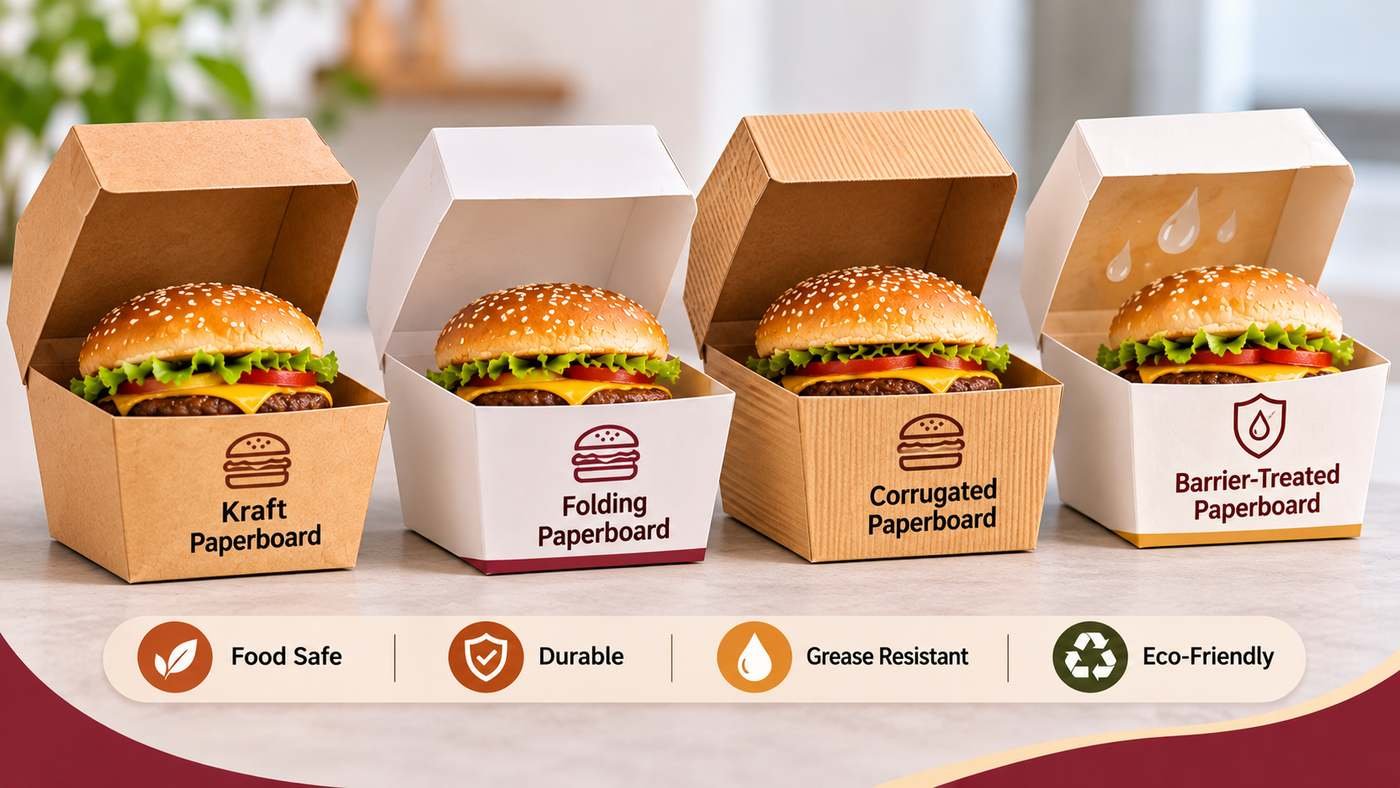
Material affects stiffness, surface appearance, grease and moisture performance, printing, and handling. Common paper-based options include kraft paperboard, folding paperboard, corrugated constructions, and barrier-treated paperboard. Each has different specifications, so do not rely on the material name alone.
Confirm that the exact material, coatings, adhesives, and printing components are suitable for the intended food-contact application. Ask the supplier for specifications and supporting documentation. For a deeper comparison, see burger box materials for food businesses.
4. Design the graphics around your brand
Once the structure and material are established, create a visual system that customers can recognize. Good packaging graphics communicate the restaurant’s identity clearly without making the box look crowded.
Make your logo easy to recognize
Place the logo where it can be seen when the box is closed and when it is held or photographed. Keep adequate clear space around it, and make sure it remains legible at the actual printed size.
Use a consistent color palette
Choose a small set of brand colors and use them consistently across boxes, bags, napkins, and other customer-facing materials. Consider how the colors will reproduce on the selected board. Natural kraft surfaces can change the appearance of printed colors compared with a white surface.
Choose readable typography
Use typefaces that match your brand personality but remain easy to read. Avoid very small text for essential information. Check contrast between text and background, particularly on uncoated or textured paper surfaces.
Keep the layout uncluttered
Give the logo and key brand elements room to breathe. A simple pattern, short brand message, or small illustration can add personality without competing with the main identity. Make sure important artwork does not fall across folds, tabs, or cut lines.
5. Make the packaging useful for customers
Visual design attracts attention, but practical details shape the customer’s experience. Review the package from the customer’s point of view.
- Easy opening: Customers should understand where and how to open the box without tearing it apart.
- Secure transport: The closure should help keep the burger contained during ordinary carrying and delivery.
- Clean handling: Consider where customers will hold the box and whether grease or sauce could transfer to their hands.
- Clear identification: If your menu includes different burger types, consider a practical way to identify each one, such as a printed label area or approved product marking.
- Useful information: Include only relevant details, such as your restaurant website, social handle, or customer service information, where appropriate.
If you include promotional messages, QR codes, or social links, test them at the final print size and confirm that they scan or read clearly on the finished package.
6. Balance moisture management with heat retention
Packaging design for hot burgers requires a balance. A tightly sealed container may hold more steam, while a highly ventilated design may allow the burger to cool faster. The right approach depends on the recipe, material, structure, and expected delivery time.
To evaluate a design, pack a burger using the normal kitchen process and inspect it after realistic delivery intervals. Check the bun, toppings, condensation, temperature, and condition of the box. For more practical moisture-control ideas, read how to keep burgers from getting soggy in takeout packaging.
Keep food safety procedures separate from packaging experiments. Do not extend holding times or leave food at unsafe temperatures in an attempt to improve texture. Follow applicable food-handling requirements for your operation.
7. Prepare artwork correctly for printing
A strong design can lose quality if the production artwork is not prepared correctly. Ask your packaging supplier for a dieline or template for the exact box structure before finalizing the layout.
- Use the correct dieline for the selected box size and construction.
- Keep logos, text, and important graphics inside the supplier’s safe area.
- Account for folds, cut lines, glue areas, tabs, and ventilation openings.
- Supply artwork in the requested file format, resolution, and color specification.
- Check that fonts are embedded or outlined according to the printer’s instructions.
- Review small text, fine lines, and color contrast at actual print size.
- Approve a production proof before the full run.
Do not assume that artwork placed on a flat mockup will align correctly after folding. Review a three-dimensional mockup or physical sample to see how the design wraps around the finished box.
8. Test a physical sample before bulk production
A physical sample helps reveal issues that may not appear in a digital design. Test the package with the burger, kitchen workflow, and delivery method it is intended for.
- Does the assembled burger fit without being compressed?
- Does the box stay closed during carrying and stacking?
- Does the material hold its shape when exposed to normal food moisture and grease?
- Does the ventilation design suit the recipe and delivery interval?
- Can kitchen staff assemble and pack it quickly?
- Are the logo, colors, and text clear on the finished box?
- Do folds, tabs, and cut lines align with the artwork?
- Does the package open easily and present the burger well?
- Does the final construction meet the intended food-contact requirements?
Repeat the test with different menu items if the box will be used for several burger styles. Make changes to the structure or artwork before approving a wholesale production run.
9. Plan cost, quantities, and storage
Packaging cost is not just the price per box. Compare the full specification and the way the packaging fits your operation.
- Minimum order quantity and expected usage rate.
- Material grade, size, barrier treatment, and printing coverage.
- Tooling or setup costs, if applicable.
- Production lead time and delivery charges.
- Storage space and whether boxes arrive flat or pre-assembled.
- Consistency between repeat orders and availability of matching packaging.
Choose a quantity that fits your forecast and available storage. Packaging should be stored in a clean, dry area according to the supplier’s recommendations to help protect it before use.
Custom burger boxes that combine function and branding
Custom burger boxes can be developed around your burger dimensions, packaging material, box structure, and brand artwork. Share the intended use and menu details when discussing a design so the functional requirements are clear from the beginning.
Printed burger boxes help carry your visual identity through the takeaway experience. Review color reproduction, logo placement, print readability, and how the design looks after the box is folded and assembled.
When comparing wholesale burger boxes, ask for a clear specification covering material, dimensions, printing, order quantity, samples, lead time, and shipping. For branded burger boxes, approve the physical or production proof before authorizing the full order.
Restaurants looking for custom burger boxes in the USA should also confirm that the finished materials and components meet applicable food-contact requirements for their intended use. Ask suppliers for relevant documentation and verify the final package before ordering.
Frequently asked questions
How do you design burger packaging?
Start by measuring the assembled burger and understanding how it will be packed, carried, and delivered. Choose a suitable material and structure, test fit and moisture performance, then develop the logo, colors, typography, and print layout around the approved box design.
What should be included on burger packaging?
Common design elements include a restaurant logo, brand colors, a short message, and relevant website or social information. Include only details that serve the customer and fit the available print area. Follow applicable labeling requirements for your product and market.
Which material is suitable for custom burger boxes?
Kraft paperboard, folding paperboard, corrugated constructions, and barrier-treated paperboard may all be considered depending on the burger and service conditions. Check the exact grade, food-contact suitability, grease and moisture performance, and structural strength.
How can burger packaging help prevent sogginess?
Packaging can help manage moisture through suitable material selection, box fit, and a tested ventilation design. Recipe ingredients, packing methods, and delivery time also affect the result, so test the complete package with your actual burger.
Can I print my restaurant logo on burger boxes?
Many custom paper-based box designs can be printed with logos, brand colors, and other artwork. Ask for the correct dieline, print specifications, and a proof or sample before production.
Why should I order a sample before buying wholesale burger boxes?
A sample lets you check dimensions, closure, strength, food presentation, moisture performance, artwork, and kitchen usability before committing to a larger quantity.
Design packaging that works for your burger brand
Explore custom burger packaging options and plan a box around your menu, dimensions, delivery needs, and brand identity. Share your specifications to get started.