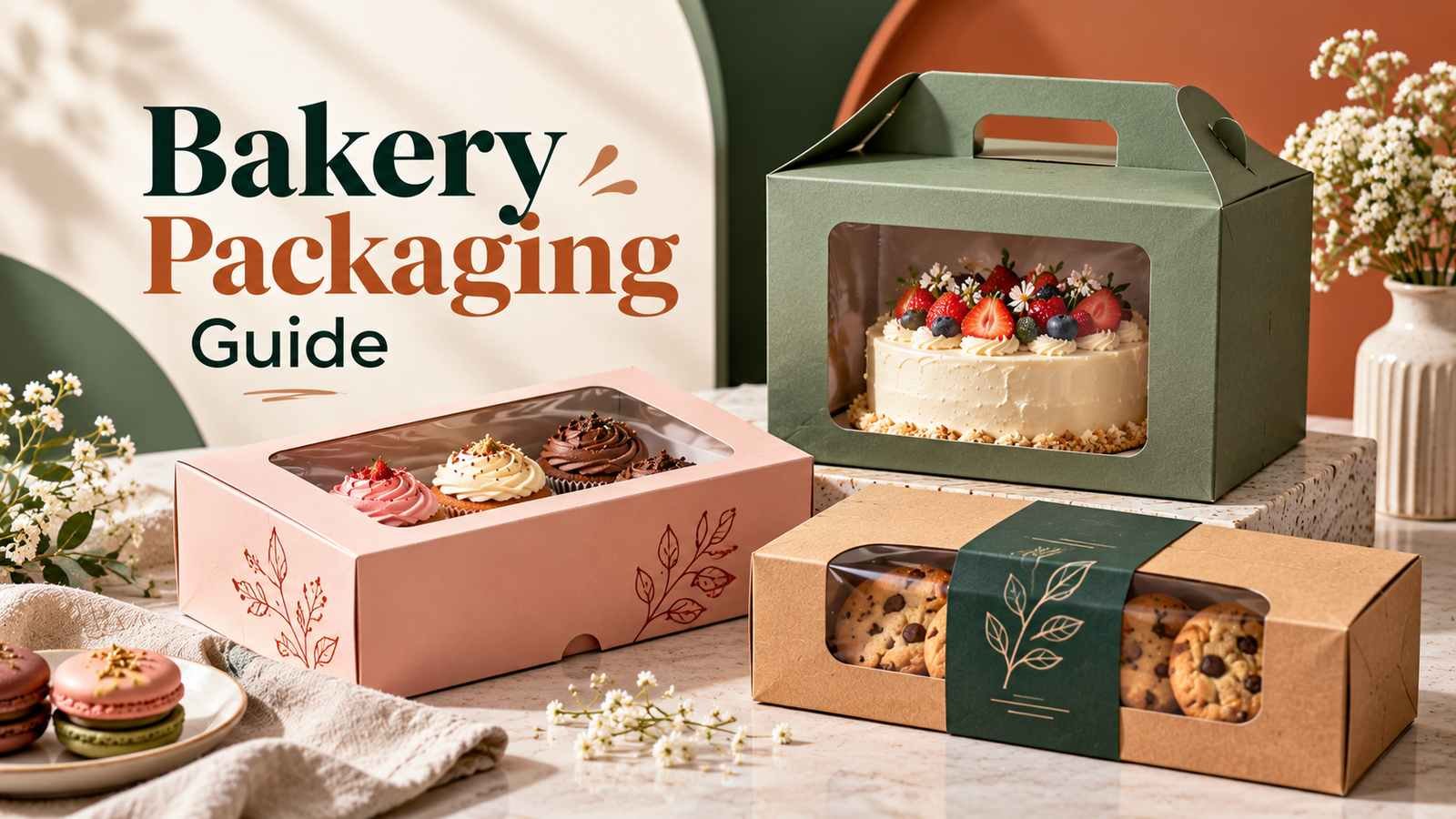
Choosing the right bakery packaging is about more than putting baked goods in a box. Packaging needs to protect delicate products, maintain a neat presentation, support convenient handling, and communicate your bakery’s brand. A box that works well for cookies may not be suitable for a frosted cake, delicate pastries, or freshly baked bread.
For bakeries, cafes, home-based baking businesses, and wholesale pastry suppliers, the best packaging depends on the product’s size, texture, toppings, moisture, and delivery requirements. This guide explains how to choose bakery packaging for different baked goods, compare box styles, select suitable sizes, and decide when custom printing or wholesale ordering makes sense.
Quick takeaway
Match bakery packaging to the product first, then consider branding and cost. Cookies and brownies often need compact cartons, cupcakes require enough height to protect frosting, and cakes need a sturdy base with sufficient clearance. Custom kraft bakery boxes can provide a consistent presentation across different products when sizes and designs are selected carefully.
1. Understand What Your Bakery Products Need
Before selecting a box, consider how the baked good will be stored, handled, displayed, and delivered. Delicate decorations, sticky toppings, crumbs, and moisture can all affect packaging performance. The box should fit the product without squeezing it or leaving so much empty space that it shifts during transport.
- Product dimensions: Measure the length, width, and height of the finished baked good.
- Fragility: Consider whether frosting, icing, decorations, or flaky layers can be damaged by contact.
- Moisture and grease: Determine whether the product needs a suitable liner or grease-resistant packaging component.
- Presentation: Decide whether customers should see the product through a window or open the box to reveal it.
- Distribution: Consider whether the box will be used for counter sales, catering, takeaway orders, or shipping.
These requirements help narrow down box styles and materials before you invest in a large order.
2. Choose Packaging for Cakes and Celebration Cakes
Cakes often need more clearance and structural support than smaller baked goods. Packaging that is too short can damage frosting or decorations, while an oversized box may allow the cake board to move. Choose a box that accommodates the cake board, decoration height, and any additional support required.
For round cakes, confirm the internal width and height. For sheet cakes and rectangular cakes, measure both sides and check that the box closes without touching the icing. A stable base and a secure fit can help reduce movement during short-distance delivery.
For decorated cakes, test the complete packed product before using the box for customer orders. If the cake is delivered by vehicle, consider how the package will be carried and positioned during transport.
3. Select Boxes for Cupcakes and Muffins
Cupcakes need packaging that protects frosting, sprinkles, and other toppings. A box with enough vertical clearance helps prevent decorations from rubbing against the lid. For multiple cupcakes, inserts or individual cavities can keep products separated and reduce movement.
- Measure the cupcake across its widest point, including frosting.
- Check the height from the base to the top of the decoration.
- Choose inserts that hold each cupcake securely.
- Confirm that the insert and lid fit together without compressing toppings.
- Test the box with the actual cupcake size and decoration style.
For seasonal assortments or branded bakery collections, printed boxes can create a consistent look across single-cupcake, multi-cupcake, and gift-pack formats.
4. Use Suitable Packaging for Cookies and Brownies
Cookies, brownies, blondies, and bars are often easier to pack than decorated cakes, but the right box still matters. Fragile cookies may crumble when they move around, while soft brownies can leave grease marks on unsuitable packaging.
Choose a carton that keeps the products organized without pressing them together. Dividers, inserts, or parchment-style liners may be useful depending on the product and presentation. For assorted cookies, a shallow box can help display the range neatly, while a deeper box may suit stacked products if the cookies can withstand the arrangement.
For brownies and other rich baked goods, test the packaging with the actual recipe. Grease resistance and product separation may be important, particularly when the products are sold in gift sets or placed together in a larger assortment.
5. Choose Packaging for Pastries and Delicate Baked Goods
Croissants, Danish pastries, turnovers, tarts, and similar products can be delicate and may lose their shape when compressed. Packaging should provide enough space for the pastry while helping protect its outer layers and toppings.
For individual pastries, a suitably sized carton can make packing and takeaway handling easier. For assorted pastries, arrange the products so they do not press against one another. Consider whether a tray, insert, or divider would improve stability.
If a pastry contains cream, custard, or another temperature-sensitive filling, the box alone does not provide temperature control. Follow appropriate food storage and handling practices for the product.
6. Select Packaging for Bread, Rolls, and Loaves
Bread packaging should reflect the type of bread and how customers receive it. A crusty artisan loaf, soft sandwich loaf, dinner rolls, and sweet bread may have different packaging requirements. Consider the loaf’s dimensions, crust, moisture, and intended storage conditions before selecting a carton or other packaging format.
Boxes can help create a polished retail presentation and protect the loaf from some handling damage. However, packaging should not trap unwanted moisture or interfere with the product’s intended cooling and storage process. Test the packaging with your bakery’s actual workflow.
For bakeries offering several bread varieties, a consistent packaging layout with clear product labels can make products easier to identify while keeping the brand presentation cohesive.
7. Compare Bakery Packaging Options
Different packaging styles offer different benefits. The most suitable choice depends on product protection, display preferences, brand identity, and how the bakery operates.
This comparison is a starting point, not a substitute for product testing. The same baked good may require a different format depending on its size, recipe, toppings, and sales channel.
8. Consider Custom Kraft Bakery Boxes
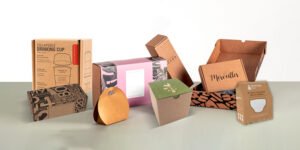
Kraft packaging offers a natural, understated appearance that can suit artisan bakeries, neighborhood cafes, home baking businesses, and specialty food brands. Its neutral look can be paired with simple typography, a bakery logo, illustrations, or accent colors.
Custom kraft bakery boxes for small bakeries can help create a consistent packaging style across cookies, pastries, and other baked goods. The key is to select a box structure and size that suit each product rather than trying to fit every item into one carton.
When comparing kraft bakery packaging, review the material specification, dimensions, construction, printing options, and suitability for the intended food application. Do not assume that every paperboard box is automatically greaseproof, moisture-resistant, or suitable for direct food contact. Confirm the specifications with your packaging supplier.
If your bakery sells several product types, consider a small family of box sizes with a shared visual design. This can help maintain brand consistency while accommodating different products more appropriately.
9. Decide Whether You Need a Window
A window can let customers see the baked goods without opening the package. This may be useful for cookies, pastries, cupcakes, and selected gift assortments where product appearance is part of the buying decision.
- Does the visible product make the package more appealing?
- Will the window placement leave enough room for branding and product information?
- Does the package still provide the protection the baked good needs?
- Are the window material and box construction suitable for the intended use?
- Can the finished package be stacked, carried, and stored safely?
Window designs vary by box style and supplier. Confirm available options and specifications before preparing final artwork.
10. Use Custom Printing to Build Brand Recognition
Custom printing helps your bakery packaging look recognizable and consistent. A logo, product name, brand colors, and a simple graphic system can distinguish your packaging from generic cartons without making the design cluttered.
For custom printed kraft bakery boxes, consider these design principles:
- Keep the logo visible: Choose a placement that remains noticeable when the box is displayed.
- Prioritize readability: Make product names and important information easy to read.
- Use consistent colors: Apply a shared palette across different box sizes and product lines.
- Leave breathing room: Avoid filling every surface with text or graphics.
- Proof the final artwork: Check spelling, colors, dimensions, and print placement before production.
A good design system can use the same basic layout across the bakery range, with small variations for product names, flavors, or seasonal collections.
11. Choose the Right Box Size
Box dimensions affect product fit, presentation, and handling. A box that is too small can compress the product or make packing difficult. A box that is too large may allow delicate goods to shift and can waste storage space.
- Measure the finished product at its widest and tallest points.
- Include frosting, decorations, liners, boards, or inserts in your measurements where relevant.
- Confirm the box’s usable internal dimensions with the supplier.
- Pack a sample product and check how easily it can be placed inside and removed.
- Test the closed package for movement, stacking, and normal handling.
For products with irregular shapes, test several samples if possible. A box that works for one cookie size may not fit a larger decorated cookie or a pastry with toppings.
12. Plan Wholesale and Bulk Bakery Packaging Orders
As a bakery grows, buying packaging in larger quantities may help maintain consistent branding and simplify replenishment. However, the right order quantity depends on sales volume, storage space, available cash flow, and how frequently the menu or packaging design changes.
Before ordering wholesale custom kraft bakery boxes, prepare a clear specification:
- Box style and intended baked good.
- Required internal dimensions and any inserts or windows.
- Artwork, logo files, print colors, and finishing preferences.
- Quantity needed for each size or design.
- Material and intended-use requirements to confirm with the supplier.
- Delivery timing, storage capacity, and reorder expectations.
Compare the total cost and practical requirements, not just the unit price. A large order may be less economical if designs change often or unused boxes take up valuable storage space.
If you serve customers across the United States, confirm shipping arrangements, lead times, and specifications before placing an order for custom bakery boxes in the USA.
Ready to plan your bakery packaging?
Compare box styles, sizes, and branding options for your baked goods before choosing packaging for your bakery.
13. Test Your Packaging Before Ordering
Even a well-designed box should be tested with the actual baked good. A sample helps you identify fit problems, difficult closures, insufficient height, or issues that may not be obvious in a digital design proof.
- Does the product fit without being squeezed?
- Can staff pack it quickly and consistently?
- Does the lid close securely without touching decorations?
- Does the product remain in position during ordinary handling?
- Are labels and printed details readable?
- Does the packaging suit the intended storage and distribution process?
Keep a record of approved box dimensions and artwork. This makes future reorders easier and helps your team use the correct packaging for each product.
Bakery Packaging Checklist
- Identify the baked good and its protection needs.
- Measure the finished product and decorations.
- Choose a suitable box style, material, and size.
- Check whether inserts, dividers, liners, or windows are needed.
- Keep branding clear and product information readable.
- Confirm material specifications and intended-use suitability.
- Test a sample before approving a large order.
- Compare quantity, storage needs, and total cost.
Frequently Asked Questions
What are kraft bakery boxes used for?
Kraft bakery boxes are used to package and present baked goods such as cookies, pastries, brownies, and selected cakes. The appropriate style depends on the product’s size, fragility, and intended handling. Always confirm that the chosen box specifications suit the intended use.
Can bakery boxes be printed?
Yes, custom bakery boxes may be available with printed logos, brand colors, product names, and other artwork, depending on the supplier and box style. Confirm print areas, available colors, minimum quantities, and artwork requirements before ordering.
Can I add a window to a bakery box?
Some bakery box styles offer window options that allow customers to see the product. Availability depends on the box design and supplier. Consider product protection, window placement, presentation, and intended use before selecting this feature.
What sizes are available for bakery boxes?
Available sizes vary by supplier, style, and product range. Measure the baked good, decorations, and any insert or base, then confirm the usable internal dimensions. Custom sizing may be available for suitable orders.
Can I order wholesale kraft bakery boxes?
Wholesale or bulk ordering may be available depending on the supplier, box style, and quantity. Before placing an order, confirm pricing, minimum quantities, production timing, shipping, and the specifications of the packaging.
Final Thoughts
The right bakery packaging protects the product, supports convenient handling, and creates a consistent presentation for your brand. Cakes need adequate clearance and support, cupcakes benefit from suitable inserts, and cookies and pastries need a fit that reduces unnecessary movement. Bread packaging should also suit the product’s storage and handling requirements.
Start with product measurements and practical testing, then choose the material, window, printing, and quantity that fit your business. With a clear packaging plan, your bakery can create a cohesive customer experience without using the same box for every baked good.
Create a consistent look for your baked goods
Explore packaging options and plan box sizes and printed designs around the products your bakery sells.