Choosing packaging for a burger business involves more than finding a box that fits the food. The material affects how the package holds its shape, handles grease and moisture, retains heat, supports printing, and performs during takeaway or delivery. Understanding burger box materials for food businesses helps restaurants compare options based on their menu, service style, and packaging requirements.
There is no single material that is best for every burger. A compact box for a simple takeaway burger may have different needs from packaging for a tall, saucy gourmet burger that travels across town. This guide explains common packaging material categories and the practical questions to ask before selecting a design.
Compare burger box materials by food-contact suitability, grease and moisture resistance, strength, ventilation, insulation needs, print compatibility, disposal options, and total cost. Ask suppliers for material specifications and test samples with your actual menu and delivery conditions before ordering in bulk.
Why burger box material matters
A burger package is exposed to heat, steam, oil, sauces, handling, stacking, and sometimes a long delivery journey. The material and construction need to work together to protect the product and make the order convenient to carry and open.
- Food protection: The box should hold the burger securely and help prevent crushing or unnecessary movement.
- Grease and moisture management: The construction should suit the amount of oil, sauce, and moisture in the menu item.
- Heat and ventilation: The package design should balance warmth with the need to manage steam.
- Structural strength: The box should maintain its shape during packing, stacking, and transport.
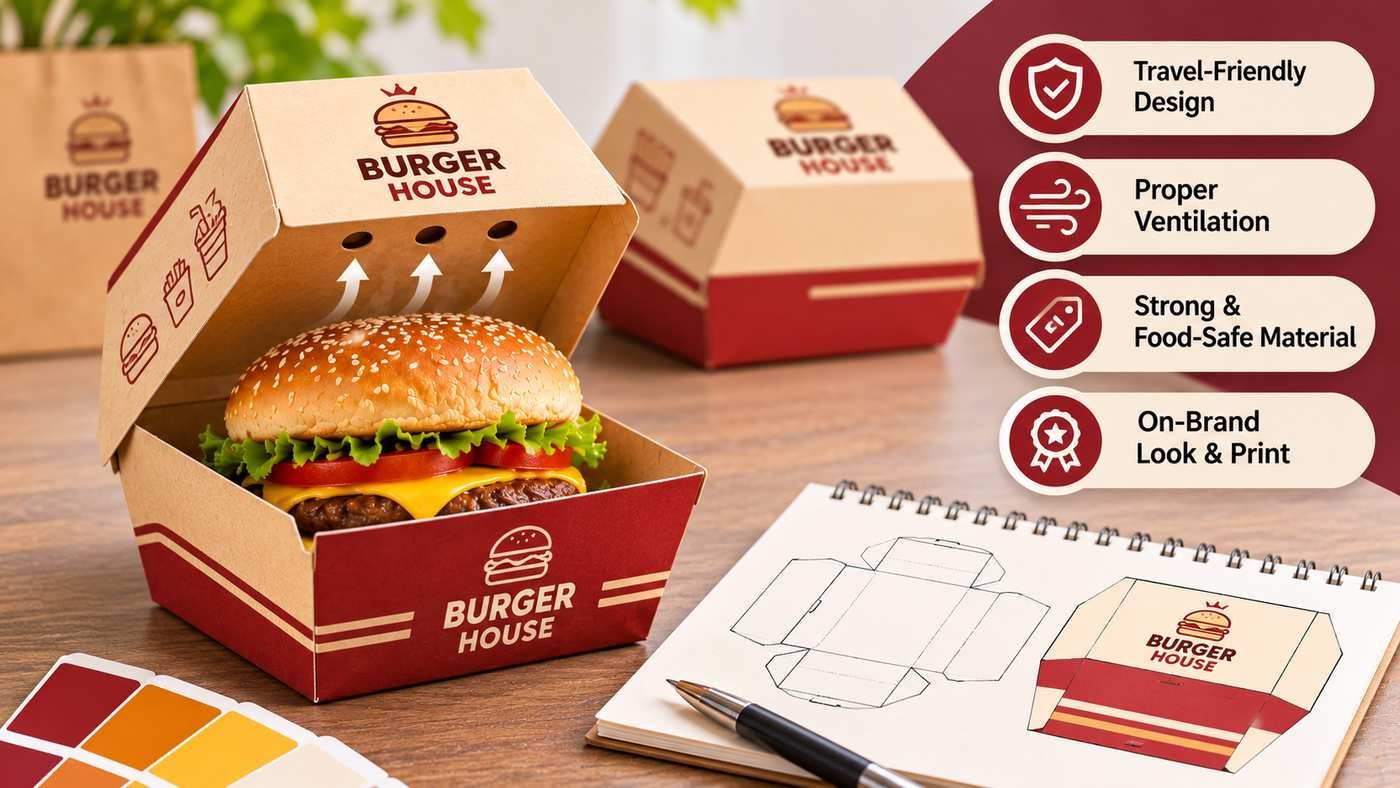
- Brand presentation: Surface quality and print compatibility influence how clearly your logo and design appear.
- Operational fit: Storage, assembly, minimum order quantities, and unit cost all affect day-to-day use.
Common materials used for burger boxes
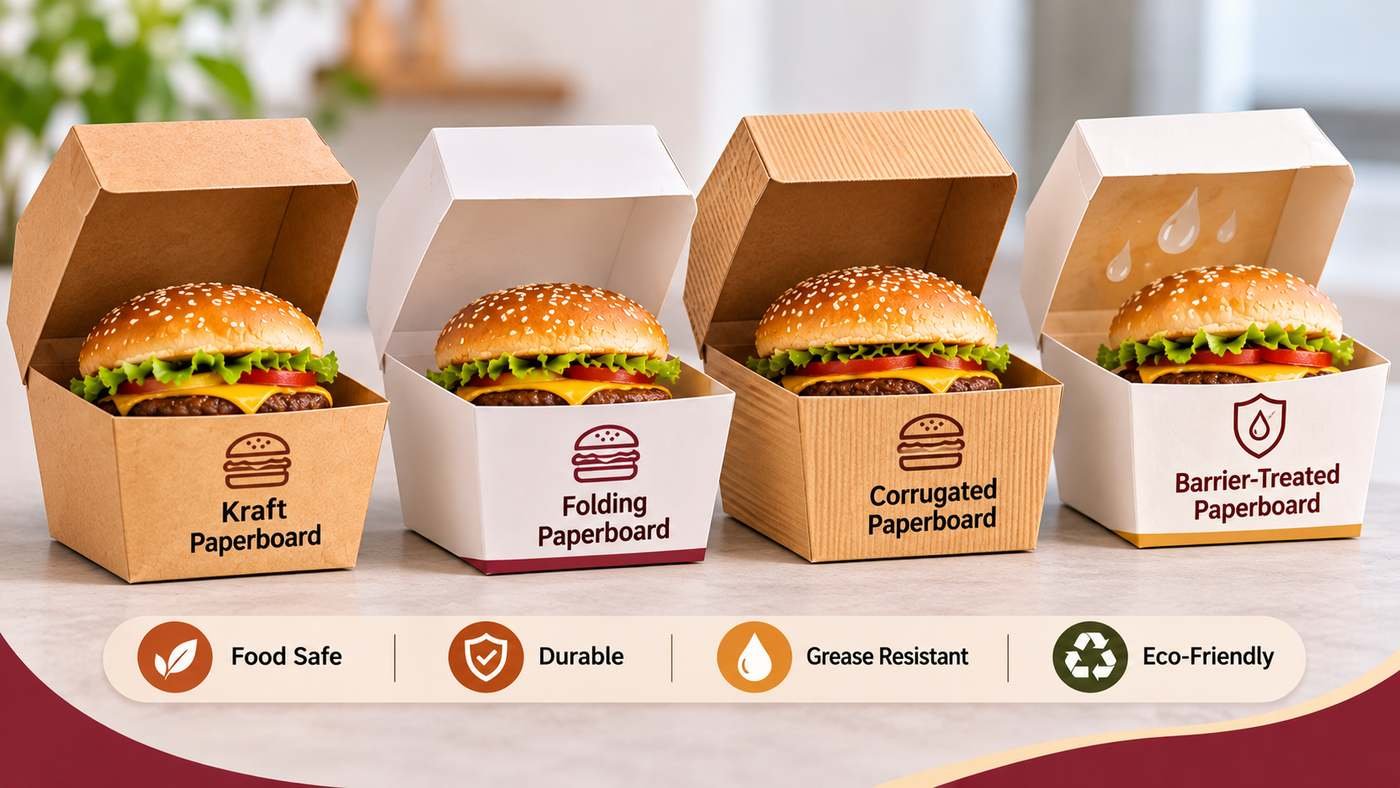
Burger packaging can be made from several types of paper-based and other food-packaging materials. Names such as kraft, paperboard, and corrugated describe different material characteristics; actual performance depends on grade, thickness, construction, coatings, and manufacturing quality.
1. Kraft paperboard
Kraft paperboard is commonly selected for its natural paper appearance and suitability for a range of custom packaging designs. It can provide a practical surface for branding and can be converted into folding cartons and takeaway boxes.
Potential advantages:
- Natural brown appearance that can suit simple, rustic, or minimal brand identities.
- Available in different grades and constructions for different packaging needs.
- Can support custom printing, depending on the board and print specification.
- Can be formed into a range of box styles and sizes.
Points to check: Plain kraft board is not automatically greaseproof, waterproof, or suitable for direct contact with every type of food. Ask whether the selected grade or barrier treatment is appropriate for your burger and whether the finished package meets applicable food-contact requirements.
2. Folding paperboard
Folding paperboard is used for many carton-style packages. It is available in different weights and finishes, and can be die-cut, creased, folded, and printed to create a branded burger box.
Potential advantages:
- Supports a wide range of shapes, closures, and printed artwork.
- Can provide a smooth surface for logos, colors, and product graphics.
- Can be specified in different thicknesses to suit the product and structure.
- Can be efficient to store and assemble when supplied as flat blanks or folded cartons, depending on design.
Points to check: Board weight alone does not tell you how a box will perform. Ask for the finished box specifications and test resistance to bending, grease exposure, moisture, and handling with the actual food.
3. Corrugated paperboard
Corrugated board has a fluted layer between liner sheets. It is often associated with shipping cartons, but suitable corrugated constructions may also be used for food packaging where extra rigidity or cushioning is needed.
Potential advantages:
- Fluted construction can provide rigidity and cushioning.
- Can be useful for larger or heavier food packages, depending on the design.
- Can support printed branding on appropriate outer surfaces.
Points to check: Corrugated board may be bulkier than folding paperboard and is not automatically the best choice for an individual burger. Confirm that the specific grade, flute profile, liner, and any barrier treatment are suitable for the intended food application.
4. Coated or barrier-treated paperboard
Some paper-based packages use a coating or barrier treatment to help manage grease or moisture. The barrier may be applied to a paper surface or incorporated as part of a multi-layer construction. The exact performance depends on the formulation and intended use.
Potential advantages:
- Can be specified for menus where grease or moisture exposure is a concern.
- May help protect the package’s appearance and structural performance during use.
- Can be combined with a printed exterior and a functional food-facing surface.
Points to check: Ask what the barrier is designed to resist, whether it is suitable for direct food contact, and how it affects local disposal or recycling options. Do not assume all coated papers are recyclable or compostable in every location.
5. Molded fiber and other formed-fiber options
Formed-fiber packaging is made by shaping fiber pulp into a three-dimensional form. Depending on the product and specification, it may be considered for food containers and trays. Its suitability for a particular burger depends on fit, strength, moisture management, surface finish, and food-contact compliance.
Potential advantages:
- Can be molded into shapes that help hold food in place.
- May offer a distinctive natural-fiber appearance.
- Some designs are developed for specific food-service applications.
Points to check: Review the exact barrier treatment, grease performance, lid or closure arrangement, stackability, and supplier documentation. Formed fiber is not automatically suitable for every hot, oily, or saucy burger.
Burger box material comparison
The table below is a general selection guide. It is not a performance ranking: actual results vary by grade, thickness, coatings, box design, and use conditions.
How to choose the right material for your burger menu
Start with the food and the way customers receive it. A material that works for a small, lightly dressed burger may not be appropriate for a large burger with multiple patties, melted cheese, and generous sauce.
Consider the burger’s ingredients
Look at patty size, fat content, sauces, cheese, vegetables, and any toppings that release moisture. A greasy or heavily dressed burger may need a different barrier specification from a relatively dry menu item. Evaluate the complete package, not just a material sample.
Consider the delivery journey
Think about typical time from kitchen to customer, how orders are carried, whether boxes are stacked, and whether multiple hot items share a delivery bag. Ventilation and insulation are design considerations that need to be balanced for your service model. More ventilation is not automatically better, because it may also allow heat to escape more quickly.
Check box strength and dimensions
Measure the assembled burger and check the internal length, width, and height of the box. The package should provide enough room for toppings without letting the burger move excessively. Check whether the lid closes without pressing down on the bun. Read our guide to burger box sizes for different burger styles for more sizing considerations.
Review food-contact and regulatory requirements
Request documentation for the exact material, coatings, adhesives, and printing components used in the finished package. Requirements vary by market and intended use. For U.S. sales, confirm that food-contact materials comply with applicable requirements and obtain the relevant supplier declarations or supporting documentation. Do not rely on a generic claim such as “food grade” without understanding what it covers.
Consider branding and printing
Choose a surface and construction that support your artwork. Natural kraft can suit a minimal look, while a smoother paperboard surface may be preferred for detailed graphics. Ask for a printed sample or proof to check color, logo clarity, and how the design appears on the assembled box.
Custom burger boxes: material, printing, and construction
When ordering custom burger boxes, specify the burger dimensions, approximate weight, ingredients, serving temperature, and expected delivery time. These details help the packaging supplier recommend a suitable board and structure.
Printed burger boxes can carry a restaurant logo, brand colors, promotional artwork, or product information. Confirm the printing process and ink suitability for the package’s intended use, especially where printed surfaces may contact food.
For businesses comparing wholesale burger boxes, review the full specification alongside price: board grade, dimensions, barrier treatment, printing, minimum quantity, sample availability, lead time, and shipping. Branded burger boxes should be tested in the same way as plain packaging because print and finish choices are part of the final construction.
Restaurants sourcing custom burger boxes in the USA should communicate their intended food use and ask for material and compliance documentation relevant to their market. Confirm the final artwork and packaging sample before approving a production run.
A practical checklist before placing a bulk order
- What exact board or fiber material and grade will be used?
- What are the finished box’s internal dimensions and structural specifications?
- Is the material and any coating suitable for the intended food-contact conditions?
- How does the package perform with grease, moisture, and hot food?
- Does the design include ventilation, and has it been tested with this type of burger?
- What printing methods, inks, adhesives, and finishes are specified?
- What documentation is available for food-contact and environmental claims?
- Can the supplier provide samples for a real delivery test?
- What are the minimum order quantity, production lead time, and shipping terms?
- How should the packaging be stored to protect it before use?
Test samples before choosing a burger box material
Before committing to a large order, pack your actual burger in each candidate box. Follow your normal kitchen process and evaluate the package after realistic holding and delivery intervals.
- Check whether the box stays rigid and closes properly.
- Look for grease marks, softening, or leakage.
- Inspect the bun and toppings after the expected delivery time.
- Check whether steam buildup affects the food or package.
- Assess stacking, carrying, opening, and overall presentation.
- Repeat tests so your decision is based on consistent results.
Record the results and compare performance with cost and operational needs. This helps prevent a material choice based only on appearance or a supplier’s general description.
Frequently asked questions
What is the best material for burger boxes?
There is no universal best material. Kraft paperboard, folding paperboard, corrugated board, barrier-treated paperboard, and formed fiber each have different characteristics. Choose based on your burger, grease and moisture exposure, delivery conditions, food-contact requirements, and budget.
Are kraft paper burger boxes greaseproof?
Not automatically. Grease resistance depends on the specific paper grade and any barrier treatment. Ask the supplier for details and test the finished box with your menu.
Is thicker paperboard always better for burger packaging?
No. Thickness can contribute to stiffness, but performance also depends on material grade, box geometry, creasing, closure design, and exposure to heat, grease, and moisture. Evaluate the finished package.
Can burger boxes be custom printed?
Yes. Many paper-based box constructions can be printed with logos, brand colors, and custom artwork. Confirm the print specification and suitability of all inks and finishes for the intended packaging application.
What should U.S. restaurants check when buying burger boxes?
Restaurants should confirm that the specific food-contact materials and components meet applicable U.S. requirements for their intended use. Request relevant supplier documentation and verify environmental claims against the actual material and local collection facilities.
Should I test burger boxes before ordering wholesale?
Yes. Test samples with your real burgers and delivery routine. Check fit, strength, grease and moisture performance, ventilation, print quality, and how the food looks when the package is opened.
Explore custom burger packaging
Compare packaging options for your menu, branding, and takeaway requirements. Share your burger dimensions and intended use to help identify a suitable custom box specification.