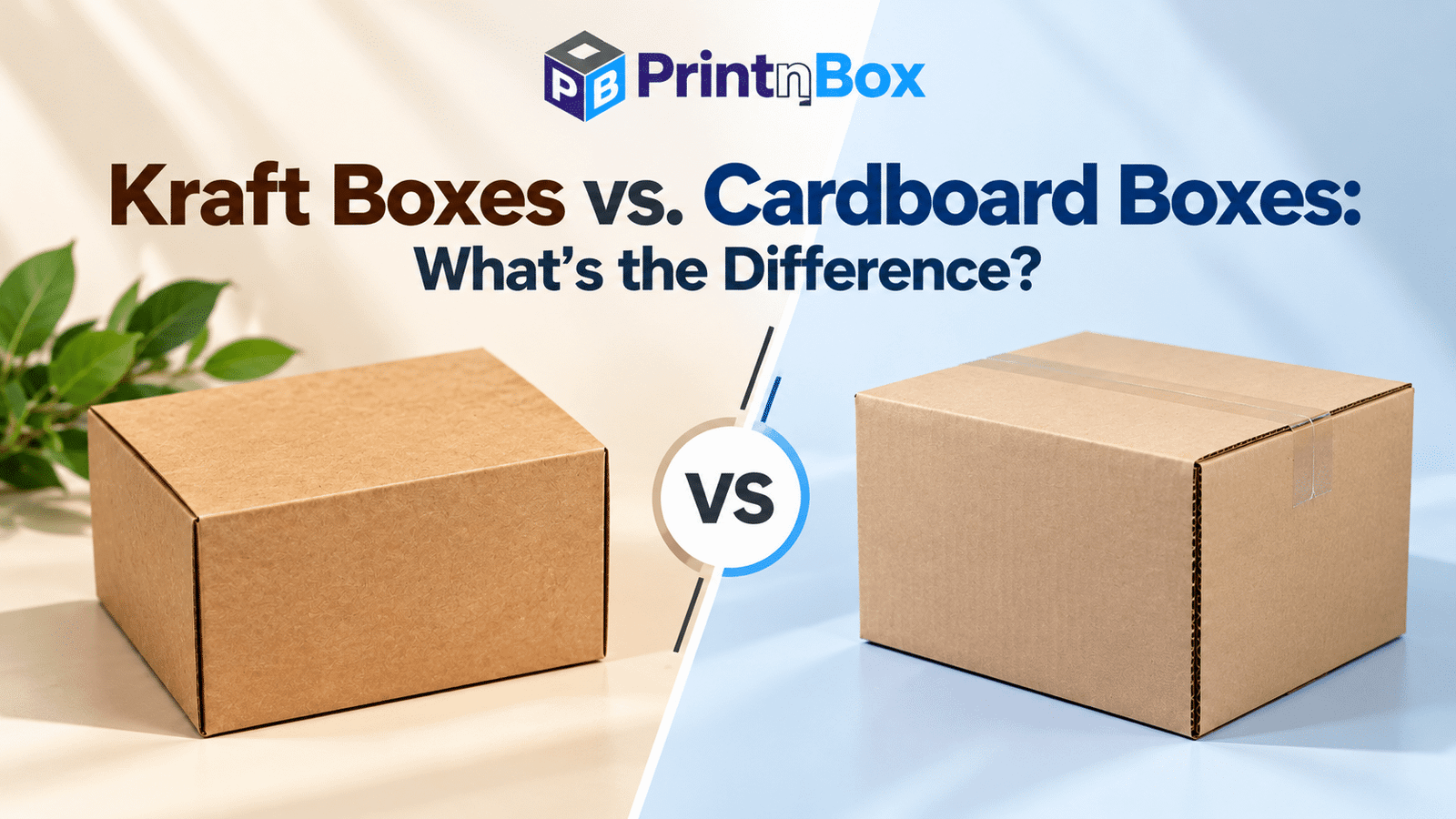
Choosing the right kraft boxes vs cardboard boxes packaging material can affect product protection, presentation, shipping, branding, and overall packaging costs. Two terms that are often used interchangeably are kraft boxes and cardboard boxes, but they are not exactly the same thing.
The main difference is that kraft describes a paper-making material or process, while cardboard is a broader term used for several types of paper-based board packaging. A kraft box can be made from kraft paperboard or kraft-based corrugated board, depending on the application.
What Are Kraft Boxes?
Kraft boxes are packaging boxes made using kraft paper or kraft paperboard. The kraft process is commonly associated with strong paper fibers and the natural brown appearance frequently used for packaging.
- Natural brown or kraft appearance
- Strong paper fibers
- Lightweight construction
- Printable surfaces
- Customizable dimensions
- Multiple folding and structural options
Quick Answer: Kraft and cardboard are not competing material categories in every case. Kraft refers to a paper material/process, while cardboard is a broad everyday term for paperboard and related board packaging. A cardboard box can use kraft paper in its construction.
What Are Cardboard Boxes?
Cardboard is a general term commonly used to describe paper-based board used for packaging. In the packaging industry, the exact material may include paperboard, corrugated board, or other engineered paper structures.
Cardboard boxes can therefore vary considerably in thickness, construction, strength, finish, and intended use.
Kraft Boxes vs. Cardboard Boxes: Key Differences
| Factor | Kraft Boxes | Cardboard Boxes |
| Material | Usually made from kraft paper or kraft paperboard. | Broad category that can include paperboard and corrugated board. |
| Appearance | Often natural brown, but can also be printed or finished in different colors. | Can range from white and printed paperboard to brown corrugated board. |
| Typical Uses | Retail, food, gifts, cosmetics, apparel, and product packaging. | Retail packaging, shipping, storage, e-commerce, and product cartons. |
| Branding | Can be printed with logos, colors, graphics, and product information. | Can also support extensive printing and finishing depending on the board. |
| Strength | Depends on paper weight, board structure, and box design. | Varies significantly depending on whether it is paperboard or corrugated board. |
Is Kraft Stronger Than Cardboard?
There is no universal answer because kraft and cardboard do not represent equivalent specifications. A lightweight kraft paperboard box and a heavy-duty corrugated cardboard shipping box have very different structures and performance characteristics.
- Paper or board thickness
- Material weight
- Fiber characteristics
- Number of layers
- Corrugated flute structure
- Box dimensions
- Box style
- Product weight
- Distribution and handling conditions
Kraft vs. Cardboard Appearance
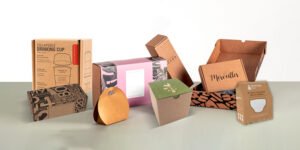
Kraft packaging is often associated with a natural, earthy, minimalist appearance. However, kraft boxes can include custom logos, full-color artwork, patterns, illustrations, brand colors, labels, interior printing, and die-cut features.
Kraft Boxes vs. Corrugated Cardboard Boxes
Corrugated cardboard is made using multiple paper layers, including a fluted middle layer between liner sheets. Kraft paper can be used to manufacture liner paper used in corrugated board. So a corrugated shipping box may contain kraft paper while also being commonly described as a cardboard box.
Which Is Better for Product Packaging?
Choose Kraft Boxes When:
- Natural packaging appearance is desired
- Lightweight product packaging is appropriate
- Custom dimensions are needed
- Retail presentation matters
- Printed branding is required
- Gift or promotional packaging is needed
Choose Corrugated Cardboard Boxes When:
- Shipping protection is important
- Greater structural strength is needed
- Stacking capability matters
- E-commerce fulfillment requires durable shipping packaging
- Products need greater transportation protection
Are Kraft Boxes More Environmentally Friendly?
Kraft packaging is often marketed as an environmentally friendly option, but environmental impact depends on fiber source, recycled content, manufacturing, printing, coatings, adhesives, packaging weight, transportation, reuse, and local recycling infrastructure.
Customization: Kraft vs. Cardboard
Both kraft and cardboard packaging can be customized with dimensions, die-cut shapes, logo printing, full-color artwork, inserts, windows, handles, closures, folding structures, and special finishes.
For brands that want packaging specifically designed around their products, kraft packaging boxes can combine tailored dimensions with a kraft-based visual identity.
Kraft Boxes vs. Cardboard Boxes for Shipping
Shipping requirements can change the ideal packaging structure. If a product is sent directly to customers, the box may experience handling, compression, stacking, vibration, drops, transportation, and storage.
Kraft Boxes vs. Cardboard Boxes by Product Type
| Product | Potential Packaging Choice | Main Consideration |
| Cosmetics | Kraft or paperboard product boxes | Presentation, branding, and product protection |
| Candles | Kraft or stronger paperboard boxes | Product weight and protective inserts |
| Apparel | Kraft mailers or folding boxes | Presentation and shipping requirements |
| Food Products | Appropriate food packaging board | Product requirements, moisture, grease, and applicable regulations |
| E-commerce Products | Corrugated or kraft-based shipping packaging | Shipping protection and dimensional efficiency |
How to Choose Between Kraft and Cardboard
- What are you packaging? Measure the product and understand its weight and shape.
- Where will the packaging be used? Retail shelves and shipping environments have different requirements.
- How much protection is needed? Fragile or heavy products may require stronger construction.
- Does appearance matter? Consider whether a natural kraft appearance fits your brand.
- Do you need custom dimensions? Custom sizing can reduce unnecessary empty space.
- Will you print the packaging? Review available printing and finishing options.
- Will the box be shipped? Consider transportation, stacking, handling, and storage.
Kraft Packaging Boxes for Businesses in the USA
Businesses selling products in the United States may need packaging that balances branding, product protection, shipping, storage, and presentation. Kraft boxes in the USA can be customized for different product categories and packaging requirements.
For businesses looking for a customized option, explore kraft boxes in the USA and compare available custom packaging possibilities.
Common Questions About Kraft Boxes vs. Cardboard Boxes
Are kraft boxes and cardboard boxes the same?
No. Kraft refers to a type of paper material or manufacturing process, while cardboard is a broad term commonly used for paper-based board packaging.
Are kraft boxes stronger than cardboard boxes?
Not automatically. Strength depends on material thickness, paper grade, construction, layers, dimensions, and box style.
Are kraft boxes good for shipping?
Some kraft-based boxes are suitable for shipping, but the appropriate structure depends on the product, weight, handling conditions, and required protection.
Can kraft boxes be printed?
Yes. Kraft boxes can be printed with logos, graphics, product information, patterns, and other branding elements.
Are kraft boxes recyclable?
Many paper-based kraft boxes may be recyclable where local recycling systems accept them. Coatings and other components can affect recyclability.
Should I choose kraft or cardboard for my product?
Start with the product’s dimensions, weight, protection requirements, shipping environment, branding needs, and desired appearance.
Final Thoughts
The biggest difference between kraft boxes vs cardboard boxes is that the terms describe different things. Kraft generally refers to a paper material or manufacturing process, while cardboard is a broad everyday term covering several types of paper-based packaging board.
For retail products, gifts, cosmetics, food, apparel, and other consumer goods, kraft packaging can provide a natural appearance with flexible customization. For shipping and demanding transportation environments, the structure and strength of the box become especially important.
For businesses that need packaging designed around specific products, custom kraft packaging boxes can provide tailored dimensions, branding, and product presentation.